
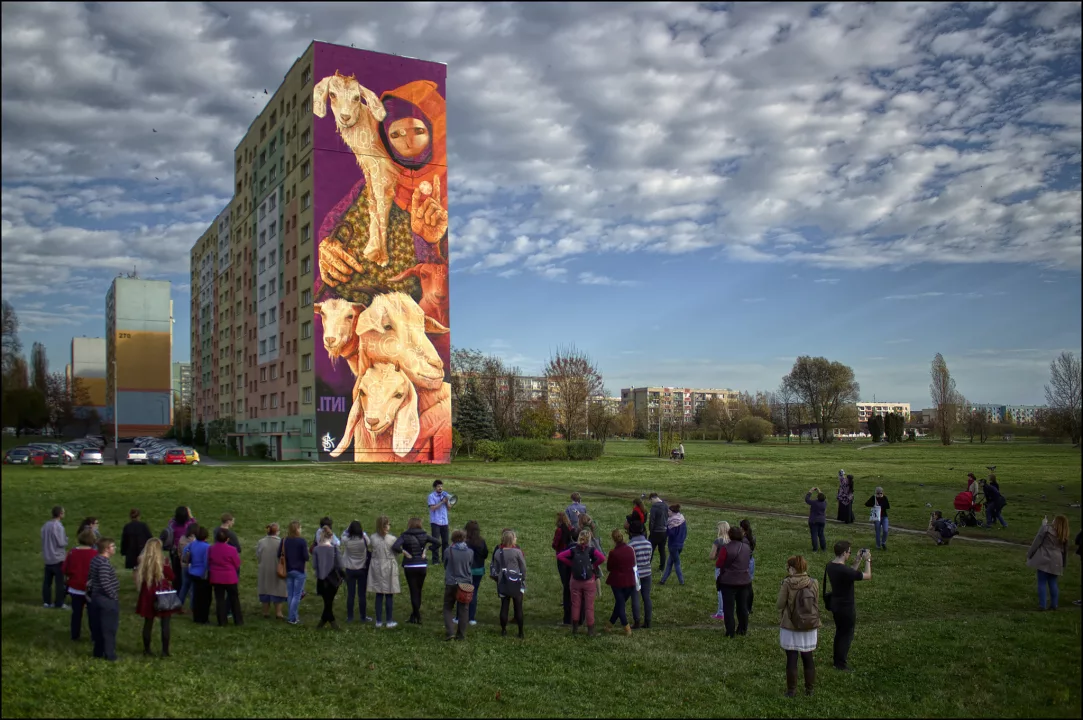
Which wall is suitable for a large-format image? Who decides on the project? How is the project transferred to the wall? And what impact does all this have on Łódź's image? – we talk about Łódź murals with Michał Bieżyński.
You have been the organizer of many artistic projects in Łódź's public space. Including murals, so you probably know the subject "inside and out". Let's start from the beginning: on what basis are locations for murals chosen? What criteria should a wall meet for a mural to be created on it?
When deciding on a particular wall, I primarily take three criteria into account. First and foremost, there should be no foreign content on the wall's surface. Murals are essentially upscaled paintings, and just as in museums or galleries we see only artworks on canvases, murals in the city should be treated the same way and should not be created on facades that have other works on them, most often in the form of commercial messages like billboards, advertising panels, or signs. These are two different worlds with different functions; they shouldn't be combined on a single facade. Taking this argument into account, roughly 60% of walls in the city are eliminated right away.
Secondly, the deciding criterion for choosing a particular facade is its technical condition. This doesn't mean the wall needs to be freshly renovated, but its technical condition should be at least "stable". When organizing something like a mural, especially when using public funds, we can't afford a situation where part of the painting falls off along with the plaster shortly after. A mural is certainly not a church or cathedral that should last centuries, but it is still a permanent undertaking and it makes sense that it can be viewed for at least several years.
The third basic selection criterion is the exposure of the wall. First and foremost, we should utilize facades that have the best location in terms of "visibility". I mean walls located on frequently traveled streets, where the largest number of residents pass or drive by every day. Murals are for residents, so it's worthwhile to choose walls with which they'll have the simplest and most frequent contact.
When a given wall passes through the filter of these three criteria, other criteria come into play, but they have a less rigorous nature.
On June 17, a tour along the trail of Łódź murals will take place, personally led by Michał Bieżyński.
Tickets available here: https://www.dziswlodzi.pl/sklep/szlakiem-lodzkich-murali
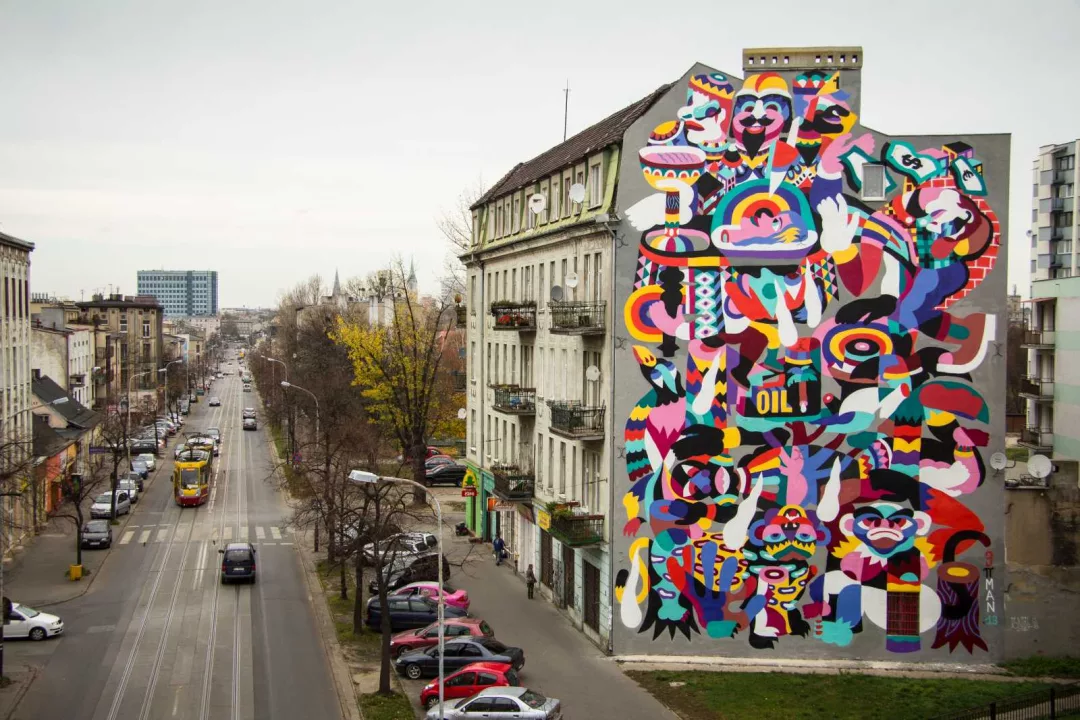
We have a potential wall. Now it's time for the project. On what basis is a mural project selected? Do you commission an artist to create an image according to their style and your expectations, or perhaps they apply with a finished project or idea?
I think the most valuable thing we can receive from invited artists is their original ideas. The mural project in Łódź functions as a public, open art gallery, and from the start I've been opposed to treating murals instrumentally and imposing top-down themes, forms, or content that a given mural should present. It's the artist's choice whether they want to reference the history and identity of the city, a particular district, or specific location where the mural is created, or to create a completely autonomous painting that has nothing to do with Łódź. Each approach has its pros and cons, each implies separate issues, but both approaches can function excellently in urban space.
Working directly with painters who created images on Łódź's walls, I try to base my work primarily on trust. This is the absolute foundation that should work both ways. Artistic freedom in creating projects is extremely important, but on the other hand, this doesn't mean approaching proposed projects uncritically—even internationally-known artists sometimes just have a weaker day.
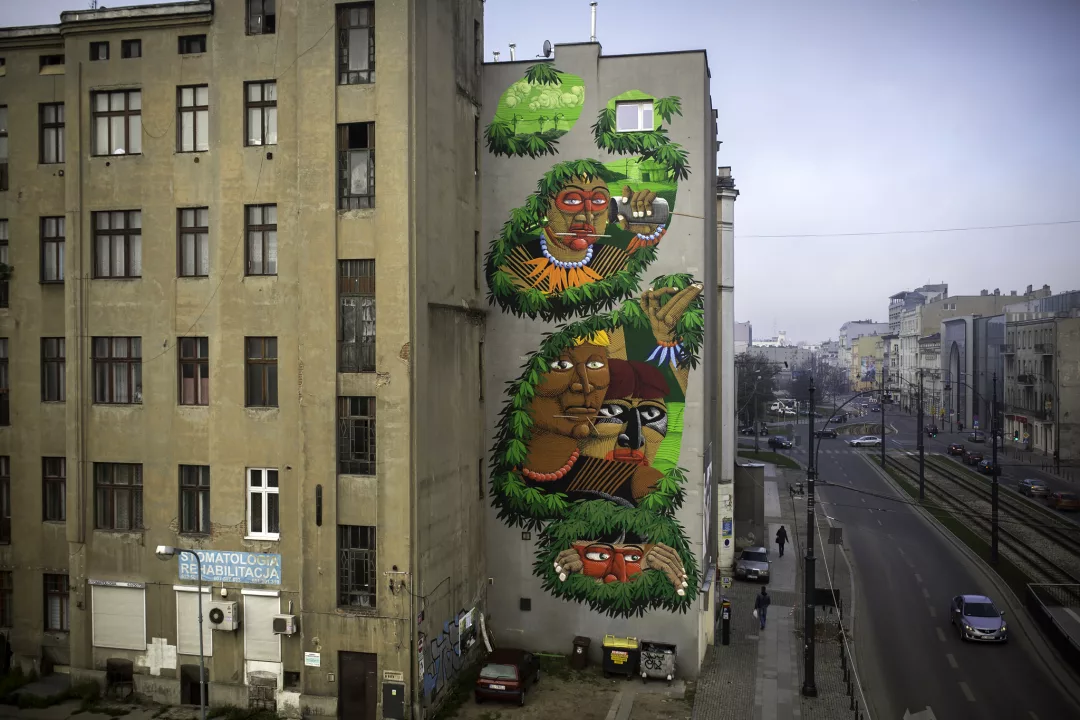
Alright. So we have a wall and a project. Now comes the question that probably intrigues us most. How is a project, often full of complicated details, transferred to the wall with such precision?
This is one of the most frequently asked questions during tours. How is it possible that a project prepared on a computer screen, printed on an A4 sheet, is so precisely transferred by artists onto a multi-story wall, working from a lift suspended just inches from the facade itself? Considering the need to maintain proper proportions, preserve the degree of complexity, take care of details—the act of creating such a mural sounds impressive. Some artists use technology to help, employing a projector to create an initial sketch on the wall, but almost all murals in Łódź were created without such equipment. Artists use various paints, apply them to the wall with different tools, have different painting stages arranged, but sketching the project on the wall in the vast majority of cases happened directly "freehand".
Freehand?! That seems almost impossible...
And yet! However, abstracting from individual techniques or habits of particular artists, I think the answer to this question comes down simply to the word "talent". The artists I've had the opportunity to collaborate with in Łódź are simply outstanding professionals, masters in their field, for whom painting on such gigantic canvases poses no problem. There's an element of magic in it :).
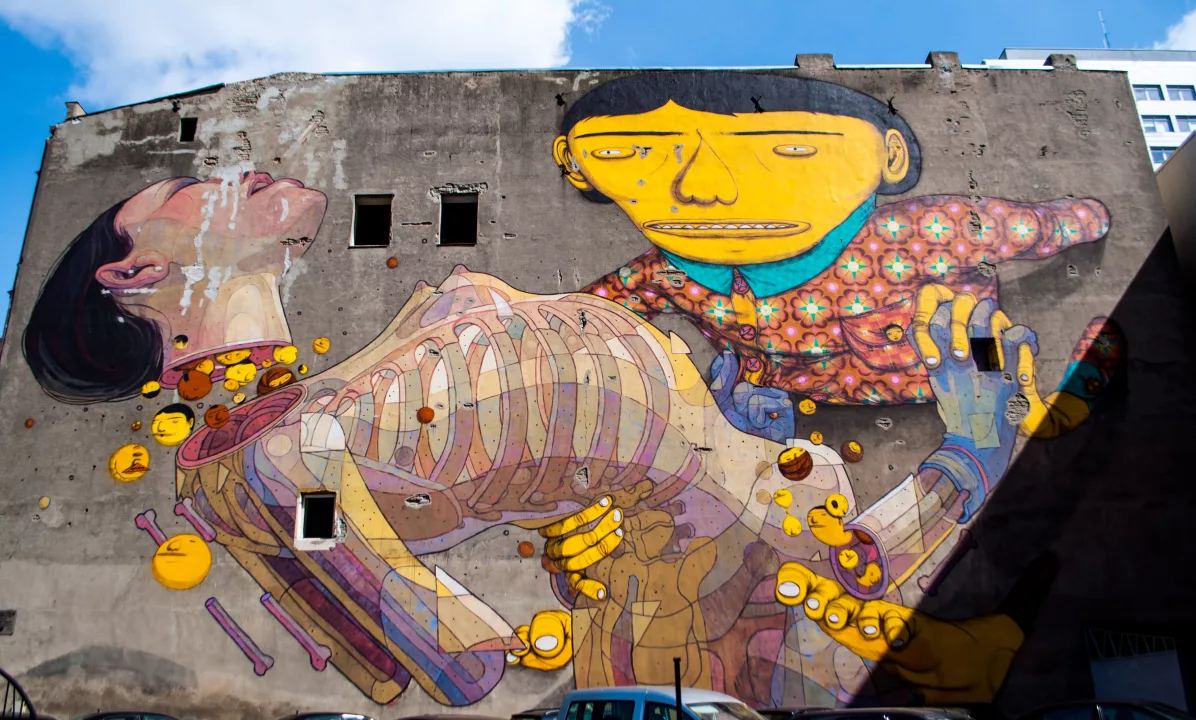
Łódź murals have become very popular. And not just in our country. Do you think they can currently be treated as one of Łódź's calling cards abroad?
Yes, Łódź murals have been covered by media around the world! American television stations like CNN and ABC News, as well as German ARD, broadcast special reports dedicated to murals in Łódź on their channels. Because of the murals, the American Huffington Post gave Łódź the title "The artsiest city" in 2014. The worldwide portal Boredpanda.com placed Łódź in second place among 20 cities with the most interesting street art. Main news programs in Poland reported on the murals: Fakty TVN, Polsat News, Teleexpress, TVN24, TVP Info. Magazyn Polityka included Łódź murals on a list of 10 most interesting events in the "visual arts" category in 2013 in Poland. Łódź Murals were multiple times featured in the popular program Dzień Dobry TVN and appeared on hundreds of websites and internet portals around the world. Łódź murals definitely have international reach.
As for tourism itself, from my experience I could share countless stories related to mural tours that I've been organizing since 2012. I've shown Łódź murals to guests from various corners of the world, including from Australia, India, Canada, USA, and most European countries. Interestingly, these people very often came to Łódź solely because of the murals, having little idea or knowledge about any other aspects of this city. I think it's fair to say that murals have already become one of Łódź's main calling cards.
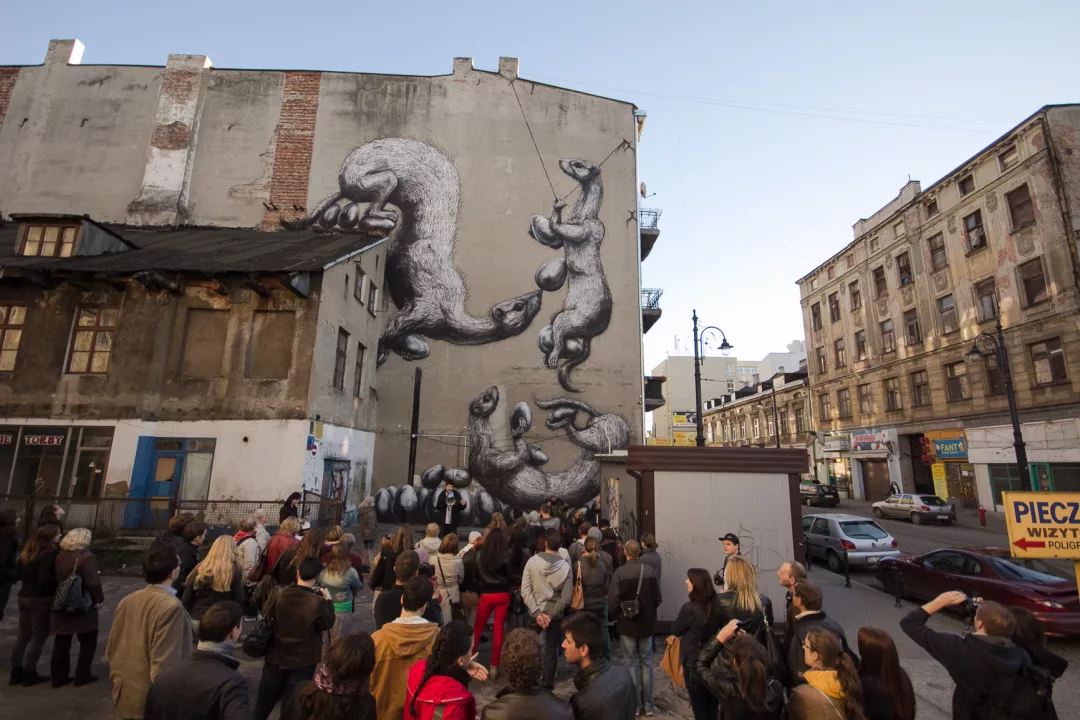
The next mural tour, which you'll be leading, is on May 19. What will we be able to learn during it?
I hope we'll discover interesting behind-the-scenes stories about the creation of the Łódź murals gallery from the perspective of someone who has been organizing this project from the very beginning and who participated in the creation of over 50 Łódź murals. During the tour, I talk about the history of the entire undertaking, about the artists, about the artistic techniques used to create murals, I share various anecdotes and answer all questions. On Saturday, I cordially invite you to a modern museum, which we'll travel through by bus :)
We can't wait :)And finally, as a summary, and perhaps (hopefully!) a good omen: what is your biggest dream related to Łódź street art?
This will obviously be a bit of an exaggeration, but I dream that in 10-20 years, Łódź will be associated with street art in the same way as a simple association—Paris - Eiffel Tower. Of course, you can't compare one of the world's most important icons of architecture to an artistic project, but I'm talking about the mechanism of association itself. That would really be something. Additionally, skillfully mixing fresh, modern art with restored, unique 19th-century architecture of Łódź can yield excellent results.
On June 17, a tour along the trail of Łódź murals will take place, personally led by Michał Bieżyński.
Tickets available here: https://www.dziswlodzi.pl/sklep/szlakiem-lodzkich-murali

Be the first! Add a comment.
You need to log in to add a comment.
Log in