
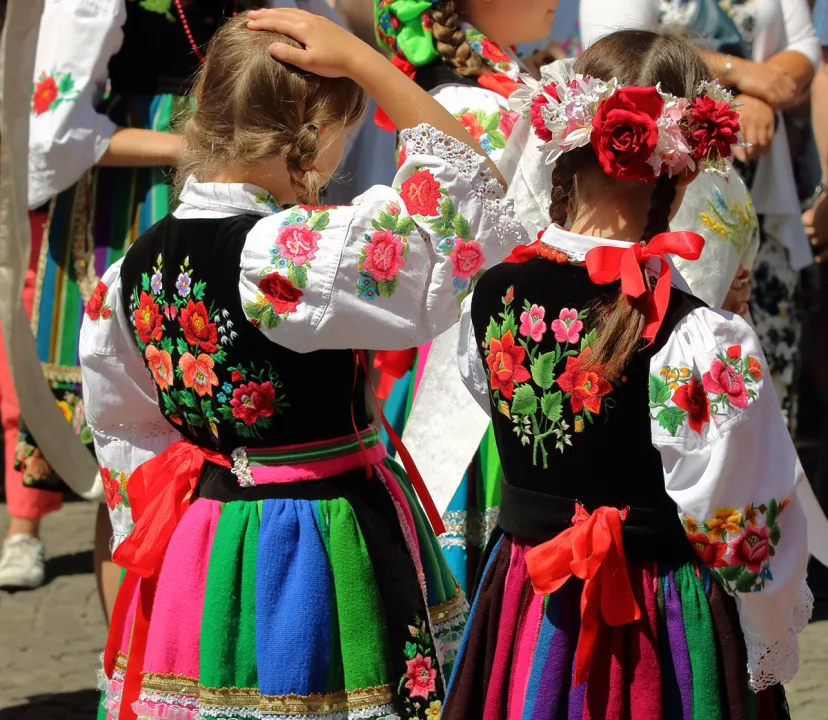
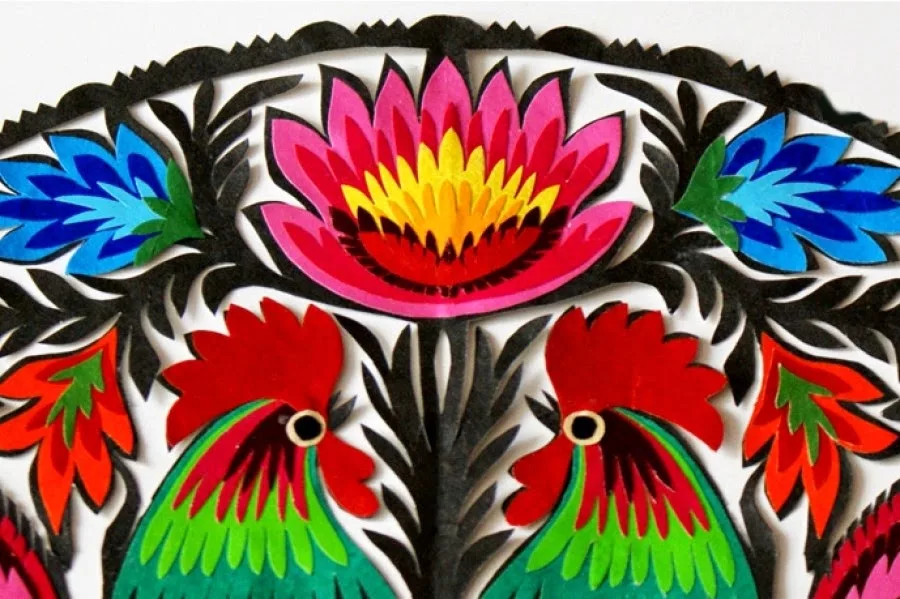
Łowicz patterns began to be placed on traditional Łowicz costumes and became famous through paper-cuts, which are typical of central Poland. Intricate paper decorations entered folk tradition in the 19th century, and their oldest examples come from the area around Łowicz in the Łódź Voivodeship.
Łowicz paper-cuts are created by cutting intricate patterns from colored paper and gluing smaller elements onto larger ones. In this way, colorful łowicz patterns are created, among which plant ornaments, flowers and roosters dominate. On łowicz paper-cuts we can also find geometric motifs or genre scenes from peasant life (such as celebrations, rituals or field work). Łowicz patterns on paper-cuts served both decorative and ritual functions. We can divide them into 3 types: rectangular Kodry (placed on ceiling beams), circular Gwiozdy or stars (which separated Kodry), and vertical Tasiemki or ribbons (used to divide, for example, pictures on walls). Paper-cuts were changed once a year – in spring – to complete the spring renewal ritual.
Łowicz patterns in the form of miniature paper-cuts (so-called oklejanki) also decorate Easter eggs.
Embroidered Łowicz patterns
The unique and world-famous łowicz patterns are also an important element of Łowicz costumes. The costumes of this region, alongside Kraków costumes, are considered the most beautiful and are regarded as the Polish "representative" costume. Popular Łowicz striped patterns (pasiaki) appeared around the 1820s-1830s. Costumes were gradually enriched with embroidery, mainly thanks to young women who wanted to add color and embellishment. A full, traditional costume was very expensive, often worn for many years and passed down as part of a bride's dowry. It is no wonder then that women, true to their nature, introduced changes and wanted to make their shirts and skirts more attractive and distinctive.
Łowicz patterns in the form of embroidery gave and continue to give decorative and artistic appearance to folk fabrics. The types of embroidery are not uniform – each ethnographic region created its own decorative motifs, shaped by local tradition and fashion. Łowicz embroidery is dominated by cross-stitch with predominant flower motifs. Łowicz flat embroidery typically consists of flower compositions (small bouquets) traditionally sewn on black velvet. In the first half of the 19th century, an extremely ornate beaded embroidery appeared in the Łowicz area. Flower and striped motifs also dominate in it. Beaded embroidery most often decorates velvet and thick woolen fabrics. Multicolored beads, sequins, jets or pearls are used to create it.
Criticism of copying łowicz patterns
Łowicz patterns promote not only Łowicz. Items with such prints can be obtained in Cepelia shops throughout the country, on the internet, or in supermarkets. But what about the legality of using łowicz patterns and reproducing them in any form? According to Łowicz craftspeople organized in the Association of Folk Creators, this is simply theft. Usually łowicz patterns – paper-cuts or embroidery – are converted into graphics and used without the consent of their creators.
Although folk art requires creation within a certain canon and often relies on reproducing existing patterns, the resulting łowicz patterns are always unique compositions. The patterns of Łowicz creators are works under copyright law, so they have the right to manage their creations, receive payment and prohibit their further dissemination.
So how can you be fair to creators while still enjoying beautiful, folkloric ornaments? The best way is to buy gadgets decorated with łowicz patterns directly from the authors or from places where you can verify that the copyright to the item is recognized and respected.

Be the first! Add a comment.
You need to log in to add a comment.
Log in