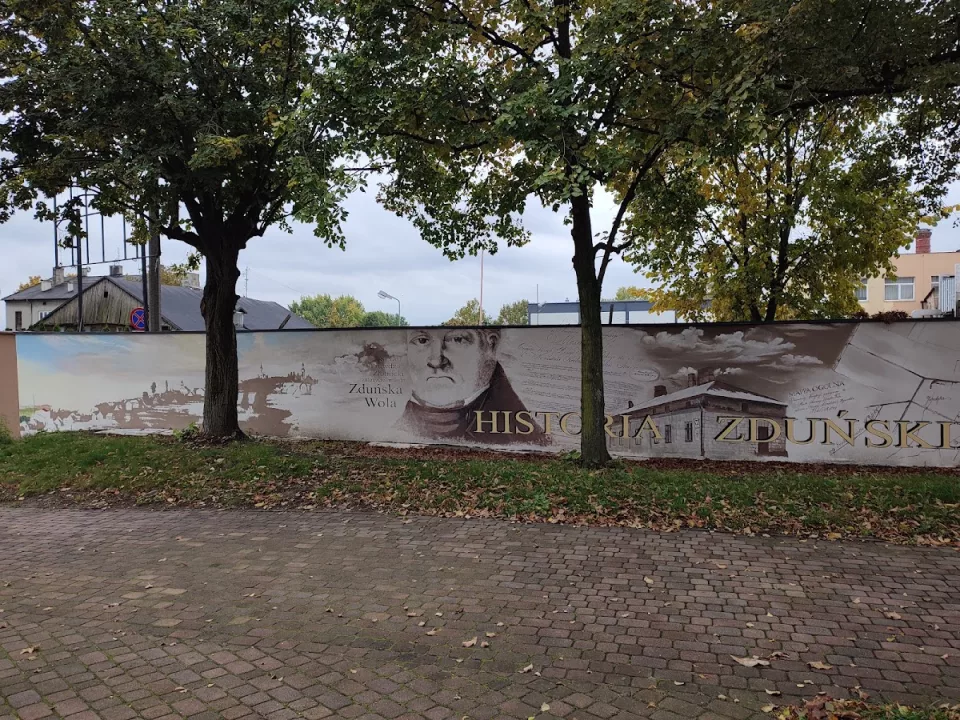
This seventy-metre mural by Czesław Łacwik on the fence of a former brewery in Zduńska Wola documents two hundred years of the town's history across 35 panels.
A seventy-metre mural on the fence of an old brewery at ulica Świętego Maksymiliana Marii Kolbego in Zduńska Wola documents the two-hundred-year history of the city through public art. The work of visual artist Czesław Łacwik, painted across more than 150 square metres, is one of the largest historical murals in the Łódź region. The project was funded and commissioned by the Museum of the History of the City of Zduńska Wola, which sought to commemorate the development of the city through a monumental work of art accessible to all residents and tourists.
The mural contains 35 separate images and historical photographs, creating a coherent visual narrative. Each panel depicts a different stage in the evolution of Zduńska Wola. A section devoted to the time of the city's founding shows its original forms of settlement, moving through the turbulent period of the nineteenth century, when Zduńska Wola became a significant centre of textile production. During this period, factories were expanded here, which attracted investors and workers from throughout the region, making the city one of the important centres of the textile industry. Subsequent sections of the mural document the city's experiences during the Second World War and occupation, and the final panels show Zduńska Wola in contemporary times.
The precise dimensions of the mural – 70 metres in length and 2 metres in height – make it one of the most expansive works of wall art in Łódź Voivodeship. Painting such a large surface required precision, artistic vision and knowledge of painting techniques working outdoors throughout every season. The background of the mural is formed by the concrete fence of the old brewery, which previously was a grey, unnoticed wall. After being painted, this same place became a historical gallery, drawing the attention of passers-by and tourists.
The mural is located in the central part of Zduńska Wola, directly next to Pałac Złotnickich, which serves as the main seat of the city authorities. This location is not coincidental – public institutions of the city believed that history should be visible and accessible in the very heart of the city, where decisions about its future are made. The fence of the old brewery, on which the mural is drawn, symbolises the industrial past of the city – a brownfield being transformed into a cultural object. A walk along the entire length of the mural takes several minutes, but requires planning time to examine each of the 35 panels carefully.
Czesław Łacwik, the author of the mural, is a visual artist known for documenting the history of local communities through street art. His involvement in the Zduńska Wola project stemmed from a passion for recording historical narratives on durable, publicly accessible media. The Museum of the History of the City, which invited the artist to collaborate, provided him with rich archival material – photographs, documents, descriptions, memories – which he had to incorporate into a harmonious and legible visual narrative.

Be the first! Add a comment.
You need to log in to add a comment.
Log in