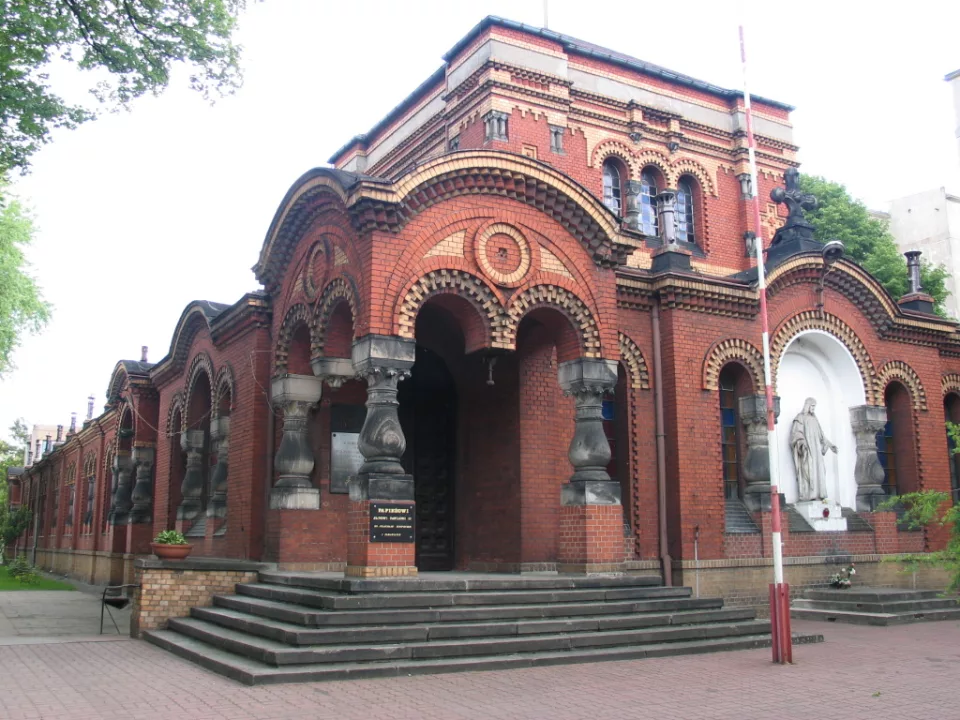
The sacred section was originally combined with a hall used as a horse-riding arena for the garrison, and after 1919 the turrets' onion domes were removed.
The Church of Saint George Garrison at ulica świętego Jerzego 9 in Stare Polesie [Old Polesie district] was built as an Orthodox military church and still bears the marks of that heritage today. Łódź factory owners constructed it for the Russian garrison, and since 1919 it has served the Polish military as a Roman Catholic place of worship.
Construction was undertaken to commemorate the 37th Yekaterinburg Infantry Regiment, stationed in Łódź since 1863, and the centenary of its founding falling in 1896. A building committee was formed in 1894, the project was prepared by the city architect Franciszek Chełmiński, and work began in 1895 under the direction of Robert Nestler, concluding a year later. The consecration took place at the end of November 1896. The construction was funded by Łódź industrialists, among them Karol Wilhelm Scheibler junior and Izrael Kalmanowicz Poznański, whose factory on Ogrodowa street is known to every resident of Łódź today.
The interior combined two functions, which is a rarity in Łódź heritage buildings. The sacred space was laid out on a square plan, and the adjoining rectangular hall with an exposed roof truss served as a riding school for the garrison's horses. The structure was built of red clinker brick in a style drawing on Russian national architecture, with four corner turrets topped with onion domes and a lantern in the centre. This arrangement was practical: the regiment needed a place of prayer and a place for exercises, and there was only one budget.
After regaining independence, the damaged building was taken over by the Catholic Church and in 1919 a decision was made to adapt it as a Roman Catholic church, formally opened on 23 November that year. The onion domes, which gave the building its Russian character, were removed, and the dedication to Saint Alexis, Metropolitan of Moscow, was replaced with the dedication to Saint George. Around 1920 a copy of the Jasna Góra image arrived here, crowned in 1926 as Our Lady, Hetman Protectress of Polish Soldiers. In 1927 a Catholic military parish was established at the church. During German occupation the Nazis converted the building back into a riding school and stripped it of its copper fittings. Pastoral ministry returned in 1946, and an independent military parish was established in 1990 by bishop Sławoj Leszek Głódź. A monument to John Paul II at the church was unveiled on 27 June 1998.
The focal point of the interior is the altar in Byzantine style with an image of Our Lady, Hetman Protectress of Polish Soldiers. Icons from the Orthodox period have been preserved, and the windows feature modernist stained glass from the Polish period. The building is entered in the municipal heritage register of Łódź. For comparison of scale and style, it is worth setting it alongside the Basilica-Cathedral of Saint Stanisław Kostka, built at a similar time in an entirely different convention.

Be the first! Add a comment.
You need to log in to add a comment.
Log in