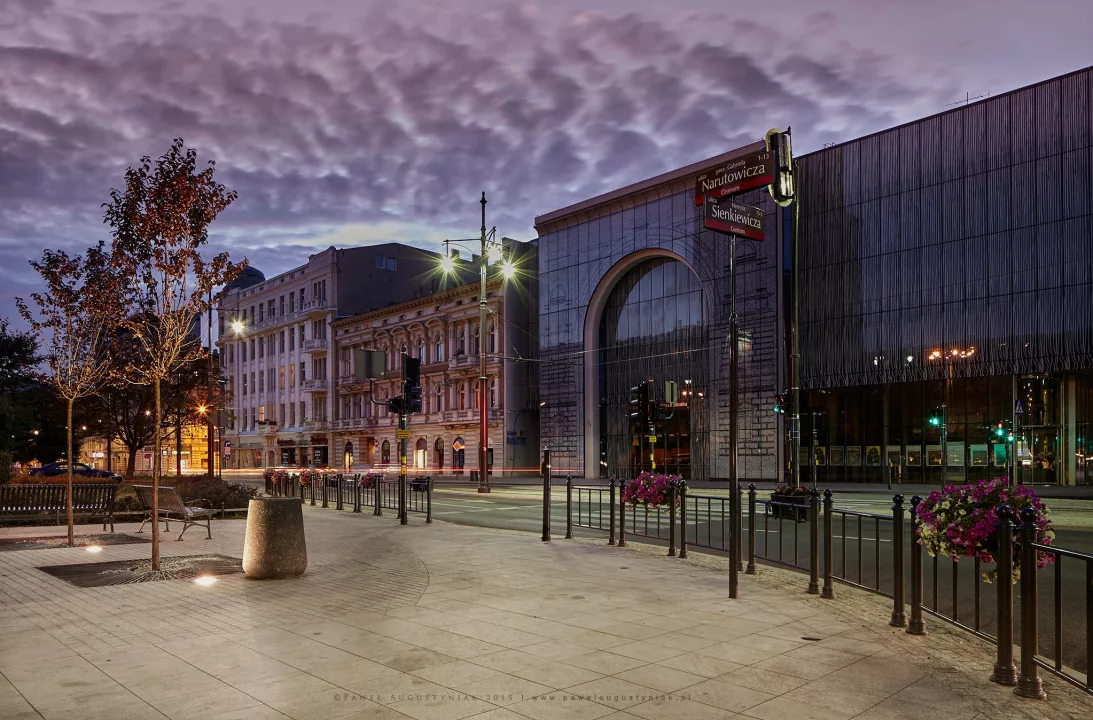
The Łódź Philharmonic has performed since 2004 in a building on the site of the former Concert House, where Artur Rubinstein, born the day before its 1887 opening, made his debut, now home to two independent organs.
Filharmonia Łódzka im. Artura Rubinsteina at Narutowicza 20/22 operates in a building opened on 10 December 2004, erected in the exact location of the former Łódź Concert House. Music has sounded here since 1887, and today's concert hall has two independent organ instruments, one Baroque and one Romantic.
The predecessor of the philharmonic was the Łódź Concert House, opened on 27 January 1887 at Dzielna Street 18, now Narutowicza. The building was constructed in 1883-1886 by Łódź businessman Ignacy Vogel according to a design by Otto Albert Gehlig. A restaurant operated on the ground floor, and on the first floor there was an impressive concert hall with the largest stage in the city.
Artur Rubinstein was born in Łódź the day after the Concert House opened, he made his public debut in this hall and gave over thirty concerts there. Before the war, Ignacy Jan Paderewski, Fritz Kreisler, Bronisław Huberman, Paweł Kochański and composer Camille Saint-Saens also performed here, and lectures were given by Janusz Korczak, Julian Tuwim, Leopold Staff and South Pole explorer Roald Amundsen. The hall also served as a cinema, venue for fashion shows, dance marathons and boxing matches.
The orchestra is older than the philharmonic itself. The Łódź Symphony Orchestra gave its first concert on 17 February 1915, and its founder and first conductor was Tadeusz Mazurkiewicz. In the ensemble played violinist Paweł Klecki, a later renowned conductor, and Aleksander Tansman, one of the most important Polish composers of the twentieth century. In 1916 the orchestra performed here with the Hazomir choir Mozart's Requiem.
After the war, the building at Narutowicza became home to the State Philharmonic, which the ensemble moved into in 1948. The institution has borne the name of Artur Rubinstein since 1984. In the 1990s the technical condition of the old building was so poor that concerts were moved to other venues, including the church of St Matthew and a hall at Piotrkowska 243. The mixed choir has operated alongside the philharmonic since 1969.
The current building was designed by Kraków architect Romuald Loegler, and its construction in 2001-2004 cost nearly 70 million złoty. The structure is defined by glazed walls, panoramic lifts and elliptical stairwells, and the façade references its predecessor. In the 2004 Building of the Year competition the building received the second prize, and SARP [Association of Polish Architects] recognised it as the best building realised with public funds that year. The main hall seats 658 listeners across 22 rows and seven boxes, whilst the underground chamber hall holds approximately 120 people.
The organs were installed in 2010-2014 according to a design by Prof. Ludger Lohmann from Stuttgart. The Baroque instrument was built in Dresden by the Kristian Wegscheider workshop after the pattern of organs by Gottfried Silbermann: 1600 pipes in 37 stops, mechanical action from key to pipe, tuning a semitone lower than modern pitch, allowing performance with early music ensembles. It was presented to the public on 11 April 2014. The Romantic instrument has approximately 3200 pipes in 66 stops, tuned to the symphony orchestra, with a movable console so the organist can see the conductor. It is the only concert hall in the world with two such independent instruments and the only secular hall in Europe with a Baroque organ. The curator of the instruments is Krzysztof Urbaniak.


Be the first! Add a comment.
You need to log in to add a comment.
Log in