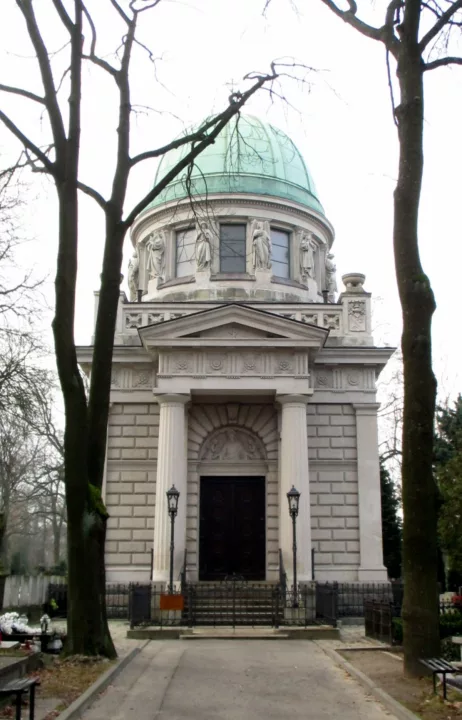
The Heinzel Family Mausoleum on Ogrodowa Street is a heritage funerary chapel that testifies to the rich history of industrial Łódź. It is worth visiting to see nineteenth-century architecture and learn about one of Łódź's important industrial families.
The Heinzel Family Mausoleum is a Neo-Renaissance funerary chapel overlooking the Catholic section of the Old Cemetery at Ogrodowa 39. It was erected for Juliusz Heinzel, one of Łódź's greatest manufacturers, and was built by his widow Paulina of the Volkmann family along with their descendants. Construction began in 1899 and was completed in 1903 or 1904 according to historical sources.
The design was created by Berlin architect Franz Schwechten, known for his work for the Prussian court. The structure directly references the Sigismund Chapel at Wawel, and the doors were modelled on the Cappella Pazzi at the Santa Croce church in Florence. Scholars of sepulchral architecture identify the Heinzel chapel as one of the last dome-type mausoleum designs of this kind realised in Polish territories. The scale and expense of such an undertaking speaks much of the ambitions of Łódź's industrial families, who at the same time were building palaces along Piotrkowska Street.
The rectangular structure, measuring approximately 10.4 by 9.5 metres, is crowned with a dome and closed at the rear by an apse with a semicircular interior. The entrance is guarded by a two-column Doric portico; above the doors sits a semicircular tympanum with a bas-relief of Christ the Merciful, and life-size angel figures stand on the pilasters. Twelve windows are distributed around the dome's drum. The interior is lined with cream-coloured Szydłowiec sandstone, with a descent from the apse leading to crypts where Juliusz Heinzel, his wife Paulina and successive generations of the family rest. A marble statue of the manufacturer that once stood in the chapel has disappeared.
For years the building fell into a deplorable state. Sheeting was stolen from the roof, water leaked inside, and the building remained sealed for six years. Conservation work undertaken from the mid-2000s onwards included drying the burial crypts, replacing the dome windows, repairing the copper roof, restoring the marble altar, architectural details and chandeliers, and polishing the surviving flooring. Outside, the sandstone walls and wooden doors were cleaned, and the brass fittings were reconstructed. Funding came from the city, the Łódź archdiocese and conservation services. The chapel is registered in the heritage register under number A/121.
The Old Cemetery was established in 1855 at the junction of Ogrodowa and Srebrzyńska streets. It covers approximately 21 hectares and is divided into three religious sections: Catholic, covering 11 hectares; Evangelical-Augsburg, covering 9 hectares; and Orthodox, less than one hectare. In 2015 the necropolis was recognised as a historical monument, and over two hundred gravestones are registered as heritage objects. Besides the Heinzel mausoleum stand the tombs of the Grohmans, Geyers, Kunitzers and Kindermanns, and on the Evangelical side stands the Neo-Gothic Scheibler chapel from 1885 to 1888, designed by Edward Lilpop and Józef Pius Dziekoński. The Scheibler family also left Księży Młyn to the city. Since 1995, a collection for restorations has taken place on the cemetery on 1 November, and a society established in 1999 has overseen the monuments.


Be the first! Add a comment.
You need to log in to add a comment.
Log in