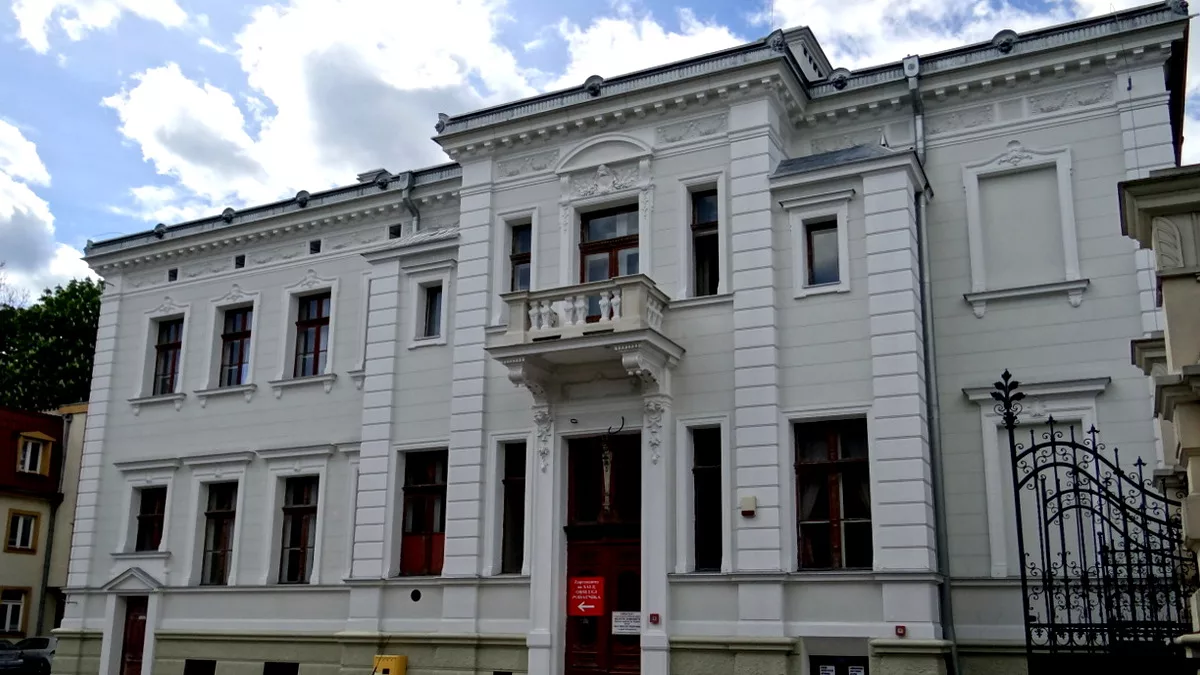
Rudolf Kindler's palace from the 1880s on Zamkowa Street, once the residence of one of Pabianice's wealthiest industrialists, now the tax office, viewable only from outside.
Kindler Industrialist's Residence is the former palace of Rudolf Kindler at ulica Zamkowa 26 in Pabianice, erected after 1880. Today the building serves as the headquarters of the Tax Office, so it can be viewed only from the outside as part of the historic factory-owner architecture of Pabianice, rather than as an interior open to visitors.
Rudolf Karol Kindler was born on 5 June 1819 in Stawiszyn and died on 9 August 1891 in Pabianice. He was an industrialist of German origin who, before establishing his own company, worked as a weaver, mechanic and dyer. He launched his own factory in 1854, and in 1861 opened a woollen workshop with 68 looms and a dyeing works. Over time his enterprise became the second largest textile factory in Pabianice.
By 1913 Rudolf Kindler's company was the largest cloth manufacturer in the Kingdom of Poland and won a gold medal at the Agricultural and Industrial Exhibition in Paris. In 1889 it was transformed into a joint-stock company, but in 1925 the business collapsed. Most of the factory buildings were demolished in the late 1990s, and a hypermarket now stands in their place. The palace at ulica Zamkowa 26 itself survived and was converted to administrative use.
Kindler Palace is listed among the most important objects of industrial architecture in Pabianice from the second half of the 19th century, alongside the Enders family palace at ulica Piłsudskiego, the Krusche family palace at ulica Świętego Jana 4 and the Weavers' House at Świętego Jana 20. The Kindler family belonged before the First World War to the most important and wealthiest industrial families in the city, also known for their social activity.
In Pabianice, at the evangelical cemetery at ulica Ewangelicka 4, stands a separate object connected with the name Kindler: Kindler mausoleum, a chapel-mausoleum from 1907-1909 designed by the firm Wende and Klause, funded by Ludwig and Sophia Kindler. This is a different building and different address from the palace at ulica Zamkowa 26. Both places, however, demonstrate the scale of the Kindler family's presence in the architecture and economic history of Pabianice.

Be the first! Add a comment.
You need to log in to add a comment.
Log in