The town's former marketplace, now Plac Kościuszki, is lined with buildings from different eras including Dom Esterki, and its central monument was rebuilt from an earlier 19th-century one.
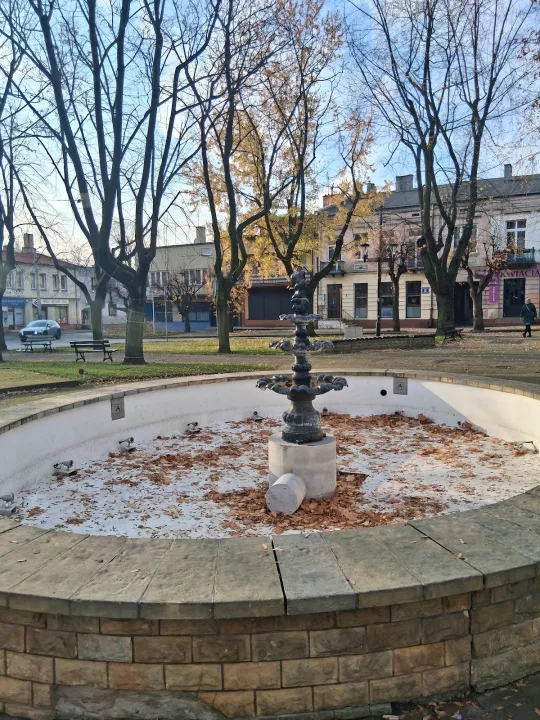
A square at the very centre of Opoczno, today bearing the official name Plac Tadeusza Kościuszki [Tadeusz Kościuszko Square], functioned for centuries as the city's market – the commercial and social heart of the town. It is surrounded by tenement houses of various origins, and in the middle stands a monument to the square's patron, which itself has a surprisingly complicated history.
The name was changed in 1917, on the centenary of Tadeusz Kościuszko's death, on the occasion of the unveiling of his monument on 15 October that year. Previously the place functioned simply as the Rynek [market], a typical commercial centre of a small town with merchant houses and market stalls around it.
The present Kościuszko monument was created from a reconstruction of an earlier monument, erected by residents probably before 1917 in gratitude to the tsar for the emancipation decree of March 1864. During the Austrian occupation, tsarist symbols were replaced with an image of Kościuszko, and the original plaster bust was replaced in the 1920s with a stone sculpture made of fine-grained sandstone brought from near Żarnów. In 1939, fearing destruction by the occupier, residents removed the bust, eagles and inscription plates from the monument and buried them on the grounds of the local power station – they only returned to their place in 1945. In 1988 the monument underwent conservation work, during which paint build-up and lichen were removed.
At number 15 stands Dom Esterki [Esterka House], one of the oldest surviving urban buildings in Opoczno, adjacent to the castle, the presbytery and the Gothic choir of the parish church of St Bartholomew the Apostle. The rest of the frontage consists of tenement houses with varied architecture – some date from the nineteenth century, others were rebuilt in the twentieth century after wars and fires, so the square has no uniform style, only a layered history recorded in its facades.
The town received its charter under Magdeburg law in 1365, and in 1483 it was destroyed by a great fire. From the fifteenth to the eighteenth centuries, the nobility held courts in Opoczno, and in 1787 King Stanisław August Poniatowski visited the city and castle. The market witnessed all this history before it became the square named in honour of Kościuszko.

Be the first! Add a comment.
You need to log in to add a comment.
Log in