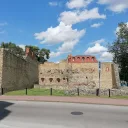
Of Wieluń's 14th-century town walls, fragments survive along with a gate built into the town hall and several towers, including the connected Męczarnia, now a mini-museum in a former torture chamber, and the ruined Prochownia with its 16th-century public bathhouse.
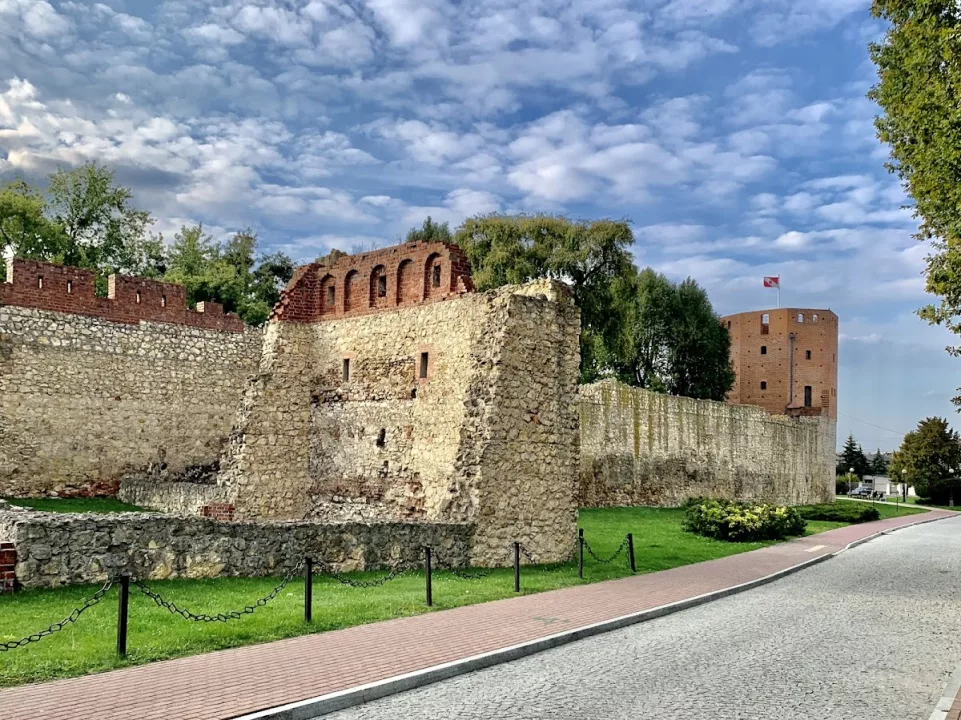
The town walls in Wieluń are medieval fortifications that once surrounded the entire city, built in the 14th century under the reign of Casimir the Great. To this day, fragments of the wall, a gate built into the town hall, and several towers scattered around the Old Town survive, including two connected by a wall: Baszta Męczarnia, today a mini-museum, and the ruins of Baszta Prochownia with a former public bathhouse.
Casimir the Great granted Wieluń city privileges and incorporated it into a network of fortified cities on the south-western border of the Crown. The city became one of 25 centres reinforced with walls as part of the so-called Eagles' Nests, protecting the borderland from raids from the west. The first fortifications were made of wood and earth, and after a city fire in 1335 they were replaced with a wall of local sandstone, more durable and fire-resistant.
The stone wall enclosed an area of approximately 12 hectares, the entire chartered city of that time. Its height reached 6-8.5 metres, and its total length was approximately 1200-1300 metres. It was topped with crenellations, and on the outside the wall was protected by a moat and an earthen rampart. Originally, two gates led into the city, Kaliska and Krakowska, and the fortifications had no bastions, typical of later, early modern fortifications. Of the two, only the Krakowska Gate survives, built into the structure of the then town hall in the early 19th century, so today it forms part of the buildings around the market square rather than a separate defensive structure.
Baszta Męczarnia stands at the north-eastern part of the walls, built at the turn of the 14th and 15th centuries of stone and brick, on a square plan that becomes octagonal in its upper sections. The first mentions of it date from 1518, when it was called Katownia, connected with its function as the seat of the city executioner. Later it was referred to by the names Piekarnia and Męczarnia. After Wieluń received the privilege of trying criminal cases from King Zygmunt Stary in the 16th century, the tower served as a torture chamber, from which its present name derives, a tradition of almost 500 years.
Over the centuries, from the mid-16th century to the second decade of the 21st century, the tower suffered damage. In 2010-2014 it underwent a comprehensive revitalisation, funded by EU funds and Gmina Wieluń, restoring its former appearance and functionality. The tower was officially opened to the public on 14 June 2014 as a mini-museum combining educational activity with the presentation of artefacts and historical narrative.
The oldest structure of Prochownia dates from 1571: a stone building with a roughly square plan, measuring approximately 12 by 12 metres and reaching a height of over 6 metres, built by Jakub Proboszcz of Byczyna as a public bathhouse, an important institution for medieval city life. In 1593, Sebastian Sobek and Melcher of Brzeg erected a semicircular artillery bastion on the site and other structures connecting the bathhouse with the tower, the defensive walls and Brama Krakowska.
The name Prochownia derives from gunpowder storage on the site, but some of the buildings also contained housing for poor residents of Wieluń. In 1996 a partial reconstruction of the tower was carried out according to preserved historical plans, which stabilised the structure, although the building remains in ruins, not adapted for full public use.
Of the remaining defensive elements, Baszta Skarbczyk and Baszta Swawola have also survived, located at various points of the former ring of walls. Visiting them therefore means walking around several places in the old town, not a single visit to one address, and not all towers are currently open for interior visits.
The walls were entered into the register of monuments in 1948 and again in 1967. Nearby it is worth seeing the market square in Wieluń, the main square of the Old Town; the Krakowska Gate has become part of the town hall structure, so both are worth seeing together.
| Monday | 09:00 – 15:00 |
| Tuesday | 09:00 – 15:30 |
| Wednesday | 09:00 – 15:00 |
| Thursday | 09:00 – 15:00 |
| Friday | 09:00 – 15:30 |
| Saturday | 09:00 – 13:30 |
| Sunday ← today | Closed |
Hours per Google Places - may change on public holidays.

Be the first! Add a comment.
You need to log in to add a comment.
Log in