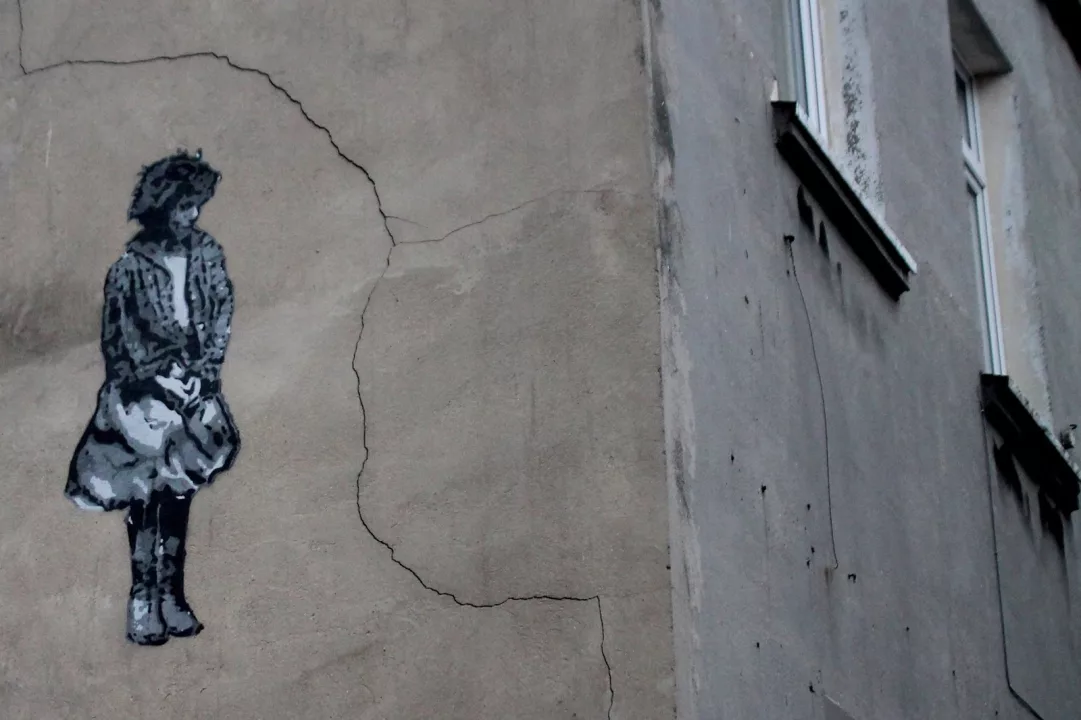
The mural on Starosikawska street commemorates an unnamed girl from the camp for Roma people, set up within the Łódź ghetto in 1941.
At ul. Starosikawska 23 in Bałuty, on a tenement wall, a portrait of a girl has been painted. The mural was unveiled in October 2016 as part of the fifth edition of a cycle commemorating the histories of children held in Łódź during German occupation. The address lies within the area where, in summer and autumn 1941, a separate camp for the Roma population functioned, set apart within the Łódź ghetto.
The camp for Roma and Sinti was established on 5 November 1941 as a separate, fenced section of the Łódź ghetto, covering the area of present-day ul. Wojska Polskiego, ul. Obrońców Westerplatte, ul. Starosikawska and ul. Głowackiego. Over five thousand people were brought here from Styria and Lower Austria, crowded into fifteen buildings containing fewer than six hundred rooms, across an area of less than two hectares. In December 1941 an epidemic of typhus broke out, claiming around four hundred lives. At the turn of December and January the camp was liquidated and the prisoners were transported to the German extermination camp at Chełmno nad Nerem. Those from this group almost certainly did not survive the war.
The girl depicted on the mural remains anonymous. The cycle bases its portraits on archival photographs of real people, but in most cases no documentation has survived to connect the image with a specific name. Of the entire series, only four children are known by name and surname, and none of them came from the gypsy camp, so this portrait and the others dedicated to that community commemorate the victims collectively, without the possibility of individual identification.
The mural was painted by Piotr Saul, affiliated with the Academy of Fine Arts in Wrocław, and Damian Idzikowski from Łódź's Academy of Fine Arts, following a concept by Katarzyna Tośta. The project is run by the Association "Na co dzień i od święta", with support from the Museum of the History of Poland in Warsaw. The cycle, known as the Memorial Murals Route "Children of Bałuty", comprises portraits of Polish, Jewish and Roma children, placed as close as possible to sites connected with their history.

Be the first! Add a comment.
You need to log in to add a comment.
Log in