A stone Romanesque church from 1082, one of the oldest surviving sacred buildings in Poland, once also serving a defensive role and now open mainly in summer.
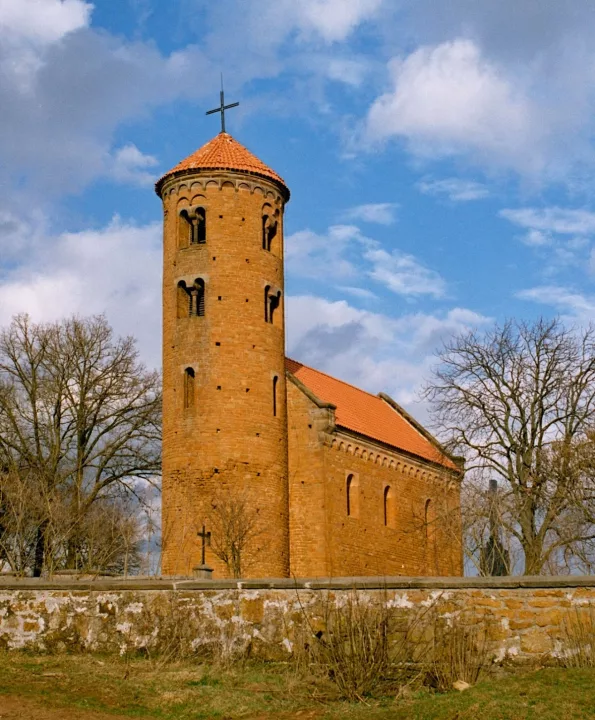
The Church of Saint Idzi in Inowłódz is a Romanesque church built in 1082 on the foundation of Duke Władysław Herman, one of the oldest surviving sacred buildings in Poland. It once served a defensive function as well, and today is a monument open to visitors mainly in the summer season.
An inscription on the church indicates 1082 as the year of construction on the foundation of Duke Władysław Herman, although the chronicler Jan Długosz gave the year 1086. At the same time as the construction of the church, a Benedictine convent was founded on the same hill, which survived until 1241, when it was destroyed by a Tatar raid.
The church was built on an axis, with a cylindrical tower to the west and a single-nave, rectangular body ending in an apse to the east. Such a layout, together with thick walls, allowed the church to additionally serve a defensive function, which was common practice in this period in border areas and along important routes.
After the construction in 1520 of a new church in Inowłódz dedicated to Saint Michael the Archangel, the Church of Saint Idzi lost its parish significance and began to fall into ruin. In 1793 Prussian soldiers robbed the church, which subsequently served for some time as a grain warehouse. The first, incomplete restoration work was carried out in 1924-1926. Full reconstruction was carried out in 1936-1938 under the direction of architect Adolf Szyszko-Bohusz, during which the tower was raised by one storey and the open arcades were replaced by a gallery with triforium windows. The church was rededicated on 1 November 1938. Further renovations were carried out immediately after the Second World War and in 2001 and 2010.
Currently, regular Sunday masses are held in the church, but only in the summer season, intended for both residents and visiting tourists. The church is also a popular venue for weddings, for couples from Poland and abroad. In the immediate vicinity stand the later Church of Saint Michael the Archangel from 1520 and the ruins of the castle of Kazimierz the Great.

Be the first! Add a comment.
You need to log in to add a comment.
Log in