
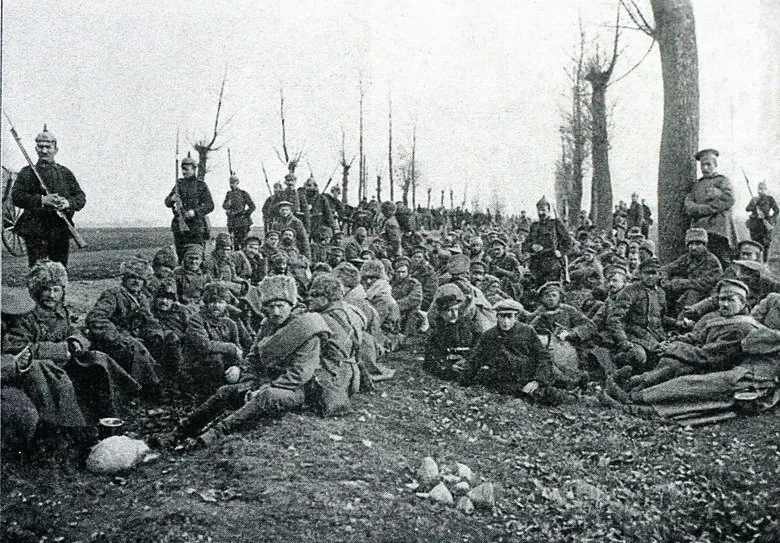
Czteroletnia zawierucha wojenna, która przeszła do historii jako I wojna światowa albo wielka wojna rozpoczęła się od bitew rozegranych na froncie wschodnim. Jedną z najważniejszych była bitwa pod Łodzią, do której doszło na przełomie listopada i grudnia 1914 roku. Przeszła do historii jako należąca do najbardziej krwawych. Trwała 26 dni, ale pochłonęła 200 tysięcy ofiar.
Poland in the fog of war
The beginning of World War I is marked by the assassination of June 28, which took place in Sarajevo. Its victims were Archduke Franz Ferdinand of Habsburg and his wife Sophie Chotek, who were commemorating their wedding anniversary. They were shot by conspirator Gavrilo Princip and both died on the spot. The event became the reason for Austria-Hungary to declare war on Serbia, which escalated into a conflict involving 34 states (almost 2/3 of the world's population at that time). 22 million soldiers took up arms, 8 million of them died, and 40 million people were wounded.
On both sides of the barricade, Poles fought fiercely as well. The partitioning powers occupying Polish lands stood against each other, so it was hardly surprising that 90% of our country's territory was at that time a theater of military operations. World War I caused colossal destruction to Polish infrastructure, industry, and agriculture.
Battle of Łódź – the beginning of German blitzkrieg
The Battle of Łódź (known in Western historiography as the Battle of Brzeziny) took place at the turn of November and December 1914. Russian and German forces faced each other at that time. It is difficult to pinpoint a clear victor of the battle, but the Germans are generally recognized as the winners. European military academies analyze it as the source of German blitzkrieg tactics used during World War II. How did the fighting begin?
In the first months of World War I, battles took place near Warsaw and Dęblin. After they concluded, the Russians planned an operation deep into Germany, which they intended to launch on November 14. However, the Germans managed to decipher their opponents' communications and repositioned their forces so they could surprise the Russian troops by attacking them from behind.
On November 1, Commander of the Eastern Front General Paul von Hindenburg and his Chief of Staff General Erich Ludendorff made the decision to preempt the Russian offensive. They thus attacked from the Toruń region toward Kutno. During this engagement, however, they failed to decisively defeat the Russian corps, and the fighting shifted to the vicinity of Łódź.
By November 22, the Germans had encircled Łódź from the north, east, and west. However, they lacked the forces to complete the encirclement. After exhausting battles, the weakened Russians were forced to abandon Łódź. They withdrew to the line of the Rawka river near Skierniewice. The main battle took place near present-day Gadka Stara. German forces were commanded at that time by the brilliant strategist General Reinhard von Scheffer-Boyadel, and after his name the German units came to be called the Scheffer Group. The unit consisted of the 49th and 50th Reserve Infantry Divisions and the 3rd Guard Division commanded by General Karl Litzmann. It was thanks to his decision that the battle ended in success for the Germans. General Karl Litzmann decided to act contrary to the order to withdraw and attacked the Russians. He was then hailed as the Lion of Brzeziny.
Historians consider this battle the greatest maneuver operation of World War I and a pioneering blitzkrieg in the history of all military science. In the Battle of Łódź, the Russians used armored cars for the first time, which additionally contributed to the uniqueness of the operation. It must be said, however, that neither the German plan to encircle the 2nd and 5th Russian Armies nor the Russian plans fully succeeded. By mid-December, the Eastern Front stabilized in this location.
Interestingly, the Battle of Łódź became so memorable for the Germans that, in reference to it and the actions of General Litzmann, during World War II the city of Łódź was renamed Litzmannstadt.
fajne pisemko
You need to log in to add a comment.
Log in