
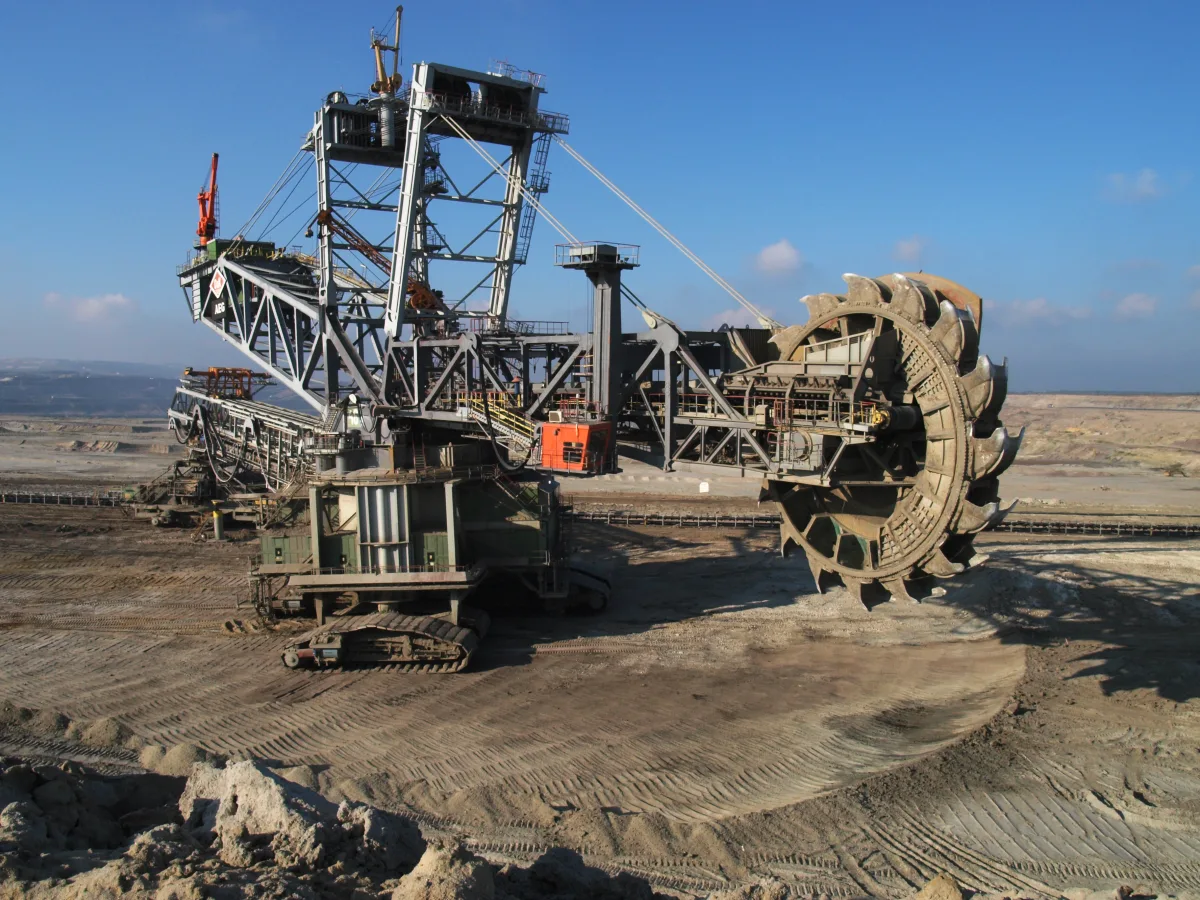
For most of its history, Bełchatów looked much like dozens of other small towns in the Łódź region - a modest centre of craft, later of textiles, with no particular ambition to play a role on the country's map. All of that changed with a single exploratory borehole drilled in December 1960.
Six hundred years of provincial history
The first historical mention of Bełchatów dates from 1391. The town received its municipal charter much later, only in 1743, granted by Augustus III of Poland. At the turn of the 18th and 19th centuries, a textile industry began to develop here - in 1801 Józef Kaczkowski founded the first textile manufactory, and from 1820 the town became the property of the Kaczkowski family, who for decades shaped its economic profile.
In 1925 Bełchatów regained its municipal charter (lost earlier as a result of reprisals after the January Uprising) with a population of just over 9,200 - a solid but otherwise unremarkable county town within the region.
The borehole that changed everything
On 9 December 1960, geologists drilled an exploratory borehole near Bełchatów that struck gigantic deposits of lignite - later estimated at over 2.1 billion tonnes. This discovery, confirmed and expanded in subsequent years of research, presented the country with a decision on a scale the region had never known before.
In 1973 the government decided to build an entire fuel-and-energy basin around Bełchatów - an opencast mine and a power plant designed to exploit the discovered deposits on a large, industrial scale. Construction work began on land that had previously been farmland and small villages.
From the first coal to a presidential city
The first coal from the Kopalnia Węgla Brunatnego Bełchatów (Bełchatów Lignite Mine) was extracted in 1980, and a year later the power plant's first unit was synchronised with the grid. These were breakthrough moments not only for the plant itself, but for the whole town - an investment of this scale meant an influx of thousands of workers, the construction of new housing estates and a complete change in the region's economic profile.
The pace of the town's growth in this period was staggering. In 1986 Bełchatów passed 50,000 residents and gained the status of a presidential city (miasto prezydenckie), and by 1992 its population had reached 58,314 - several times more than before the deposits were discovered. From a small craft-and-textile town, Bełchatów transformed into a mining-and-energy centre of nationwide importance.
A town with two identities
Present-day Bełchatów combines both of these histories today - the old, provincial and industrial one from the 19th century, and the new, energy-driven one from the second half of the 20th century. Traces of the first can be seen at the Dworek Olszewskich (Olszewski Manor), home to the Regional Museum, which presents the town's history from pre-industrial times through the growth of the textile industry.
The second, energy-driven side of the town is shown at the Ekspozycja PGE Giganty Mocy (PGE Giants of Power Exhibition) - a place devoted to the history and technology of lignite mining and power generation on a scale that for decades made Bełchatów one of the largest producers of electricity in Poland. It is worth checking the current opening hours before visiting, as the exhibition is sometimes open only on limited dates.
How to plan a visit
A walk through the town's historic centre is best started at plac Narutowicza, close to both the Dworek Olszewskich and the other monuments of the town centre.
The whole route through the centre takes about two hours, longer if you add a visit to the energy museum. A full list of the town's attractions can be found on the Bełchatów page, and more of the region's history in the Poznaj Łódź (Discover Łódź) section.
Be the first! Add a comment.
You need to log in to add a comment.
Log in