
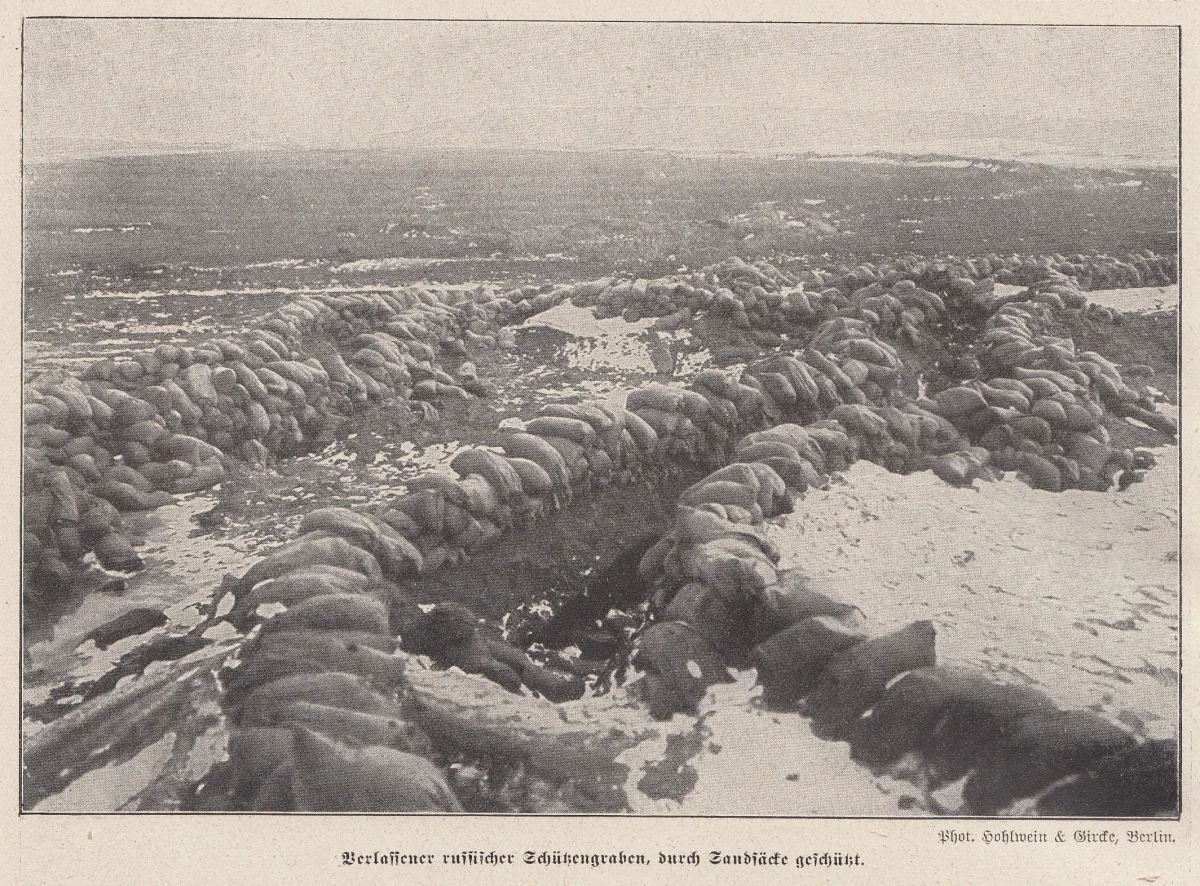
From November to December 1914, one of the largest mobile battles of the First World War was fought around Łódź - it pitted the German 9th Army under August von Mackensen against the Russian 1st, 2nd and 5th Armies. The fighting took place in a ring around the city, taking in dozens of surrounding villages. On both sides, the front left thousands of dead, who were buried on the spot, in field cemeteries laid out right next to the front lines. Many of them survive to this day.
The cemetery in Wiączyń Dolny - the largest in the region
On the northeastern outskirts of Łódź, in Wiączyń Dolny, lies one of the largest war cemeteries in the region - an estimated 9,000 soldiers of the German and Russian armies rest here, killed mainly during the fighting in this area between 9 and 15 December 1914. The cemetery is divided into two parts, Russian and German, and the gravestone monuments were funded by the Łódź manufacturer Karol Scheibler. Many of the Russian soldiers buried here could not be identified - their graves are marked only with a regiment number or the words "unknown Russian soldier".
The cemetery in the Krogulec forest near Zgierz
In a forest on the outskirts of Zgierz, another cemetery from the First World War period has survived. Like other necropolises of this period, it was created as a burial site for soldiers killed in the fighting over the northern approaches to Łódź.
The cemetery in Sędziejowice
South of Łódź, in Sędziejowice, lies a German war cemetery established in 1914. It holds, among others, soldiers of the Russian army, including men of the 156th and 2nd infantry regiments, killed in the fighting that autumn.
Other burial sites from 1914
Besides the three cemeteries described above, further necropolises from the period of the Battle of Łódź have survived in the region - among them in Bechcice, where on the site of a former Protestant cemetery more than 120 German soldiers and more than 200 Russian soldiers killed in December 1914 rest, and in Pawlikowice, where a cemetery was laid out while the fighting was still going on. Another, the cemetery at Poćwiardówka, arose after heavy clashes fought between 17 November and 5 December 1914, when the Germans attacked Russian units defending the approach to Łódź and Brzeziny.
Why is this route worth knowing?
The cemeteries of the Battle of Łódź 1914 differ from the better-known memorial sites of the Second World War - these are the graves of soldiers of foreign armies, killed in a conflict that for the region's residents was largely someone else's war, fought on their land. Even so, these places are maintained and marked today, and a walk around them shows the scale of the fighting waged in the immediate vicinity of Łódź more than a hundred years ago.
How to plan such a route?
The cemeteries described are scattered within a radius of a dozen or so to several dozen kilometres from the centre of Łódź, so it is most convenient to visit them by car. All are accessible free of charge, all year round, though some lie in less-frequented, wooded or open-field locations, so it is worth planning the journey in advance and dressing appropriately for the terrain. The whole route, including travel time, usually takes from half a day to a full day, depending on the number of places visited.
More on the region's history from the First World War period and on other memorial sites in the region can be read in other articles in the Poznaj Łódź (Get to know Łódź) section.
Be the first! Add a comment.
You need to log in to add a comment.
Log in