
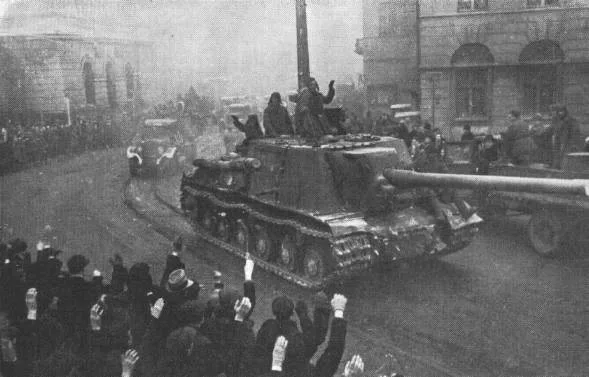
In early January 1945, Warsaw lay in ruins, over 80 percent destroyed. Łódź, less than 140 kilometres away, had survived the war almost unscathed. It had factories, housing, railway stations and a central location within the borders that were about to shift westward. For a short time, someone in the new authorities genuinely wondered whether the ministries should sit here rather than in the ruined capital.
Why was Łódź even considered?
The arguments were mainly practical. The city had a working water supply, tram network and railway, and thousands of flats in the so-called Berlinki, housing estates built by the Germans during the occupation, stood empty and ready for use. There was also a political argument: Łódź, a city of workers and factories, fit the image of the new people's power better than pre-war Warsaw, which had largely been a city of officials.
After the Warsaw Uprising, Warsaw was practically without civilian population and without infrastructure. Rebuilding from scratch was expected to take years, and decisions had to be made immediately, because fighting was still going on in the country.
Who really decided?
Historians agree on one thing: the idea of moving the capital to Łódź never went beyond backroom talks. It was considered, among others, by Bolesław Bierut, but he did not have the final say in the matter. The decision was really made in Moscow.
On 3 January 1945, the Provisional Government formally decided that the capital would remain Warsaw and that the city would be rebuilt. That was not the end of the matter, though - the backroom discussion kept going, and the final confirmation would come only a couple of weeks later, and not from Warsaw or Lublin.
22 January 1945 - a short order from the Kremlin
When Bierut arrived in Moscow to report on the situation in the country, Stalin is said - according to accounts cited by historians - to have settled the matter briefly: the capital of Poland would be Warsaw, and if there were problems with rebuilding it, the Soviet Union would help. Opinions differ on whether this was a promise or rather a veiled threat to keep control over the country's reconstruction. What is certain is that after this conversation, the subject of Łódź as capital stopped appearing in official documents altogether.
Łódź was not the only city considered, either. The idea of moving the capital to Kraków was also rejected - there, the concern was the strong, pre-war elites and traditions that did not fit the new system.
An unofficial capital, before the decision fell
Before the matter was settled, Łódź actually served for a few months as the base of central government. Various state institutions settled here, for longer or shorter periods, for lack of space in ruined Warsaw. The city buzzed with a different kind of life than before the war - the factory owners' tenement houses and wide streets that had survived the wartime turmoil suddenly became the backdrop for bureaucratic bustle.
The symbol of that untouched Łódź remains, to this day, ulica Piotrkowska (Piotrkowska Street) - the city's main thoroughfare, which survived the war practically unscathed, unlike most streets of Warsaw, which were razed to the ground.
A few hundred metres further stands plac Wolności (Freedom Square) with its monument to Tadeusz Kościuszko - a representative square whose architecture in 1945 looked almost identical to before the war.
What remained of this episode
Łódź was never formally declared the capital and never held that status in any legal act - hence the phrase "capital on paper", which is essentially a figure of speech: the matter existed only in plans and conversations, not in documents. The city served as the country's administrative base for a few post-war years, until Warsaw got back on its feet. In the late 1940s, a wave began that historians sometimes call "Warsaw-mania" - institutions moved to the capital one after another, and Łódź lost the significance it had held right after the war.
An interesting trace of that period is the history of the buildings that housed those institutions at the time - some of them are former factory owners' palaces, built half a century earlier for an entirely different purpose. The grandest of them, the pałac Izraela Poznańskiego (Izrael Poznański Palace), today houses an art museum, but in the post-war years, like other Łódź residences, it served purposes quite different from what its first owners intended.
Following the footsteps of that Łódź today
The easiest way to picture that episode is to walk through the city centre, which in 1945 looked almost the same as it does today. It is worth starting from the historic monuments of Łódź clustered around Piotrkowska, crossing plac Wolności and stopping by the cathedral on plac Kościelny, one of the few large churches in the region that was not damaged in the wartime fighting.
The whole route takes about two hours at a relaxed pace, and entry to the church interiors is free. More history from this period of the city is available in the Poznaj Łódź (Discover Łódź) section, and a full list of the city centre's landmarks on the Łódź attractions page.
Be the first! Add a comment.
You need to log in to add a comment.
Log in