
The city's name first appears in written sources in 1332, as the designation of a small settlement belonging to the bishops of Włocławek. Almost seven centuries have passed since then, and yet researchers still do not agree on where the name actually came from. There is, however, one thing all historians confirm: the story popular today about a boat, a river and a fisherman in love is a legend written down and popularised only in the 19th century, not a source of etymology.
The heraldic hypothesis - from the Łodzia clan
The oldest scholarly attempt to explain the name was put forward in 1897 by Władysław Rowiński, and developed in 1908 by Jan Karol Kochanowski. According to this hypothesis, the settlement's name may have come from the coat of arms of the noble Łodzia clan, whose representative is said to have been the Bishop of Włocławek Gerward, known as Łodzic, who held office from 1300 to 1323. The problem is that at the time Łódź was church property, not a knightly estate - and coats of arms did not usually give their names to church settlements. For this reason modern historians treat this hypothesis as the least likely of the three main ones, though it still appears in some studies.
The topographic hypothesis - from the word for willow scrub
In 1928, in the pages of the magazine "Prawda", Andrzej Zand proposed a much simpler explanation - the name is said to have come from the word "łoza", meaning a species of willow that grows in wet, marshy ground, of the kind that actually existed on this site. In Old Polish the word "łodzia" also functioned as a synonym of "łoza", though it fell out of common use before the 19th century, which today makes it harder to trace this etymology precisely. This hypothesis explains the name through the features of the terrain where the settlement grew up, not through a legend or a coat of arms.
The anthroponymic hypothesis - from the name Włodzisław
The third hypothesis, described in 1929 in the pages of "Rocznik Łódzki" by Maksymilian Baruch, derives the name from the name of the landowner. The settlement's original name is said to have been "Włodzia", meaning the property of Włodzisław, and over time the initial "W" is said to have disappeared in pronunciation, giving a form close to today's Łódź. This is a common mechanism in Polish toponymy - many towns took their name from a former landowner's first name.
What all three hypotheses have in common
Researchers agree on at least one point: the city's name does not come from the Łódka river, contrary to today's widespread belief. It is rather the case that this small stream, flowing through the former settlement, took its name from the town, not the other way round - its current name became common only in the 19th century, when Łódź had already been a town for a long time. None of the three scholarly hypotheses has today the status of a definitively confirmed answer - it remains an open question in Polish onomastics, and each of them has its supporters and critics.
And what about the legend of the fisherman and the boat
The story popular today about a fisherman, a mysterious boat and a drowned maiden is a separate matter - written down and spread as a local tale much later than the scholarly etymological hypotheses were formed, and it has never been treated by historians as an explanation of the origin of the city's name. It is a good story for an evening by the fire, but it is worth remembering that scholarship and legend answer two different questions here - one looks for facts, the other builds atmosphere.
Where to look for traces of this history
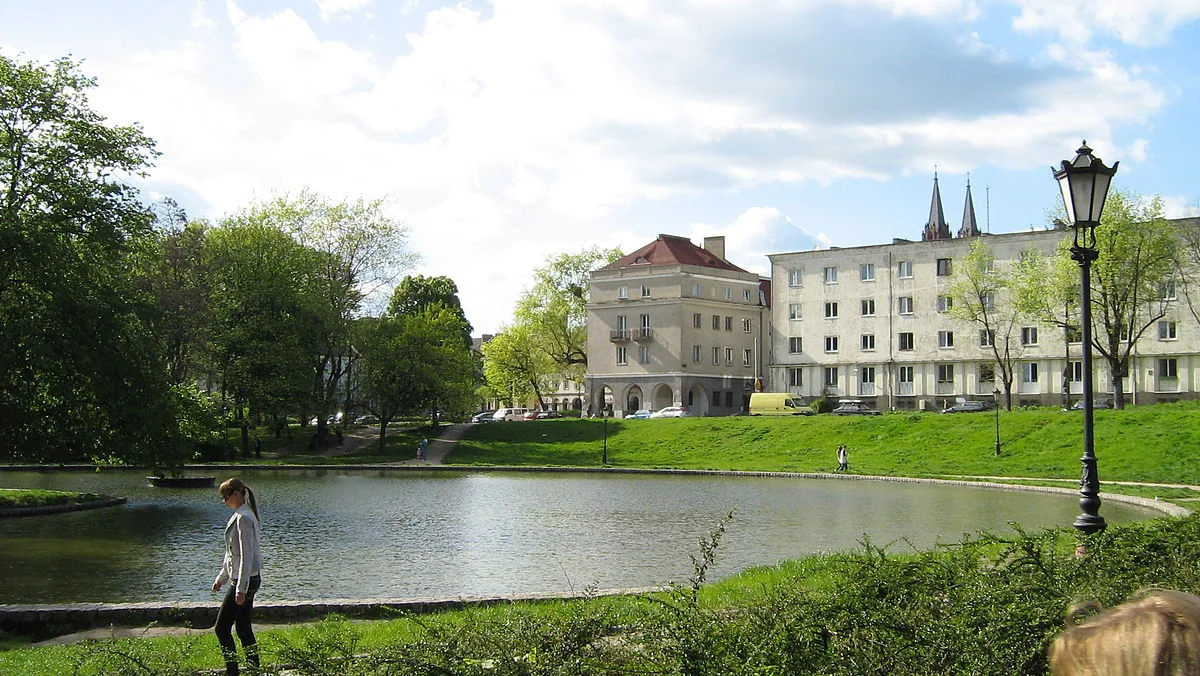
The oldest fragment of the city, where the whole story of the name began, lies today in the area of the former market square, commemorated in the Park Staromiejski (Old Town Park), and by the nearby bazylika archikatedralna św. Stanisława Kostki (Archcathedral Basilica of St Stanislaus Kostka), built on the site where the religious life of the oldest Łódź was concentrated for centuries. You can read more about the town's beginnings, including the 15th-century founding documents, in other texts of the Poznaj Łódź (Discover Łódź) section, and attractions connected with the city's history can also be found in the zabytki (landmarks) category and among the churches and monasteries of Łódź, which include the basilica itself. It is worth combining the whole route with a walk around the rest of the city centre.

Be the first! Add a comment.
You need to log in to add a comment.
Log in