
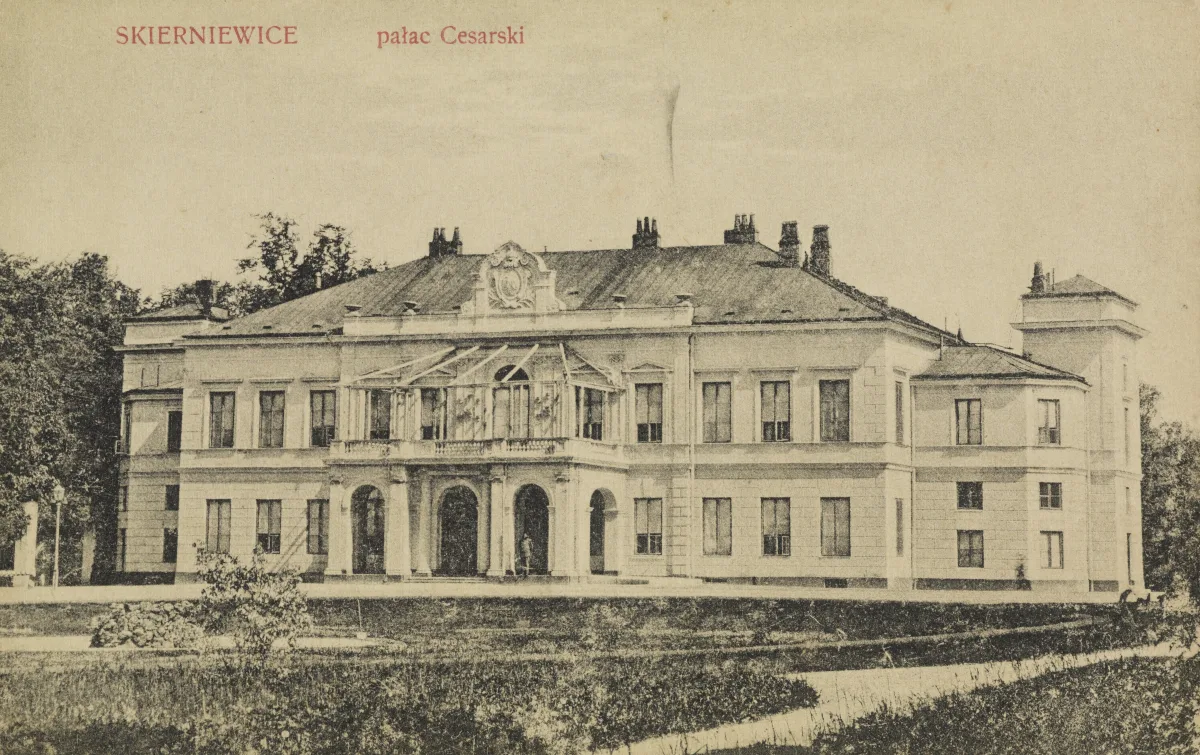
Skierniewice today is associated mainly with a railway junction and a quiet county town between Łódź and Warsaw. Few people remember that for over a year in the 18th century, it was from here, from the primate's palace, that the Commonwealth was actually ruled.
Why was it the primate who ruled the country?
In old Poland, in the period between the death of one king and the coronation of the next, the role of deputy head of state (interrex) was filled by the primate of Poland, that is the archbishop of Gniezno. This constitutional arrangement, unique in Europe, was meant to ensure continuity of power at a time when the throne stood empty and the nobility gathered to elect a new monarch.
After the death of August II the Strong in February 1733, the role of interrex was taken up by Primate Teodor Andrzej Potocki. His official residence at the time was Skierniewice, a town that had belonged to the estates of the archbishopric of Gniezno since the end of the 15th century. During the interregnum, it was from here, away from both Warsaw and Kraków, that the affairs of the state were actually run. Hence the joking, but historically well-founded, name "second capital of Poland".
A town of church dignitaries, not just for a moment
The role of Skierniewice was not limited to a single episode. The town was the residential seat of the archbishops of Gniezno for centuries, and from 1792 it became the formal administrative centre of the archdiocese. The last primate of pre-partition Poland, Ignacy Krasicki, still resided at the local palace in 1795, just before the final collapse of the Commonwealth.
Skierniewice received town rights in the mid-15th century (finally confirmed in 1463), but it was the residential function, not trade or craft, that built the town's regional importance over the centuries.
A palace that saw kings, primates and tsars
The Pałac Prymasowski (Primate's Palace) in Skierniewice was built between 1610 and 1619 as a residence for the archbishops of Gniezno. Over the following centuries it hosted not only church dignitaries but also Polish marshals, and after the partitions, also Russian tsars, who took a liking to the surrounding forests as hunting grounds. The building was rebuilt several times, and it owes its current, late-Baroque appearance to a thorough renovation carried out in the 1960s.
The park surrounding the palace, today a popular spot for walks among residents, was for centuries the private garden of successive residents, first church figures, then tsarist ones.
A second chapter: a railway town
The church history of Skierniewice has a sequel in a completely different era. In 1845, with the construction of the Warsaw-Vienna Railway, a locomotive shed was built here, which over time grew into a sizeable technical facility for trains passing through the town. Thanks to the railway, Skierniewice, lying on the route between two large urban centres, gained new significance, this time economic rather than political.
Today the former locomotive shed operates as a railway museum run by enthusiasts, with a collection of steam, diesel and electric locomotives.
What still recalls that history today
A walk following the traces of the former "second capital" is best started at the Rynek w Skierniewicach (Skierniewice market square), where the town's medieval urban layout is still visible today, and from there heading towards the Primate's Palace and the surrounding park.
Walking through the park and past the palace is free; the interiors are opened on the occasion of cultural events, so it is worth checking the current schedule before visiting. The whole route, including the locomotive shed, takes half a day without rushing. More historic monuments of the town can be found on the Skierniewice page, and other stories from the region in the Poznaj Łódź (Discover Łódź) section.
Be the first! Add a comment.
You need to log in to add a comment.
Log in