
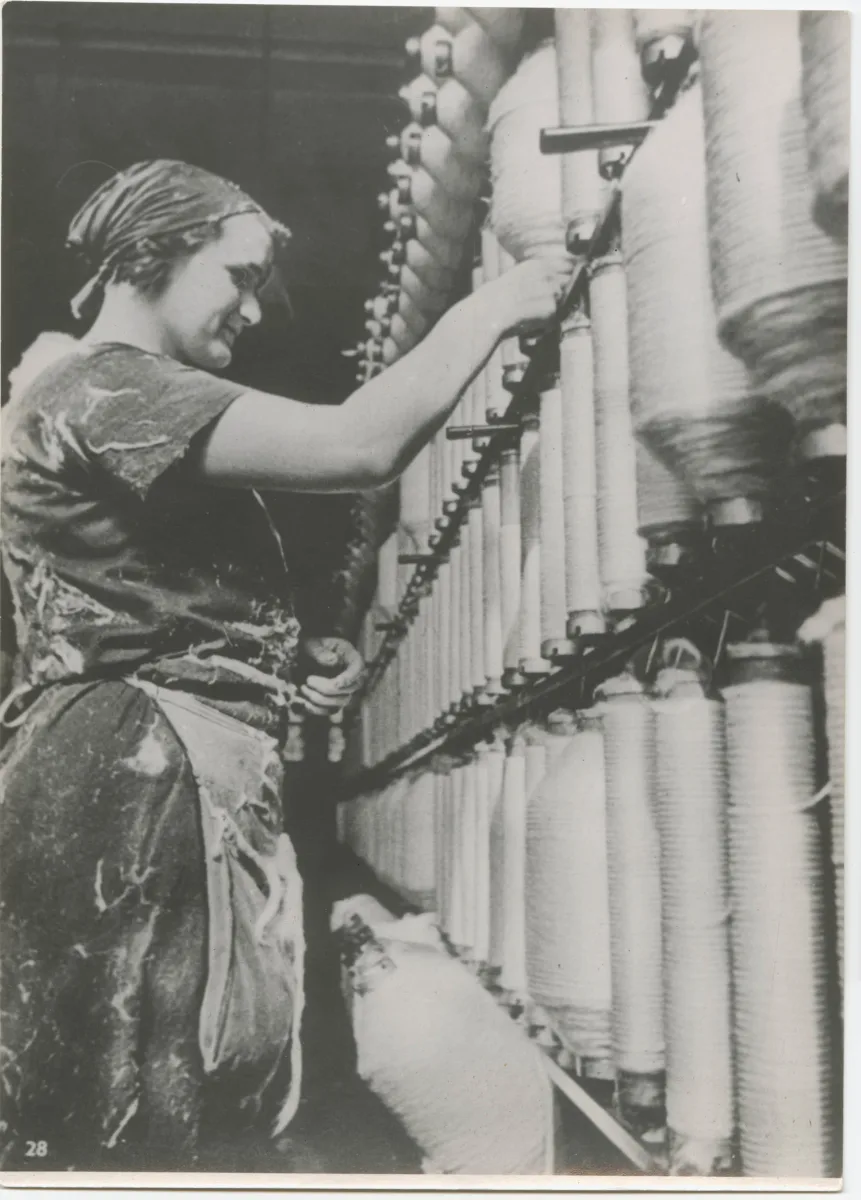
At the turn of 1970 and 1971, Poland was going through one of its post-war political crises - in December 1970, on the Baltic coast, the army and police had bloodily crushed worker protests against rises in food prices. Władysław Gomułka was then replaced as head of the party by Edward Gierek. The price rises did not disappear, however, and in February 1971 a wave of discontent reached Łódź, a city where women working in textile factories made up most of the industrial workforce.
How the strike began on 10 February 1971
The strike began at the Łódzkie Zakłady Przemysłu Bawełnianego im. Juliana Marchlewskiego (the Julian Marchlewski Cotton Works), the former factory of Izrael Poznański, where the Manufaktura shopping centre operates today, and at the Zakłady Obuwia i Gumy "Stomil" (the Stomil footwear and rubber works). By 12 February, more than 12,000 workers had joined the protest, 80 percent of them women.
How the strike grew
Over the following days, the strike wave spread to six more cotton mills, and then also to wool factories and other light-industry plants. By 15 February, 55,000 workers were on strike at 32 plants across the city. The main demand was the withdrawal of December's food price rises and a 20 percent pay rise.
How did the authorities respond?
On 14 February, a government delegation headed by Prime Minister Piotr Jaroszewicz arrived in Łódź. He tried to persuade the striking women to end the protest, appealing to trust in the new party leadership. He was met, however, with clear discontent - the crews kept repeating their demands for pay rises and were unwilling to accept mere promises without concrete decisions.
How did the protest end?
On 15 February 1971, the authorities announced a cut in food prices back to the level before the December rises. This was a rare example, in the history of communist Poland, of a worker protest actually forcing the government to reverse an unpopular decision. The strike of the Łódź textile workers is sometimes called the only fully won worker protest in Poland before the rise of "Solidarity" in 1980.
Why was this strike exceptional?
Unlike the December events on the Baltic coast, there were no clashes with the army in Łódź and no fatalities. The protest took the form of a sit-in strike - the women workers stayed inside the factory halls instead of taking to the streets, which reduced the risk of a violent confrontation. The scale of women's participation is also notable - as the main workforce of the Łódź textile industry, it was they who determined the course and strength of the protest. A decade later, in 1981, the women of Łódź again took to the streets of the city during the Hunger March, this time protesting against empty shops.
Where to see the site of those events today
The former Marchlewski factory, where the strike began, is today one of the most visited sites in Łódź - the Manufaktura complex combines historic factory halls with a shopping centre, a cinema and museums. Entry to the complex grounds is free, and individual attractions inside have their own opening hours and price lists. It is also worth walking along the nearby ulica Piotrkowska, the city's main thoroughfare, along which the most important social protests in Łódź took place throughout the 20th century.
This route is worth combining with a visit to the other historic monuments of the centre and checking the current cultural events held on the grounds of Manufaktura.
More on the city's history from the communist period can be found in other articles in the Poznaj Łódź (Discover Łódź) section, and a full list of entertainment and historic sites in Łódź in the attractions catalogue.
Be the first! Add a comment.
You need to log in to add a comment.
Log in