
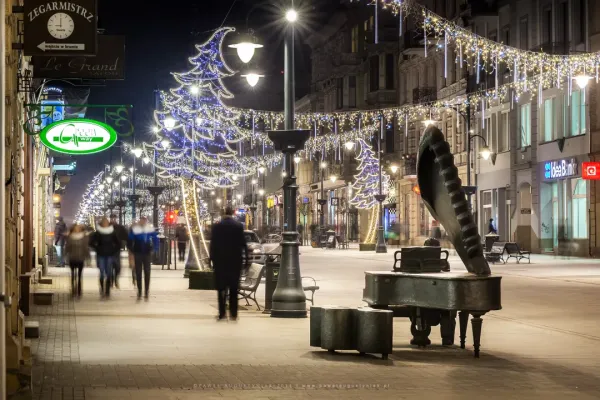
Next to Artur Rubinstein, whose statue now stands on Piotrkowska, he is the second figure from Łódź who made his mark on the history of world classical music at the turn of the 19th and 20th centuries - and yet is far less recognized today than the piano virtuoso. Aleksander Tansman, a composer and pianist, spent most of his life in Paris and the United States, but always traced his roots back to his home city.
Childhood in Łódź
Aleksander Tansman was born on 11 June 1897 in Łódź, into a wealthy Jewish family, at Próchnika street 18, not far from today's Piotrkowska. He attended a Polish secondary school, where he became friends with, among others, Julian Tuwim, the future poet, and Paul Kletzki, another native of Łódź who later made an international career as a conductor and composer. Already in those years Tansman was learning to play the piano and composing his first pieces.
Paris and a friendship with Stravinsky
Tansman began building an international career in 1920, when he made his debut in Paris. He quickly drew the attention of the greatest composers of the era - Maurice Ravel, Darius Milhaud, guitarist Andrés Segovia and Igor Stravinsky. With the latter he formed a friendship of many years, close enough that Tansman wrote and published a biography of the Russian composer in Paris in 1948, titled simply "Igor Stravinsky". He also met regularly with other leading artists of his era, including Béla Bartók and Arnold Schoenberg.
Honorary samurai
One of the most unusual episodes in Tansman's life was a concert tour of Japan in the 1932/1933 season. For his contribution to musical art, the composer received the honorary title of samurai there, along with a ritual sword - a gesture rarely extended to Western artists at the time.
War, Hollywood and help from Chaplin
The outbreak of World War II found Tansman in Europe. With the help of his friend, actor and director Charlie Chaplin, the composer managed to emigrate to the United States. From 1941 he lived in Los Angeles, where he composed, among other things, film music, joining the community of European emigres who, in those years, helped build the Hollywood film industry.
Final years and death
After the war Tansman returned to Paris, where he lived until his death on 15 November 1986, at almost ninety years of age. Although he spent most of his life outside Poland, in his work he repeatedly drew on Polish folk motifs and themes connected to Jewish musical heritage.
Remembering Tansman in Łódź
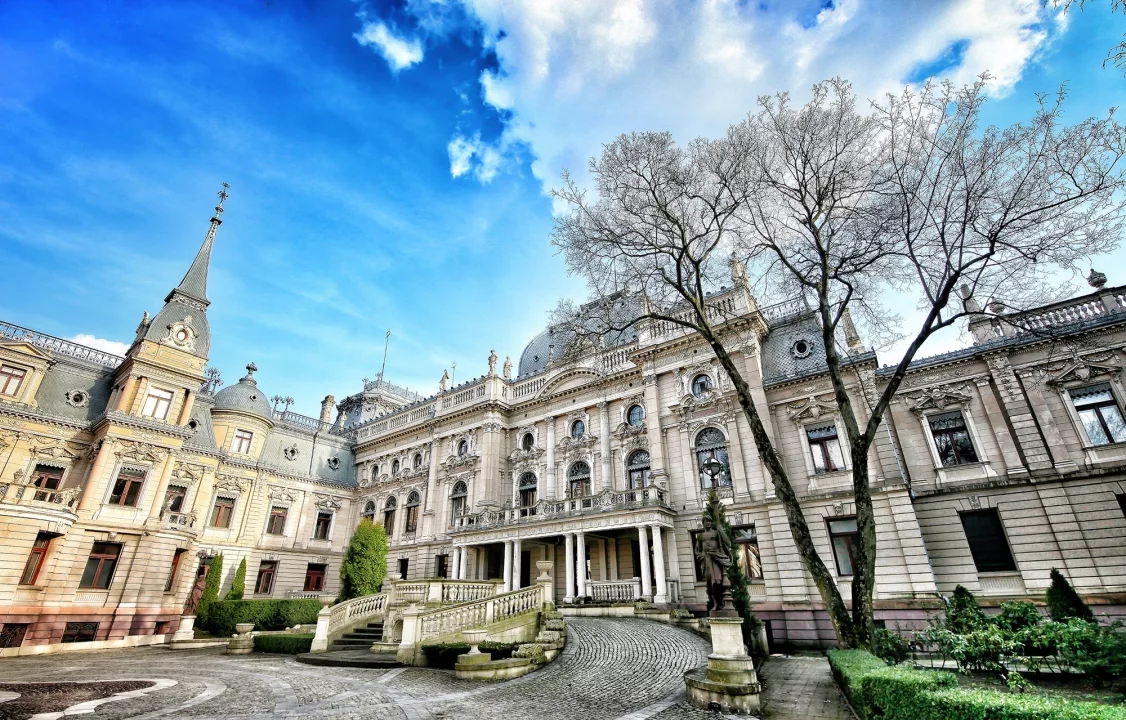
In the composer's home city he is commemorated in several ways. Since 1996 Łódź has hosted the Aleksander Tansman International Competition of Musical Personalities, aimed at young musicians from around the world. The Museum of the City of Łódź, housed in the Poznański Palace, has a permanent multimedia exhibition dedicated to his life and work - the only exhibition of its kind in Poland. Visitors can see, among other things, a composer's desk given to Tansman personally by Igor Stravinsky.
Why he is worth remembering today
Tansman is a good example of how many world-class figures came out of pre-war, multicultural Łódź - a city associated mainly with the textile industry rather than high culture. Together with Rubinstein, whose statue now stands on Piotrkowska, and Kletzki, he forms a trio of Łódź musicians who, in the same generation, came from the same city and won recognition on the world's most important stages - and yet in Poland itself their names are today known mainly to connoisseurs.
In practice: where to find traces of Tansman
The easiest place to see mementos of the composer is the Museum of the City of Łódź, where the exhibition dedicated to Tansman is a permanent part of a tour of the palace. It is worth checking the current programme of concerts and musical events in the city, including the Tansman Competition, on the list of music events. More profiles of people from Łódź can be found in other articles in the Poznaj Łódź series. A visit to the museum, together with the other palace halls, usually takes about two hours, and tickets are reasonably priced, in the range of several to a few dozen zloty - it is worth checking the current price list and free-admission days before coming.
Be the first! Add a comment.
You need to log in to add a comment.
Log in