The Museum of the City of Łódź, located on ulica Ogrodowa, offers an intimate look at the city's rich history. It is a good place to understand how Łódź changed and what shaped it.
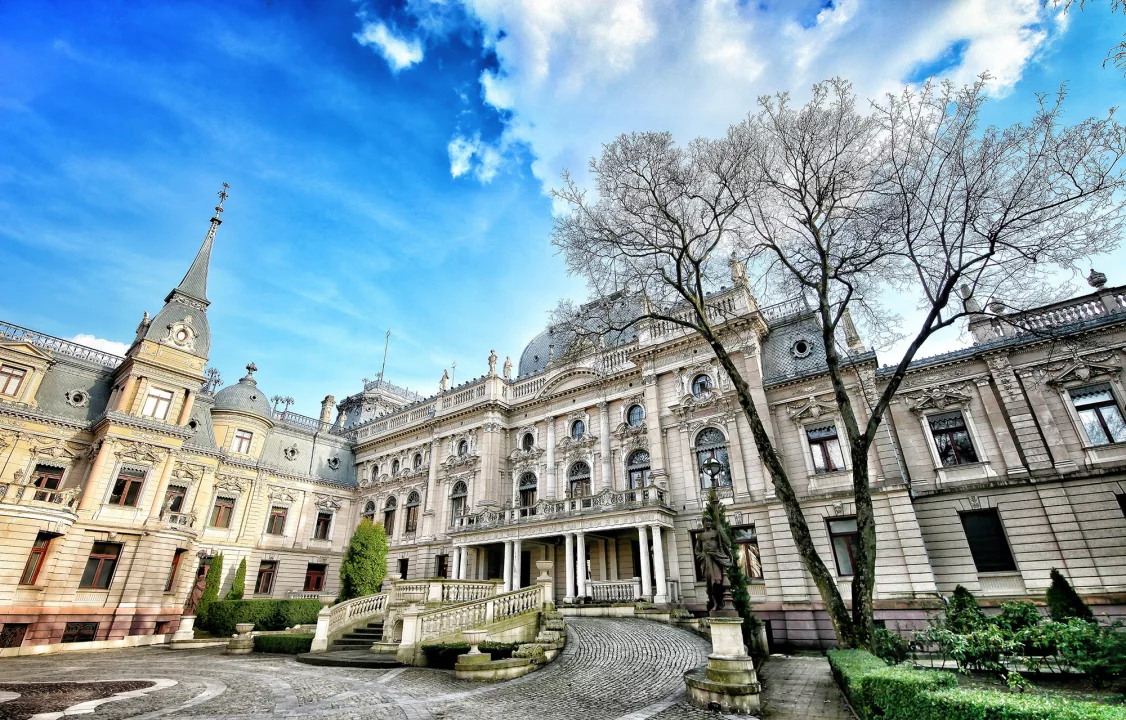
The Museum of the City of Łódź occupies the palace of Izrael Poznański at ulica Ogrodowa 15, the residence of a cotton manufacturer built next to his factories. The building was constructed in stages over more than a quarter of a century and is today one of the most recognisable structures in the city. You experience two things at once here: the representative interiors of the Poznański family and exhibitions devoted to the history of Łódź and the people who shaped it.
Izrael Poznański bought the property at the junction of ulica Ogrodowa and ulica Zachodnia in 1877, and its expansion lasted until 1903.
Hilary Majewski prepared the design for thorough reconstruction in 1888; subsequent phases were conducted by Juliusz Jung, Dawid Rosenthal and Adolf Zeligson. The monumental form that we see today was given to the building in 1901-1903, after the owner's death in 1900. The architecture combines Neo-Renaissance with Neobaroque motifs, typical eclecticism for the end of the nineteenth century. The articulated façade is densely covered in detail: stonework, balustrades and sculptural decoration.
A representative staircase, reception rooms with stucco and gilding, marble and stone cladding, patterned parquetry and stained glass.
The décor of the dining and ballrooms is associated with the name of Samuel Hirszenberg. In 1898 a winter garden covered with glass domes was added to the residence. The layout of the interiors shows that this was not merely a house: alongside the grand salons for receiving guests and conducting business were intimate residential rooms.
From 1927-1939 the palace housed the Provincial Administration Office, during German occupation the German administration, and in 1975 the building was taken over by the museum.
The basements were then adapted and interiors reconstructed. The entry in the register of historical monuments under number A/16 carries the date of 20 January 1971. In 2015 the building fell within the boundaries of a historical monument encompassing the multicultural landscape of industrial Łódź, established by presidential ordinance of 16 February 2015.
The exhibitions concern the family of manufacturers, city history and the biographies of Łódź residents who pursued careers far beyond the city.
The museum operates three locations: the palace on Ogrodowa, the Dętka Canal Museum under plac Wolności and the Museum of Sport and Tourism.
Dętka is an underground reservoir from 1926, designed by William Heerlein Lindley, a brick corridor over 142 metres long. Access leads from a glass pavilion in the northern part of plac Wolności, and visits are conducted with a guide. This branch is open Wednesday to Thursday from 10.00-17.00 and Friday to Sunday from 11.00-18.00; closed Monday and Tuesday. The Museum of Sport and Tourism operates at aleja Politechniki 10.

Be the first! Add a comment.
You need to log in to add a comment.
Log in