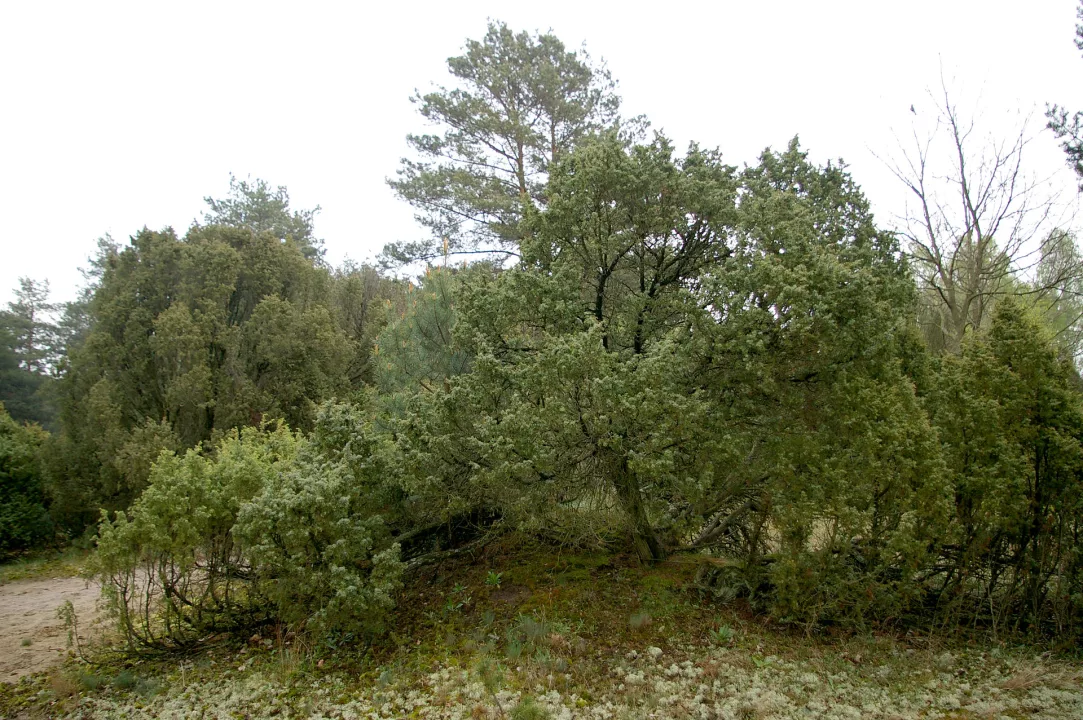
This small dune shelters around eight thousand century-old common junipers, one of the last such large natural clusters of the plant left in Poland.
Ciosny Nature Reserve protects an extraordinary cluster of common juniper trees growing on inland dunes in the area of Rosanów, near Zgierz. The reserve covers only 2.37 hectares, yet on this small area there are approximately eight thousand junipers about 160 years old, forming one of the last natural concentrations of this plant in Poland.
The reserve was established by order of the Minister of Forestry and Timber Industry in 1971. The establishment of the reserve was a response to the threat posed by ongoing urbanisation and landscape transformation in Poland in the second half of the twentieth century to natural juniper clusters. Common juniper, which was once a widespread element of Polish inland dune flora, has practically disappeared from its natural habitat, so this concentration at Ciosny has conservation and educational value.
The junipers growing in Ciosny Reserve reach exceptional sizes for this species. Trunk thickness reaches five centimetres, and height ranges from five to six metres, which represents a record for common juniper growth under natural conditions. These trees grow on dunes, that is on sandy terrain formed by wind and water, which requires plants to have special adaptations to difficult conditions - limited water access, high exposure to wind and ground instability. The fact that junipers have survived here for over a century and a half testifies to their remarkable ability to adapt.
Ciosny Reserve is accessible to tourists. From Stary Rynek in Zgierz to the reserve, a green hiking trail nine kilometres long leads, offering an attraction for walking and cycling enthusiasts. The trail passes through areas rich in ethnographic and historical points of significance. Nearby are also other nature reserves, including the newer Źródła Ciosenki Reserve, recently established and managed by Nadleśnictwo Grotniki, making the area around Rosanów a cluster of natural values worthy of a joint visit.
A nature reserve is a protected area subject to flora and fauna protection regulations. Visitors should treat all plants with respect - it is forbidden to harvest or pick juniper, destroy plants or gather protected species. The access road to the reserve is impassable for cars, so the final section must be completed on foot. The reserve has no controlled entrance or opening hours in the traditional sense - access is open and free.

Be the first! Add a comment.
You need to log in to add a comment.
Log in