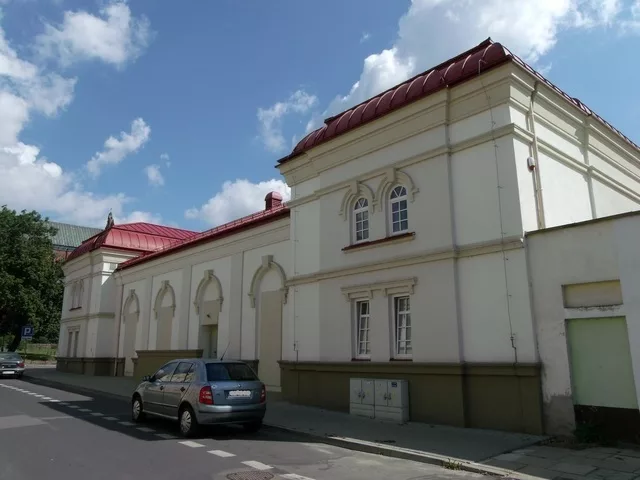
The historic 1908 Dom Dochodowy Straży Ogniowej in Kutno, funded by residents' contributions, today home to the Centrum Teatru Muzyki i Tańca.
Dom Dochodowy Straży Ogniowej in Kutno is a historic theatre building at ul. Teatralna 1, built in the early twentieth century as a result of a social initiative by local residents. Today it houses the Centre for Theatre, Music and Dance, a branch of Kutnowskie Domu Kultury, and remains one of the oldest cultural institutions in the city. The building combines historical heritage with active artistic work.
The initiative for construction was proposed by Dr Antoni Fortunat Marian Troczewski. Residents of Kutno and surrounding areas made the decision to realise the project on 9 February 1899. The cornerstone was laid on 10 September 1899, and construction work lasted ten years. The building was designed by architect Kazimierz Stebelski, who prepared the design free of charge for the Fire Brigade Society. The official opening of the building took place on 20 December 1908. The name "Dom Dochodowy" (revenue house) comes from the method of financing – the building was created from contributions by residents of Kutno and surrounding areas, which formed the income for its maintenance. The cost of construction was 21,131 rubles and 97.5 kopecks in tsarist currency (historical data from the period of tsarist partition).
The first theatrical performances in the hall took place from August 1900, even before the official opening of the building. The theatre hall attracted amateur and professional teams from nearby cities – from Warsaw and Włocławek. Among the artists who performed here were well-known figures in Polish theatre: Stefan Jaracz, Karol Adwentowicz, Wiktoria Kawecka (prima donna of Warsaw operetta) and Adam Dobosz. On 29 January 1904, a lecture by Henryk Sienkiewicz, the famous Polish writer, took place in the theatre hall. The hall contains an allegorical ceiling painting with Terpsichore – the muse of dance and song, serving as evidence of the artistic ambitions of Kutno residents at the time. The building was managed in the first period, until 1918, by Dr Antoni Troczewski.
During the Second World War, the building was occupied by the occupying force, which changed its internal structure. During this period it functioned as a cinema. After 1945, the building was renamed cinema-theatre "Polonia", initially bearing the name "Cinema Polonia" from 17 March 1945. The architectural style of the building is eclecticism, representing that stylistic era. In 2011–2012, a comprehensive modernisation of the building was carried out, financed from EU funds and the city budget. The cost of renovation was approximately 2.4 million zloty. During the renovation, frescoes painted by the Opoczński brothers were discovered, constituting invaluable evidence of artistic craftsmanship from the early twentieth century. The opening of the Centre for Theatre, Music and Dance took place in May 2012, and the building received a new mission – to be a centre for contemporary theatre and musical culture.
| Monday | 12:00 – 18:00 |
| Tuesday | 12:00 – 18:00 |
| Wednesday | 12:00 – 18:00 |
| Thursday | 12:00 – 18:00 |
| Friday ← today | 12:00 – 18:00 |
| Saturday | Closed |
| Sunday | Closed |
Hours per Google Places - may change on public holidays.

Be the first! Add a comment.
You need to log in to add a comment.
Log in