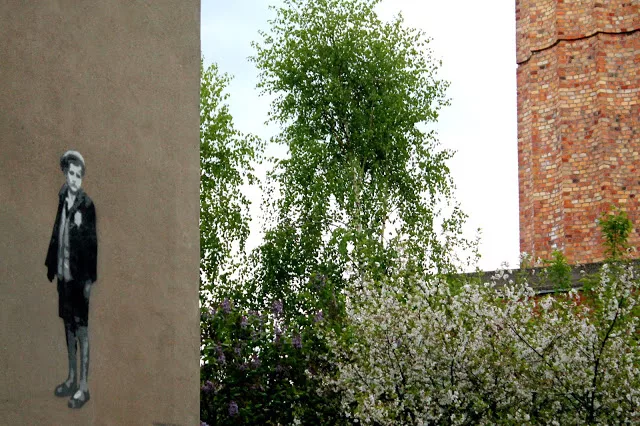
A mural by Piotr Saul and Damian Idzikowski from 2017, located on Aleja Pamięci Ofiar Litzmannstadt Getto [Avenue of Memory of Victims of Litzmannstadt Ghetto]. The portrait commemorates the tragic history of the Łódź ghetto and forms an important point of reflection on the route of memorial sites.
A portrait of a boy on the wall of a former railway signal box on al. Pamięci Ofiar Litzmannstadt Getto commemorates a child deported from the Łódź ghetto to the extermination camp at Chełmno nad Nerem. The mural was created in August 2017, on the 75th anniversary of the Gross Aktion, together with a second portrait on the same building.
The boy in the mural remains unnamed. The artists transferred his face from an archival photograph documenting deportations, and the child's name could not be established. In the entire cycle, which numbered twenty-five portraits in 2017, only four people are known by their first and last names: Dawid Sierakowiak, Abramek Koplowicz, Salek Berliński and Abramek Cytryn. The rest are children identified only from film frames or photographs. The second portrait from the same signal box, mural with a girl from the ghetto, has a separate entry on the portal.
Gross Aktion was a German deportation operation carried out in Litzmannstadt Ghetto in September 1942. Approximately fifteen thousand people left the ghetto at that time: children under ten years of age, elderly persons and the sick, deemed unable to work by the occupier. They were transported to the extermination camp at Chełmno nad Nerem. The route led through Radegast station, near which the signal box with the murals stands, so the image is located precisely on the route that the portrayed child travelled for the last time.
The portraits were created by Piotr Saul, assistant at the Department of Painting and Sculpture at the Academy of Fine Arts in Wrocław, and Damian Idzikowski from the Workshop of Graphic Design Fundamentals at the Łódź Academy of Fine Arts. Both work in the cycle Children of Bałuty, murals of remembrance, conducted since 2012 by the Association Na co dzień i od święta and co-financed by the Museum of the History of Poland in the Tomorrow's Patriotism programme. The murals are executed in black and white, without inscriptions and without decorative backgrounds, which distinguishes them from the coloured works known from the area around Piotrkowska Street. The remaining works from the cycle are scattered across Bałuty, on the walls of tenement houses within the boundaries of the former ghetto.
The signal box stands along the avenue leading to Radegast station, near a memorial area, not in the dense urban development. The murals are viewed from the pavement, at any time of day, without a ticket and without a guide. The visit is usually combined with the monument and exhibition at the station itself, and broader context of the destruction of Łódź's Jews is provided by the Jewish cemetery on Zagajnikowa Street, closer to the city centre, with a field of ghetto graves.

Be the first! Add a comment.
You need to log in to add a comment.
Log in