Nowy Rynek in Łowicz is the historic heart of the city, where you can walk among listed buildings, visit local shops and cafés, and experience the authentic atmosphere of the town.
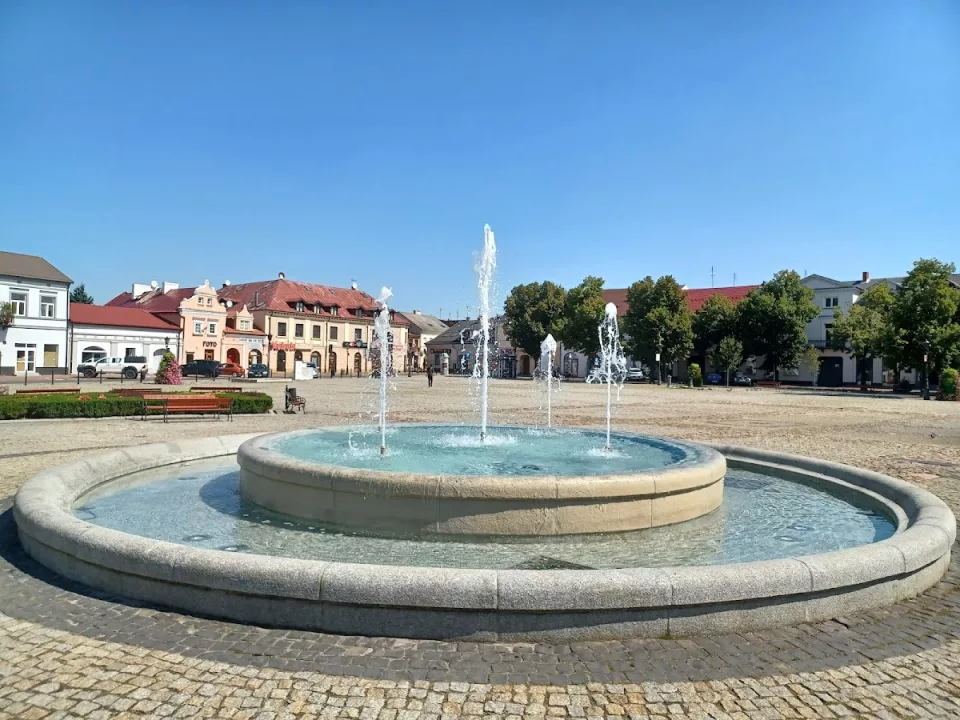
Nowy Rynek in Łowicz is a triangular city square in the Nowe Miasto district, surrounded by rows of townhouses dating from the 16th and 17th centuries. Such a shape is rare in European urban planning: only Paris and Bonn have similar triangular squares, and the Łowicz one is the only surviving example in Poland.
The square was created following a decision by Nicholas Kurowsk, Archbishop of Gniezno, who granted new town rights to the new part of Łowicz in 1405. The very fact that a separate, new city was established alongside the existing older settlement explains the name of the square to this day: Nowy Rynek was the centre of this younger, newly chartered part of Łowicz. In the 16th and 17th centuries, brick tenement houses were built around the square, some of which have survived to the present day and give the square its current, compact character.
Originally, a wooden town hall stood in the middle of the square, erected in 1443. In 1539 it was replaced by a Gothic building made of stone, with a five-storey tower. The square served a market function until 1950, when it was transformed into a recreational space. By the 1990s the square had fallen into decline, so between 2005 and 2006 it underwent a thorough renovation. The result was appreciated in 2007 by the Society of Polish Urban Planners, which awarded Nowy Rynek a prize in the category of renovated public space.
17 buildings entered in the register of monuments, dating from the 17th-19th centuries, stand on and around the square. For a city square in a town the size of Łowicz, this is a large number and testifies to how well the historic fabric has been preserved here. During the November Uprising, two insurgents were executed here, and during the Second World War the southern façade of the square was destroyed. Over the following decades, the square also changed names, which in itself is a record of the city's history: during the First World War it bore the name Hindenburg Platz, from 1929 to 1996 it was called Plac Kilińskiego, and during Nazi occupation it functioned as Neuer Ring.
| Monday | 00:00 – 24:00 |
| Tuesday | 00:00 – 24:00 |
| Wednesday ← today | 00:00 – 24:00 |
| Thursday | 00:00 – 24:00 |
| Friday | 00:00 – 24:00 |
| Saturday | 00:00 – 24:00 |
| Sunday | 00:00 – 24:00 |
Hours per Google Places - may change on public holidays.

Be the first! Add a comment.
You need to log in to add a comment.
Log in