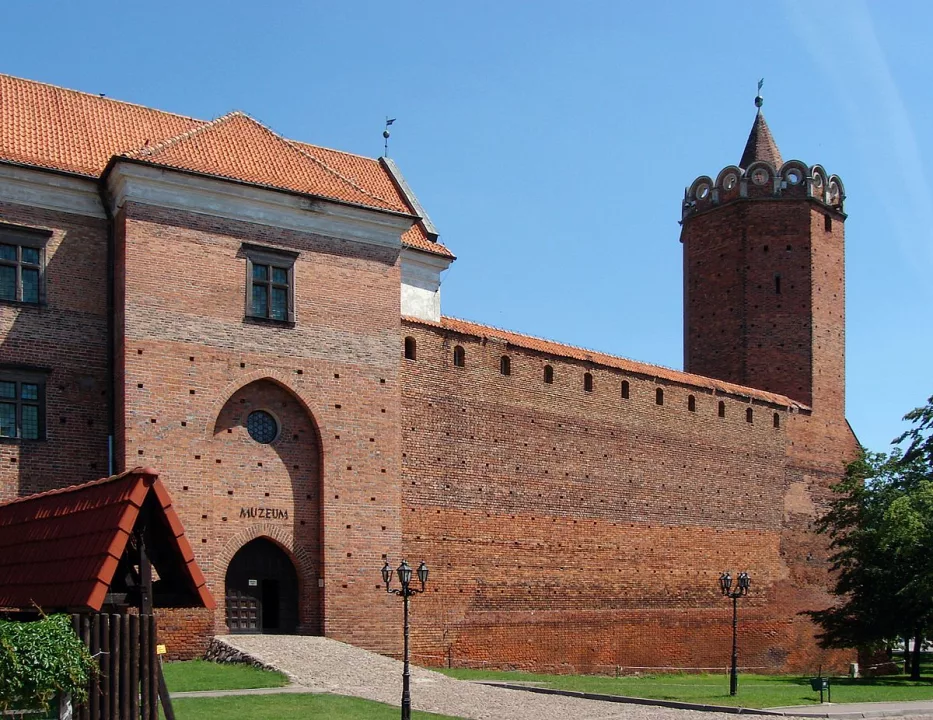
A 14th-century Gothic fortress built for Casimir the Great, site of four royal parliaments, home to the Łęczyca Museum since 1948 with its folk sculptures of the demon Boruta.
The Royal Castle in Łęczyca is a Gothic fortress from the 14th century, built by Kazimierz Wielki [Casimir the Great] around 1345–1370. Since 1948 it has housed the Museum in Łęczyca (also known as the Museum of Łęczyckie Land), presenting medieval architecture, archaeological collections, ethnographic objects and folk art of the region.
The structure is a fortress built of brick, located on an artificial mound surrounded by a moat fed by the Bzura River. The defensive walls reached a height of 10 metres and had crenellations, and one of the most valuable parts is the octagonal Knight's Tower. The complex comprised the Old House (three-storey) and the New House, built in 1563–1565 by Jan Lutomirski. In the Middle Ages the castle was a royal residence and a venue for meetings of power – it was visited by Władysław II Jagiełło among others (36 visits). The castle also hosted Elisabeth of Austria, leaving a mark on the history of the dynasty.
Łęczyckie Castle was the venue for four royal diets – in 1420, 1448, 1454 and 1462. It was a strategic point on the map of Polish political power. After the victory at Grunwald in 1410, Teutonic prisoners were held here. However, the castle's history also includes periods of destruction – it was burned in 1406 by the Teutonic Knights and occupied by the Swedes in 1655–1656. Major restoration was carried out after the Second World War in 1964–1976 under the conservation supervision of Jadwiga Grodzka, restoring it to its representative function.
The Museum in Łęczyca is renowned for Poland's largest collection of folk sculptures inspired by the legend of Boruta – a demon or spirit from local folklore. The exhibition occupies eight rooms and covers objects from four main thematic areas: archaeology (finds from Łęczyckie Land), history (medieval and modern documentation), ethnography (traditions and daily life) and folk art. The exhibition features medieval weapons, armour and everyday objects that tell the story of life in the castle.
The museum organises international jousting tournaments held annually in August in the castle courtyard – spectacles that bring to life the ceremony of medieval chivalry. The programme also includes early music concerts and lectures devoted to the history of the region. Thanks to its central location in the city, the castle remains a landmark for historical tourism in the Łódzkiego area.
| Monday | Closed |
| Tuesday ← today | 10:00 – 16:00 |
| Wednesday | 10:00 – 16:00 |
| Thursday | 10:00 – 16:00 |
| Friday | 10:00 – 16:00 |
| Saturday | 10:00 – 15:00 |
| Sunday | 10:00 – 15:00 |
Hours per Google Places - may change on public holidays.

Be the first! Add a comment.
You need to log in to add a comment.
Log in