
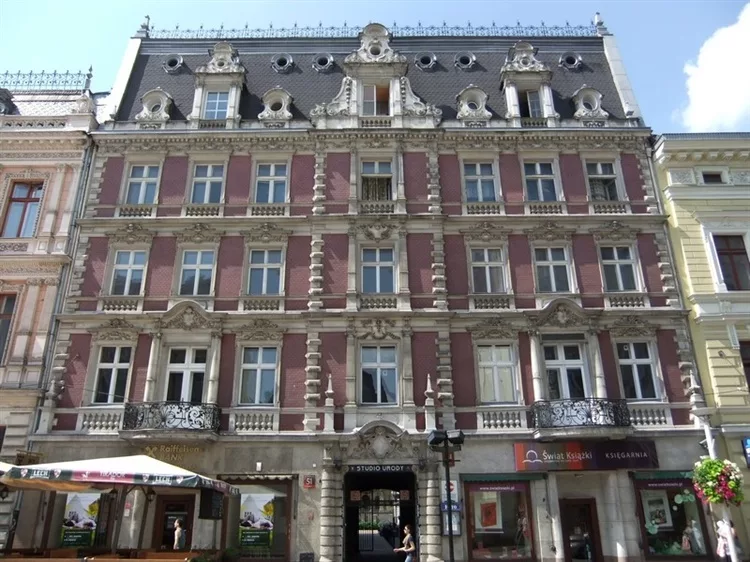
Łódź grew in under a hundred years from a weaving settlement into a city of half a million people. Fortunes rose and vanished within a single generation, factory owners died suddenly, sometimes in conflict with family or workers. Such ground is fertile for legends - and Łódź has plenty of them, though none can be either confirmed or disproved. Below are a few stories that have circulated around the city for decades as tales, not facts.
The ghost of Izrael Poznański counts coins
The most popular Łódź ghost story concerns Izrael Poznański, owner of the city's second-largest textile factory and of the palace on what is now Ogrodowa Street. According to the tale, the factory owner's ghost still walks through his former residence and tries to move the hands of the factory clock forward - just as he supposedly did in life, so that the workers would work longer. His appearance is said to be accompanied by a characteristic sound: the jingle of coins being counted, since the factory owner is said to count his fortune even after death.
This is a tale, not a documented event - nobody knows the source of the first account, and versions differ depending on who is telling them. The palace, after its 1903 rebuilding (designed by Adolf Zelinson), today houses the Museum of the City of Łódź, so the factory owner's ghost - if it exists at all - would today have company in the form of curators and visitors.
The penance of Jerzy z Bełdowa in Łagiewniki
A completely different, older legend is tied to the Łagiewniki forest and the wayside shrines standing there. It reportedly dates back to the 17th century and tells of Jerzy z Bełdowa, a stern and, according to the tale, also cruel man who had a killing on his conscience. After his death in 1669 he is said to have appeared to his loved ones, atoning for his guilt - hence the tradition of erecting penitential shrines in the forest, some of which have survived to this day.
The Łagiewniki Forest is today one of the largest urban forest complexes in Poland and a popular walking area in Łódź. The shrines still stand there - regardless of how much of the legend of Jerzy z Bełdowa is true and how much is an addition by later generations of storytellers.
The Black Manor, about which nobody knows anything for certain
On what is now Plac Reymonta, in the area of the former Górny Rynek and Rzgowska Street, there once stood an estate known to residents as the Black Manor (Czarny Dwór). The name has survived in the city's memory longer than any credible explanation of where it came from - and that alone was enough for the place to accumulate stories of ghosts and ill repute. The sources that could be found do not give one consistent version, so we treat this as a naming curiosity, not a confirmed piece of history.
The shadow of war in the Ruda Popioły forest
Not all Łódź stories about frightening places are legends in the light, Halloween sense. Stories linked to the forest near Ruda Popioły date back to the occupation - they speak of residents killed by German forces in one of the villas, and of a group of children said to have disappeared on a walk shortly after the war ended. This is a topic where it is hard to separate documented history from a tale passed by word of mouth - so we present it without detail, as a signal that not every frightening story in the region is mere entertainment.
Where do the ghosts of factory owners come from?
Łódź ghost legends share a common denominator: they almost always concern people who acquired enormous wealth in a short time, and places that this wealth left behind to the city. Manufaktura, the old tenement houses on Piotrkowska Street, palace interiors - all of this was built at a time when Łódź was growing faster than any other city in this part of Europe, and fortunes were made and lost within a single generation. Legends about the ghosts of factory owners are, at bottom, stories about how violent and uneven that growth was.
Where to find it
Poznański's Palace with the Museum of the City of Łódź is located at Ogrodowa 15; admission is paid, and it's worth setting aside around two hours for the whole exhibition. The shrines in Łagiewniki are accessible around the clock and free of charge - they are part of the walking trails of the nature reserve on the northern side of the city. The area around Plac Reymonta and the former Black Manor can be seen while walking among the historic landmarks of Łódź - today nothing there recalls the manor anymore, only the name has survived in local memory.
Be the first! Add a comment.
You need to log in to add a comment.
Log in