
In Łowicz you can hear a story that the colourful uniform of the Swiss Guard at the Vatican has its origins in the Łowicz region - that the local pasiak (a striped fabric) so delighted the Pope that he ordered uniforms for his personal guard to be made from similar cloth. It is a charming legend, proud of local tradition. The trouble is that it cannot be confirmed by any historical source outside the region itself - and that should be said clearly before passing the story on further.
What the legend says
According to local tradition, an enterprising resident of Łowicz supposedly carried a sample of the pasiak - a fabric with characteristic, contrasting stripes, from which the traditional folk costumes of the Łowicz region were made - all the way to the Vatican and showed it to the Pope. He, delighted by the colour and pattern, is said to have ordered uniforms for his personal guard to be made from similar material. In the version that circulates in the region, the whole story is meant to show how far the fame of Łowicz craftsmanship reached.
What history says
Art historians, and the Vatican itself, point to a completely different origin for the Swiss Guard's colours. The yellow and blue stripes of the uniform derive from the heraldic colours of the Medici family - specifically Pope Clement VII, that is Giulio de' Medici, who brought the Swiss into service at the Vatican in the 16th century. It was the colours of the papal family, not any regional fabric pattern, that gave rise to the uniform's characteristic look. Another legend also circulates in popular accounts - that the uniform's design was created personally by Michelangelo - but this attribution too is questioned by art historians as unconfirmed, much like the Łowicz version.
The Swiss Guard has existed in its present form since 1506, and its most famous episode is the defence of Pope Clement VII during the Sack of Rome in 1527 - when most of the guardsmen died saving the Pope's life. That event, not any visit by a Łowicz merchant, is the real foundation of the formation's identity.
Why this legend arose at all
So where did the belief in a link to the Vatican come from in Łowicz? Probably from pure visual resemblance - the guardsman's yellow and blue, contrasting striped uniform does indeed bring the Łowicz pasiak to mind, even though the two fabrics have nothing in common beyond the striped pattern itself. Local pride in local craftsmanship did the rest: the association alone was enough for a whole story about a delighted Pope to grow over time.
The real Łowicz pasiak
The pasiak itself deserves a story without leaning on the Vatican. The full costume of the Łowicz Księżacy people, made up of many layers - including a characteristic striped skirt or trousers - can weigh as much as 20 kilograms. It is festive dress, still worn today on religious and regional occasions, including the Corpus Christi procession, one of the most recognisable folklore events in Poland. Weaving of the pasiak is still practised in the region by local folk artists.
Where to see the pasiak with your own eyes
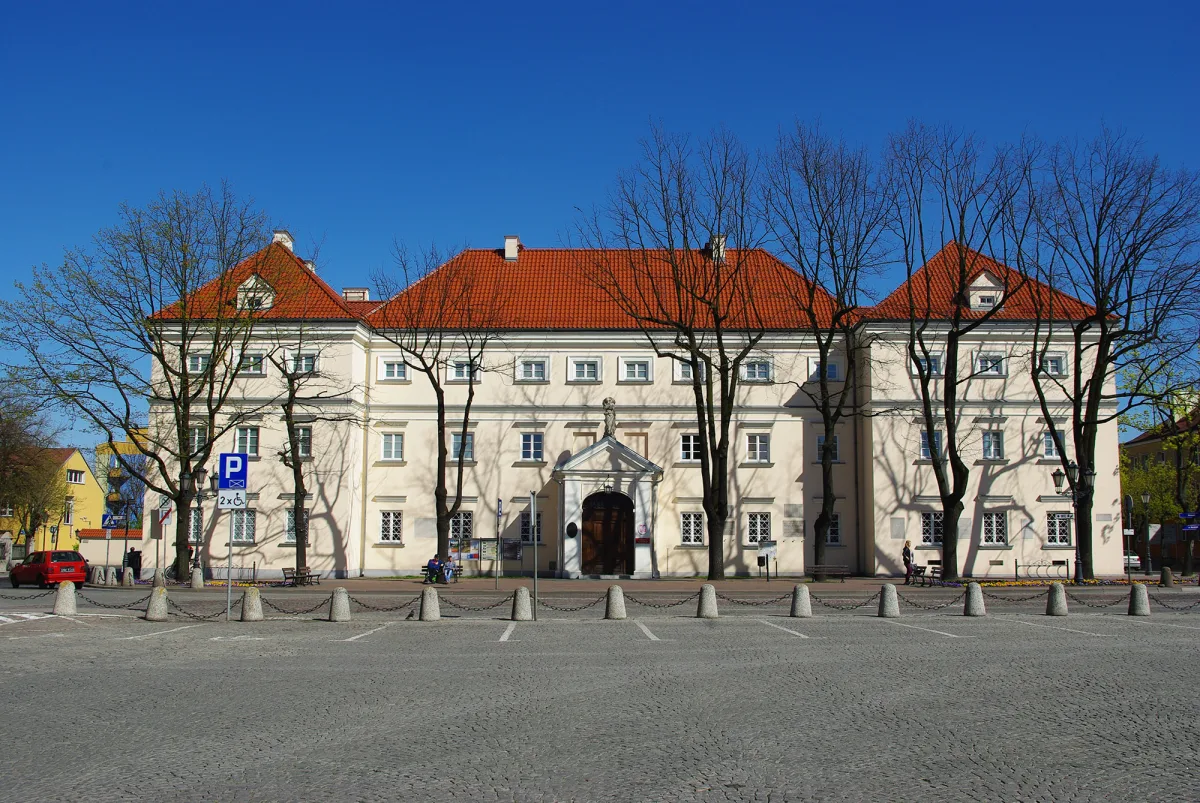
The easiest way to see traditional Łowicz costume is at the Museum in Łowicz, which has a permanent exhibition devoted to regional folk art, while folk costumes appear in real life during holidays and fairs at the Old Market Square.
It is worth combining the visit with the rest of Łowicz's historic sites - the town packs quite a few into the small area of its old town, including the unusual Button Museum.
What else to see in Łowicz
A walking tour of the old town usually passes the cathedral basilica and the ruins of the Primate's Castle - both places linked to the city's centuries-long history as a residence of the Primates of Poland. It is a good opportunity to also discover Łowicz's cultural offer, including regular weaving and paper-cutting (wycinanka) demonstrations held in the town. More ideas for exploring the region can be found among the attractions of the Łódź voivodeship.
Be the first! Add a comment.
You need to log in to add a comment.
Log in