
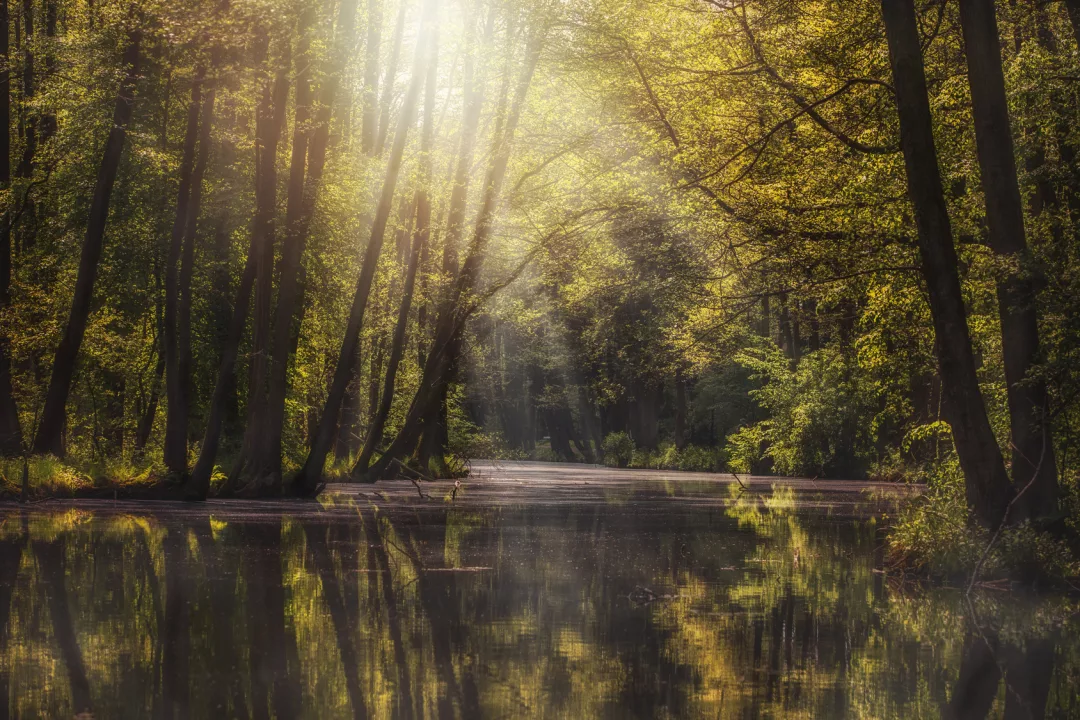
A few kilometres from the centre of Tomaszów Mazowiecki, on the border with Smardzewice, water flows out of the ground at a constant temperature of around 9 degrees Celsius. In summer it feels cold, in winter - warm. It never freezes, and on frosty mornings steam rises above the surface. This phenomenon draws visitors to the Niebieskie Źródła Nature Reserve all year round, not just in summer.
Why this water never freezes
Niebieskie Źródła are karst springs - places where groundwater rises to the surface under pressure, breaking through layers of sand and limestone. The water here comes from deep Jurassic deposits, isolated from fluctuations in air temperature, which is why it holds almost the same value all year round. The steady inflow of water that is warm compared to its surroundings keeps the surface from freezing even in temperatures well below zero.
Where the blue colour comes from
The colour that gives the reserve its name is an optical effect, not pollution or dye. The water in Niebieskie Źródła is exceptionally clear and deep at the points where it emerges, and the sandy bottom scatters light in a way that, to the eye, produces an intense shade of blue, especially on a sunny day.
The legend of the Swedish soldiers
In 1935 the ethnographer Jan Piotr Dekowski recorded a local legend about the origin of the springs. According to it, during the Swedish Deluge soldiers were said to have desecrated a roadside shrine standing on this spot: riding their horses onto the holy site and blaspheming. In response to this act, water was said to have burst from the ground to punish evil and cleanse the area. This is purely a folk legend - there is no historical evidence for the events it describes, and the scientific explanation of the phenomenon is purely geological, as described above.
Who lives in the reserve
Niebieskie Źródła is a reserve of both inanimate and living nature at once. More than 400 plant species grow here, including moisture-loving species rare in the region, and the ice-free water attracts water birds in winter - around 70 species have been recorded, some of which winter here precisely because they have somewhere to feed in freezing weather. For birdwatchers this is one of the more interesting spots in the voivodeship outside the summer season, when most nature reserves stand empty.
What else to see nearby
The reserve lies on a route worth stretching into a full day out. A few hundred metres away, on the Smardzewice side, are the Małe Groty (Small Caves) and the former Tomaszów Mineral Resource Mines "Biała Góra" - former sand excavation pits that over time became a popular viewpoint and place for walks. In Tomaszów Mazowiecki itself you can also visit the Groty Nagórzyckie (Nagórzyckie Caves), an underground labyrinth dug by hand by former sand miners, and the Pilica River Open-Air Museum, which explains the landscape of the valley through which this river flows. Together they give a full picture of why the area around Tomaszów is one of the more interesting natural corners of the Łódź region.
How to get there and visit
The reserve is located on the border of Tomaszów Mazowiecki and Smardzewice; getting there by car or bicycle takes about fifteen minutes from the city centre, and there is also a footpath from Spalska street. The reserve area is small - a walk along the marked wooden boardwalks takes 20-30 minutes, and together with the nearby attractions it is worth setting aside half a day for the area. Admission to the reserve is free, and visitors must stay on the marked paths only - this is a protected area, not a place to swim despite the tempting colour of the water. The best views come on a sunny, frosty morning, when steam rises above the springs, and on a windless day in summer, when the water is at its clearest. It is worth checking the current status of the boardwalks before your visit, as they are sometimes temporarily closed after heavy rainfall.
The whole route - Niebieskie Źródła, Groty Nagórzyckie and the Pilica River Open-Air Museum - can also be treated as one of the better ideas for a weekend trip from Łódź, described in more detail in the Poznaj Łódź section.
Be the first! Add a comment.
You need to log in to add a comment.
Log in