
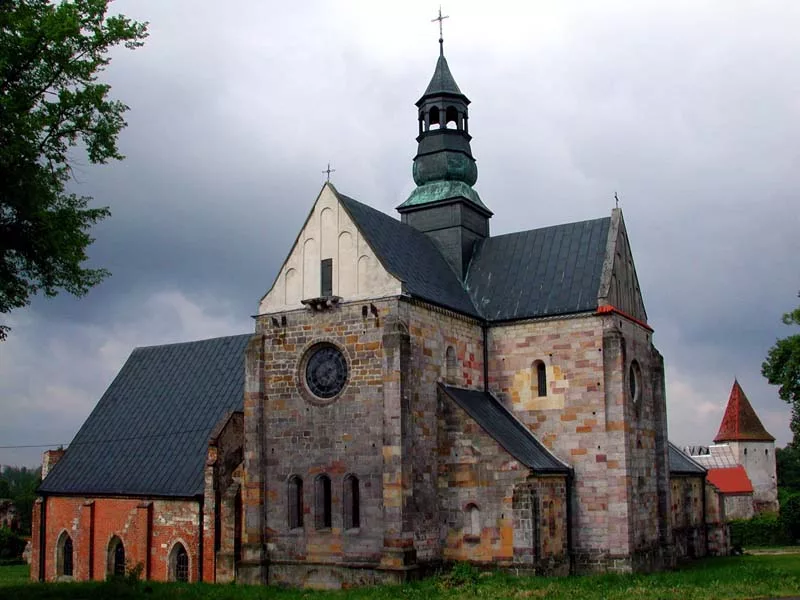
On the banks of the Pilica river, in the small town of Sulejów, stands a monastery complex that breaks a rule observed across the whole Cistercian order. As a rule, the monks avoided fortifications - their monasteries were meant to be places of prayer and work, not defence. In Sulejów, however, history forced an exception, and it is precisely thanks to this that the abbey has survived to our times in such good condition.
Who founded the abbey in Sulejów, and when
The abbey was founded in 1176 by Duke Kazimierz Sprawiedliwy (Casimir the Just), who brought in monks from Morimond in France - one of the four main mother houses of the Cistercian order in Europe. The site chosen lay by a crossing point on the Pilica, which mattered both economically and strategically - it was this location that later decided the monastery's fate.
The complex consists of a late Romanesque church and monastery buildings, including the surviving east wing of the cloister with a sacristy and chapter house. The whole was built in stages over several generations of monks, which can still be seen today in the stylistic differences between the various parts of the complex.
Why the monastery in Sulejów was surrounded by walls
The Cistercian rule forbade fortifying monasteries, but the reality of the Sieradz-Łęczyca region in the Middle Ages was brutal. The Tatar invasion of 1259 seriously damaged the buildings, and further threats - including subsequent invasions - meant that in the 14th and finally the 15th century the monks decided to build defensive walls with towers. This is the only such case among Polish Cistercian abbeys - no other monastery of this order in the country has its own full-fledged fortifications.
The walls, with six towers and bastions, gave the monastery a real chance of surviving the centuries of wars that followed, including the Swedish Deluge, which laid waste to many other historic sites in the region. Still standing today are, among others, the Baszta Mauretańska (Moorish Tower) and the Baszta Opacka (Abbot's Tower), and next to the walls survives a former arsenal from the turn of the 16th and 17th centuries.
What can be seen in Sulejów today
A visit takes in the Romanesque monastery church, fragments of the cloisters, the chapter house, and a walk along the defensive walls with their towers - for anyone used to typical, "open" monasteries, this is an unusual and clearly visible combination of sacred and military architecture. Part of the former monastery buildings has been adapted into a hotel with a restaurant serving dishes inspired by monastic cuisine, so a visit can be combined with a longer stay, not just a short tour.
In the area it is also worth visiting other sacred historic sites of the Łódź region - Sulejów fits well into a route together with the castle in Łęczyca or Piotrków Trybunalski, the closest larger town from here. More similar topics from the region's history can be found in the Poznaj Łódź section, and other sites in the area on the historic sites of the region page.
How to plan a trip
Sulejów lies about an hour's drive south of Łódź, close to Piotrków Trybunalski, which makes it easy to combine both destinations in a single trip. Touring the abbey with its defensive walls usually takes an hour to an hour and a half. Admission to the monastery grounds is sometimes charged, at a modest amount, though it is worth checking the current opening hours and guide availability before setting off, since the monastery still also serves religious functions.


Be the first! Add a comment.
You need to log in to add a comment.
Log in