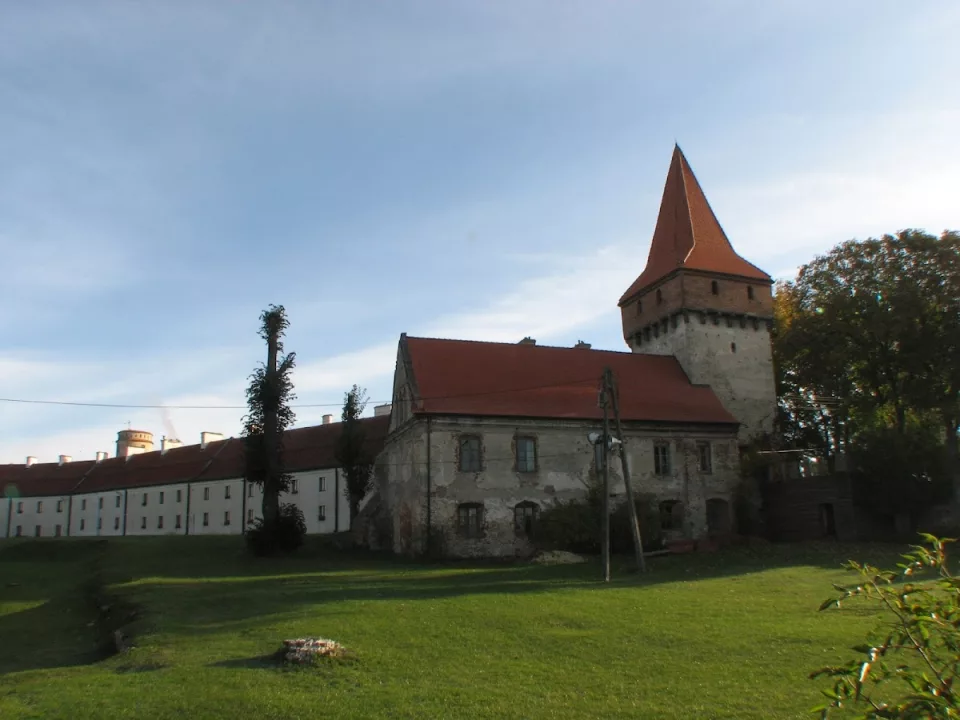
This late Gothic, square tower from around 1500 guards the eastern stretch of the Cistercian abbey walls, linked by a passage to a neighbouring arsenal building.
Baszta Opacka is a late Gothic defensive tower from the 15th/16th century, one of six surviving towers of the walls of the Cistercian Abbey in Sulejów in Podklasztorze. It has a rectangular plan and stands at the eastern section of the monastery's fortifications.
The lower parts of the tower were built from stone, the upper parts from brick, which is typical of the staged expansion of the abbey's walls over several centuries. On the eastern side are loopholes, openings for shooting, which testify to the purely defensive function of the structure. Next to the tower stands an armoury from the 16th/17th century, connected to it by a passage in the wall.
The monastic complex in Podklasztorze was founded in 1176 by Duke Kazimierz the Just, who brought the Cistercians to Sulejów. The defensive walls, including Baszta Opacka, were built in subsequent centuries, among other things in response to the threat of Tatar raids. The abbey in Sulejów is considered the only fortified Cistercian monastery in Poland with such well-preserved medieval fortifications.
Besides Baszta Opacka, five other towers of the monastery walls have survived to this day: the rectangular Baszta Rycerska, the older semicircular Baszta Mauretańska, the 34-metre Baszta Krakowska, as well as Baszta Attykowa and Baszta Muzyczna. Together they form one of the better-preserved defensive complexes of sacred architecture in the region.

Be the first! Add a comment.
You need to log in to add a comment.
Log in