
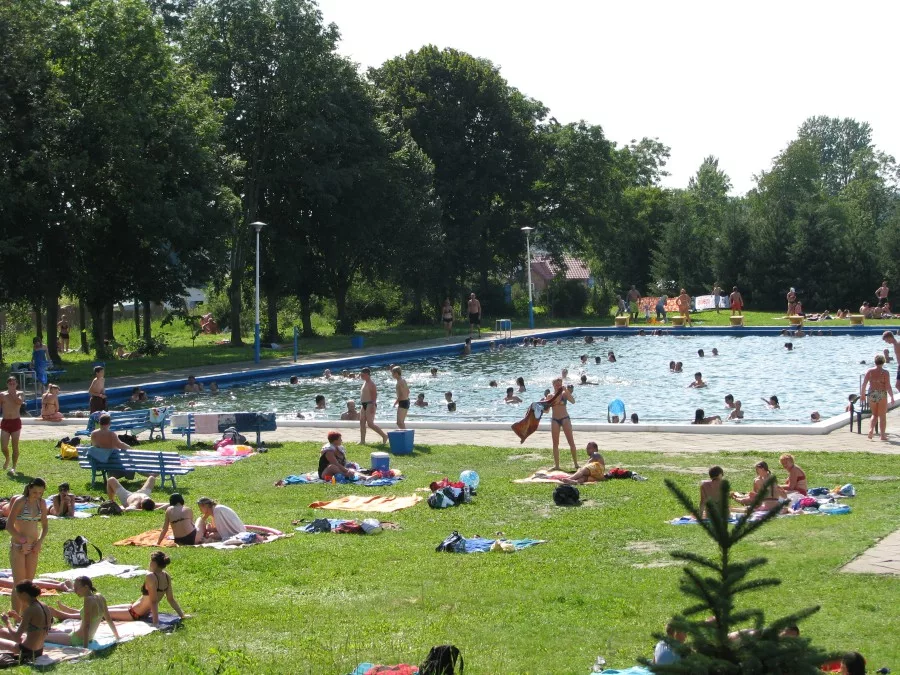
Poddębice lies less than 20 kilometres from Uniejów and, like its neighbour, owes its current tourist reputation to geothermal water. In 2010, deposits of hot water reaching 72 degrees Celsius at the source were discovered near the town - a discovery that in the following years turned this small town into another point, alongside Uniejów, on the thermal map of central Poland.
Where the hot water came from
As in many other places in central Poland, the geothermal waters in Poddębice were not found with tourism in mind from the start, but during geological surveys and research into deep water-bearing layers. Water at a temperature of 72 degrees Celsius, drawn from a depth of over two kilometres, eventually reached the Termy Poddębice complex, which has become the town's main attraction and the hub around which the rest of the offer has grown - from swimming pools to a spa zone.
A graduation tower and a seaside microclimate without the trip to the coast
In December 2022 a brine graduation tower was built next to the thermal complex. The structure of blackthorn branches, over which brine trickles down, creates around itself a microclimate saturated with tiny particles of salt and trace elements - similar to the one found naturally by the sea. Structures of this kind have long been used to help prevent and support the treatment of upper respiratory tract conditions, and walking around them is one of the more popular, free forms of relaxation at brine spas across Poland. In Poddębice the graduation tower stands next to the Pijalnia Wód Termalnych (Thermal Water Pump Room), where besides walking you can also taste the mineral water straight from the source.
Why this is a different story than at traditional spas
Classic Polish brine spa towns, such as Ciechocinek or Iwonicz-Zdrój, have developed graduation towers since the 18th and 19th centuries, when they served above all to concentrate brine for salt production - only later, as balneology developed, were their healing qualities recognised and walking infrastructure built around them. Poddębice took a different path: here the graduation tower is not a relic of an old salt industry, but part of a modern, deliberately planned tourist and spa complex, built from scratch around the geothermal water discovered in 2010. This is a difference worth knowing before comparing Poddębice to much older spa towns on the Vistula.
What else to see in Poddębice and the area
In the town itself it is worth noticing the mural "Termy Poddębickie", which has become an unofficial symbol of the town's new identity as a geothermal spa. A visit can easily be combined with a trip to nearby Uniejów, where a similar, older and larger thermal complex operates on comparable geothermal waters, alongside the castle of the Archbishops of Gniezno - together the two towns form a convenient, one-day thermal route around the region.
In practice
Poddębice lies in the western part of the Łódź region, about an hour's drive from Łódź. A walk around the graduation tower and the pump room takes about half an hour and is free, while entry to the pools and the spa zone at the Termy Poddębice complex is paid, with prices depending on the time of day and season - it is worth checking directly before travelling. For families with children it is one of the more convenient attractions in the region for the youngest visitors, thanks to pool zones suited to different ages. You will find more ideas for trips around Łódź in the Poznaj Łódź (Discover Łódź) section.
Be the first! Add a comment.
You need to log in to add a comment.
Log in