

The world is changing before our eyes, and today's technology can amaze many. Thousands of scientists from around the world are working on better and more efficient solutions. Soon we may be in for another technological revolution – and it's all thanks to graphene. As it turns out, Łódź scientists may also have a contribution to make.
Why is graphene so extraordinary?
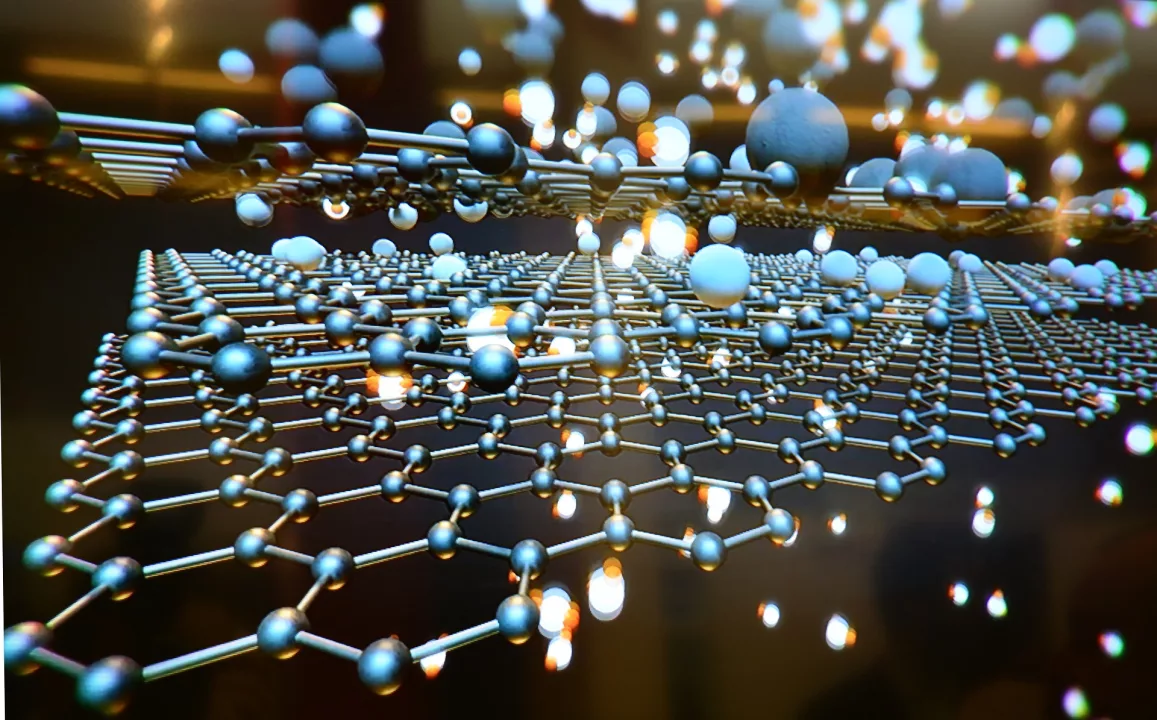
It may seem to some people – and the media bears responsibility for this – that graphene was, so to speak, invented relatively recently. However, it must be remembered that the theoretical description of graphene was created as early as 1947. Only after more than half a century passed (in 2004) did scientists from Georgia and Manchester manage to produce graphene. Why did scientists become so determined to study and manufacture something that is essentially just another allotropic form of carbon (alongside graphite or diamond)? It turned out that graphene has extraordinary properties. First – it is an excellent conductor of heat. Second – it has extremely small dimensions; "individual" graphene is a lattice resembling a honeycomb. Its thickness can be compared to the thickness of... a single atom. Additionally, this same single-atom layer is extremely durable. We also cannot forget about excellent electrical conductivity (graphene is estimated to be dozens of times more efficient than silicon in this regard) and the material's elasticity. What does all this mean? Graphene is an ideal material for use in the computer industry and the broadly understood technology sector. Graphene would effectively improve and speed up the operation of many devices. This applies above all to processors – those that would be built from graphene would be significantly faster than current silicon ones. Initially, graphene production was extremely costly, and after the material's properties were determined, it was even considered the most expensive material on earth (the cost of producing a square centimeter was estimated at around 100 million dollars).
Polish (and Łódź) contribution to graphene
Research on graphene also includes contributions from Poles, specifically two teams – one from Warsaw (Institute of Electronic Materials Technology together with the Faculty of Physics at the University of Warsaw) and another from Łódź (Łódź University of Technology). The Łódź team presented a particularly interesting invention intended to serve graphene production from the liquid phase. Thanks to the device, it would be possible to produce graphene in large-scale flakes, and moreover, in quality close to theoretical assumptions. The product was named HSMG. The graphene production method developed by the Łódź scientists was patented and received protection in the USA and throughout the European Union. Time will tell whether it is thanks to the Łódź scientists that graphene production will turn out to be as fast and efficient as ever before.



Be the first! Add a comment.
You need to log in to add a comment.
Log in