
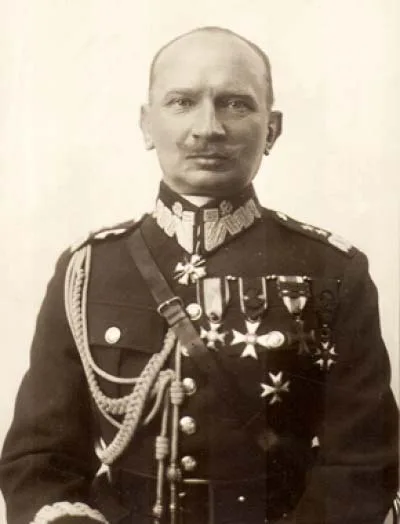
Army “Łódź” was one of eight main operational formations of the Polish Army prepared to defend the country against German aggression. It was formed on 23 March 1939, and command was taken by Gen. Div. Juliusz Rómmel. It comprised four infantry divisions (the 2nd, 10th, 28th and 30th), two cavalry brigades (Wołyń and Kresy) and the Sieradz National Defence Brigade - in total 34 infantry battalions, 29 cavalry squadrons, about 170 guns, 50 tanks, two armoured trains and 55 aircraft.
What did the first days of the war look like in the region?
The Germans crossed the border on 1 September 1939, at around 3:45-4:00 am. Army “Łódź” covered a wide belt of territory west and south of the city, among others in the area of Łask and Pabianice, where some of the heaviest fighting of the war's first days took place.
The defence of Pabianice
In Pabianice, defenders included the 15th “Wilków” Infantry Regiment under the command of Maj. Józef Ratajczyk, part of the 28th Infantry Division subordinated to Army “Łódź”, as well as the 28th Light Artillery Regiment and further infantry regiments. Despite inflicting serious losses on the Germans - at least 70 German soldiers killed - the exhausted and depleted Polish units received the order to withdraw. The regiment left the city on the evening of 7 September, at around 9:00 pm.
Why was the city of Łódź itself taken without a fight?
On 4 September, Gen. Rómmel pressed for offensive action on the flanks, and on the morning of 5 September the fighting along the Warta river reached its climax. That same evening an order to withdraw was issued - German units had already partly outflanked Army “Łódź”, isolating part of the commander's forces from the rest of the grouping. As a result, the city itself was taken by the Germans on 8 September 1939 practically without a fight - most of the troops defending the region had withdrawn earlier to lines further east, rather than defending the built-up centre.
What happened to the army afterwards?
The withdrawing units of Army “Łódź” were directed toward the crossings on the Vistula, and part of the forces eventually reached the Modlin Fortress, which held out until 28 September 1939. After the difficult retreat, command over the remnants of the army was taken over by Brig. Gen. Wiktor Thommée. Despite the defeat, the soldiers of Army “Łódź” effectively delayed the German advance for the first week of the war, despite the enemy's overwhelming superiority in armour and aircraft.
What commemorates these events today?
Several monuments dedicated to the defenders of September 1939 survive in the Łódź region, among others in Brzeziny, a town lying on the eastern approaches to Łódź, through which the defence line also ran.
Where to look for traces of the fighting today?
Plaques and monuments commemorating the defenders of 1939 can be found in several towns around Łódź, among others in Pabianice and Brzeziny, a dozen or so to several dozen minutes' drive from the centre of Łódź. All are accessible free of charge year-round.
More about the events of September 1939 in the region can be read in other articles in the Discover Łódź section, including about the Battle of the Bzura, the bombing of Wieluń and the Battle of Mokra.
Be the first! Add a comment.
You need to log in to add a comment.
Log in