
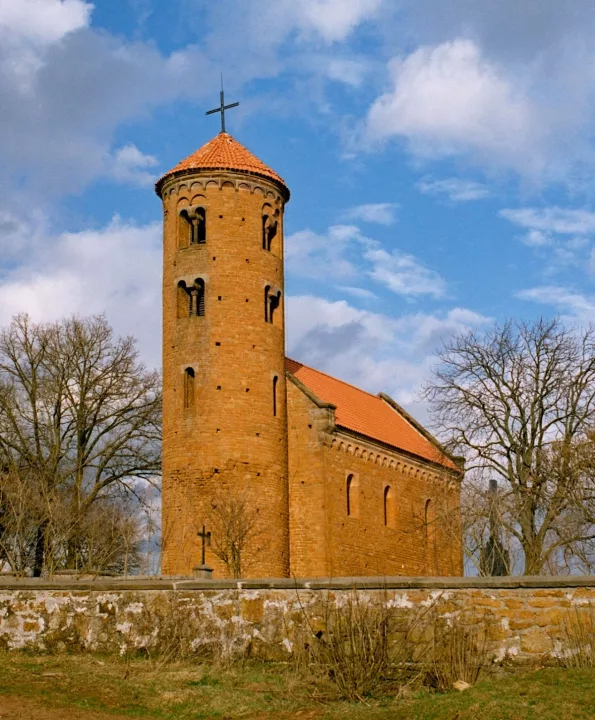
Inowłódz is today a small town on the Pilica river, known mainly for its holiday character and proximity to Spała. Few people driving past to the river in summer realize they are passing the oldest surviving church in the entire Łódź region - a building nearly a thousand years old.
A church meant as thanks for a son
According to the chronicle of Jan Długosz, the Church of St. Giles in Inowłódz was built in 1086, funded by Duke Władysław Herman. Legend has it that the ruler, long childless, prayed for an heir through the intercession of Saint Giles - patron saint of childless couples. When a son was born to him in 1086, the future Bolesław the Wrymouth, he founded a church dedicated to that very saint in gratitude.
Historians do not fully agree on the exact date the building was constructed - some researchers suggest the church may have been built only during the reign of Bolesław the Wrymouth himself, rather than his father. Regardless of whether the founder was Herman or his son, the story of a votive offering for the birth of a king remains a legend in the sense that it cannot be conclusively verified from sources today - but it is precisely this story that has given the place its special status for centuries.
A church that was also a fortress
The Romanesque Church of St. Giles was built with defence in mind, not just prayer. Thick stone walls, small, high-set windows, a narrow entrance door that could easily be barricaded, and a tower serving as an observation point - all of this meant that in case of danger, the building could serve as a shelter for the local population. This kind of architecture, combining the sacred with a real need to survive raids, was typical of the oldest brick and stone churches in Polish lands.
Originally the building had a single nave - its present, somewhat more elaborate shape is the result of later rebuilding. The monastery attached to the church was destroyed by Tatars raiding the region in 1241, but the church itself survived. From the 16th century it fell into neglect, before undergoing a series of renovations in later centuries - in 1790, 1911 and 1938, with interruptions forced by wars.
The castle next to the church - a different era, the same story of power
A few hundred metres from the church, above a ford on the Pilica river, Casimir the Great built a castle that served both a practical and a fiscal purpose - it protected the river crossing and allowed tolls to be collected from merchants passing along this route. The building suffered during the Swedish Deluge, and after the destruction, local people gradually dismantled it for building material, a common practice at the time for abandoned strongholds.
Today the castle ruins are partly restored - conservation works, largely financed from EU funds, have secured the surviving wall fragments and opened them to visitors.
What's worth seeing along with the church
Inowłódz lies in a picturesque bend of the Pilica river, so a walk between the church and the castle is worth combining with a short trip down to the river itself - the Pilica valley here is one of the most attractive stretches of the river in the region, with sandy banks and views of the surrounding forests.
Visiting the church and the castle ruins is free or involves a symbolic fee, depending on whether you happen to visit on a day when the church interior is open - worth checking before arrival, as the church is mainly accessible during services. The whole route takes about an hour, longer if you add a walk by the river. A full list of the town's historic sites can be found on the Inowłódz page, and more of the region's history in the "Poznaj Łódź" (Discover Łódź) series, linked from here.

Be the first! Add a comment.
You need to log in to add a comment.
Log in