
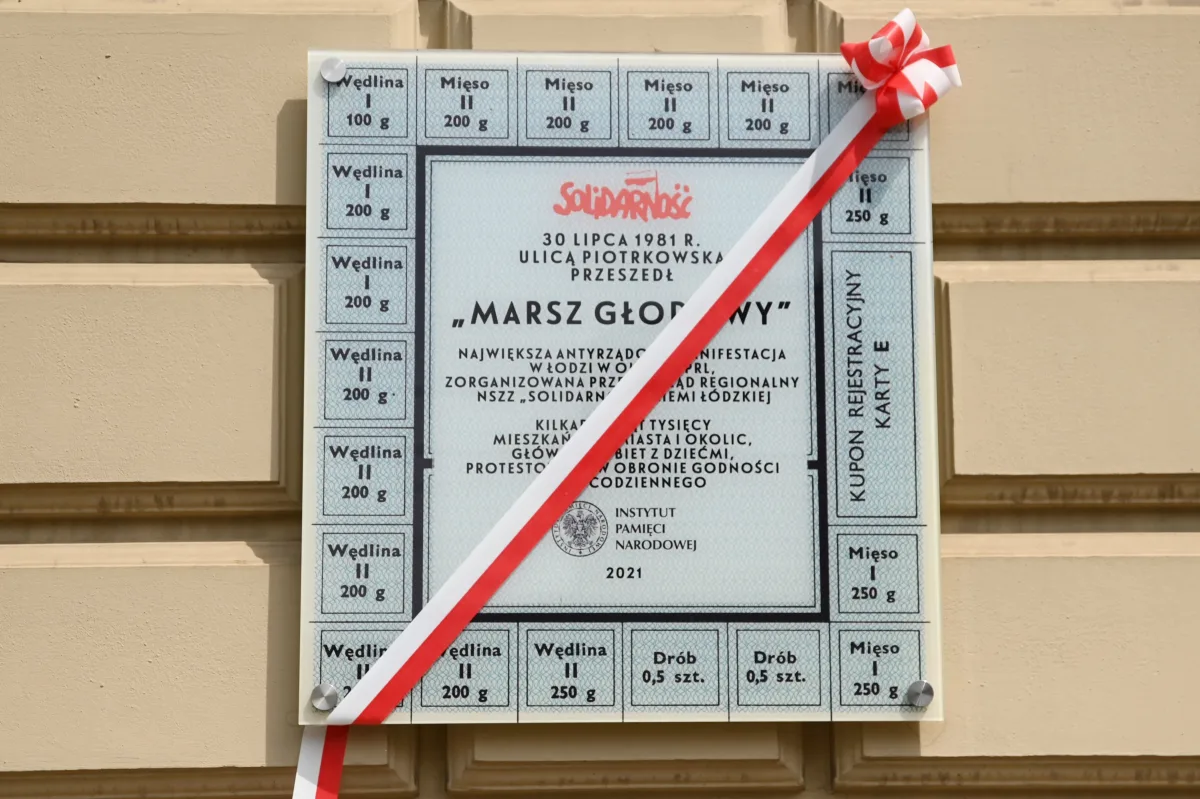
In the summer of 1981, shops in Łódź, like those across Poland, stood empty. There was a shortage not only of meat, which had been rationed for months, but also of bread, dairy, milk for children, and even toilet paper and sanitary pads. In a city where most people employed in industry were women working in textile factories, the supply crisis hit especially hard - it was they who, in practice, took on the daily task of getting food for their families, standing in hours-long queues after work.
How did the march of 30 July 1981 come about?
The protest was organised by the independent trade union NSZZ "Solidarność" together with the city's residents, frustrated by weeks of empty shelves. The gathering point became the square in front of the Łódź cathedral - the Bazylika archikatedralna św. Stanisława Kostki (Archcathedral Basilica of St Stanislaus Kostka) on plac Katedralny.
From there the crowd set off toward the city centre, passing along Piotrkowska street - the city's main artery, halting all car traffic there for several minutes. The march stopped at the City Hall, where a rally was held, and ended at plac Wolności (Freedom Square).
How many people took part in the protest?
The exact number of participants varies depending on the source. Historians estimate it at more than 40,000 people, trade unionists from that time spoke of as many as 50,000-100,000, while the Security Service (SB) understated the number of participants in its reports to 10,000-20,000. Regardless of which estimate is closest to the truth, one fact is confirmed across the board: around 85 percent of participants were women - mostly workers from the Łódź textile plants.
How did the march unfold and how did it end?
The demonstration was peaceful and passed without major incidents - there were no clashes with the militia and no forceful intervention, which in the realities of communist Poland was far from a given. Participants carried banners about shortages in supplies, food rationing and the living conditions of working-class families. The Hunger March in Łódź was one of the largest protests of its kind in the whole country between the Solidarity strikes of August 1980 and the imposition of martial law in December 1981.
The event forms part of a chain of social tensions that in the following months led to martial law. For the residents of Łódź, however, it became above all evidence that women working in factories were able to organise and take to the streets in defence of basic living conditions - just as they had done a decade earlier, in February 1971, during the strike of the Łódź textile workers.
How is the event commemorated today?
In July 2021, on the fortieth anniversary of the march, a memorial plaque was unveiled along the route of the march, recalling this protest and the social resistance to the shortage economy. Anniversary observances are usually held in late July - it is worth checking current dates in the city's events listings.
Where can you walk the march route today?
The 1981 route - from plac Katedralny, along Piotrkowska street, to plac Wolności - is today one of the most frequently visited stretches of the city centre of Łódź. The whole walk, without stopping, takes about 40-50 minutes, but it is easy to spend several hours along the way, since it passes dozens of townhouses, shops and eateries. It is worth combining it with a visit to the cathedral, which is open daily, though sightseeing can be limited during services.
More on the history of Łódź in the communist era can be read in other articles in the Poznaj Łódź (Get to know Łódź) section, and a list of other atmospheric places in the city centre can be found in the attractions catalogue.

Be the first! Add a comment.
You need to log in to add a comment.
Log in