
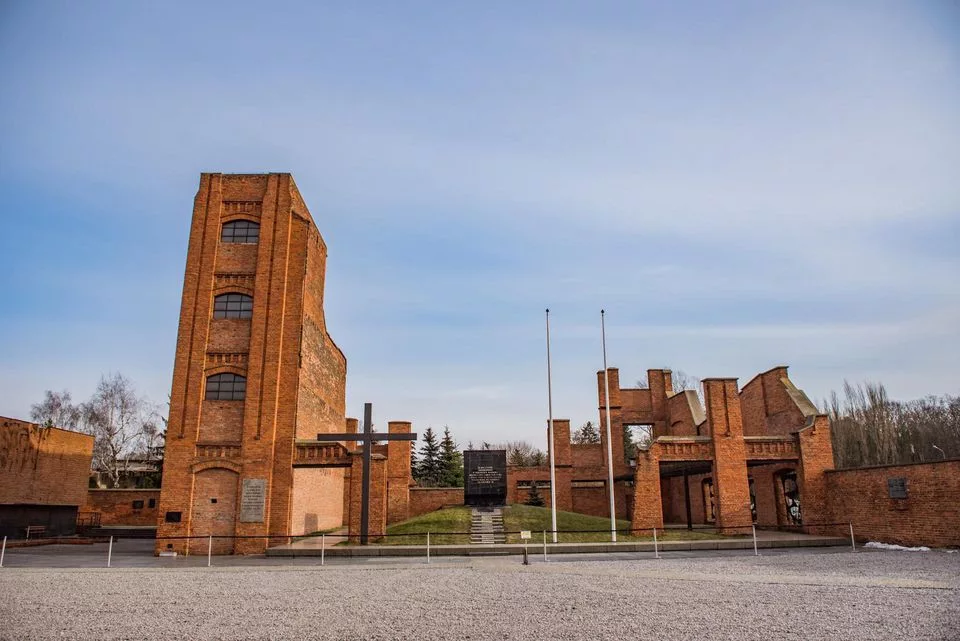
The prison in the former spinning mill at Radogoszcz, in the northern part of Łódź, operated from the first months of the occupation. Poles suspected of underground activity, hostages taken after attacks on Germans, and people rounded up in street raids were sent there. In January 1945, as the front approached the city, the cells held, according to various sources, anywhere from just over a thousand to nearly two thousand people.
On 17 January 1945 the Red Army took Warsaw, and Soviet troops were already only a few dozen kilometres from Łódź. The German city administration began evacuating. No one planned to evacuate the prison at Radogoszcz along with its staff - the decision was made to liquidate the prisoners on the spot.
What exactly happened that night?
On the night of 17 to 18 January, past midnight, SS men entered the cells. They shot and stabbed prisoners with bayonets, room by room. Some of those held on the upper floors tried to defend themselves with bricks and boards torn from the floors. In response, the Germans set the building on fire in the early hours of 18 January. People fleeing the flames and gunfire took shelter on the roof and in a fire-fighting water tank.
The fire and executions continued into the early morning. A dozen or so hours later the Red Army entered the city - Łódź was taken on 19 January 1945, practically without fighting and without major destruction in the centre. Radogoszcz was one of the last acts of the occupation.
How many people died that night?
Sources give a figure of about 1500 killed. After the war a list of victims' names was compiled, covering over 1200 people - some of the murdered could never be identified, because the bodies burned or the prison records were lost in the fire. The exact number of prisoners held in the building that night is not known precisely, which is why different studies give similar but not identical figures for the victims - they fall in a range from about 1500 to just under 2000.
About 30 people survived the fire and the executions. Some of them survived by managing to hide in the water tank or get out through the roof of the building, before help arrived from the residents of Radogoszcz and the advancing Soviet soldiers.
Who were the prisoners?
Among the murdered were activists of the independence underground, but also people detained by chance - during street round-ups or under collective responsibility for the actions of the resistance. The prison at Radogoszcz was subordinate to the German security police, and in the last months of the occupation decisions on the treatment of prisoners were issued by Wilhelm Koppe, the Higher SS and Police Leader in the occupied Polish territories.
What can be seen on the site of the crime today?
The site of the former prison became a memorial site as early as the spring of 1945. In 1961 a mausoleum was unveiled - a symbolic burial mound with a black sarcophagus and a thirty-metre obelisk, visible from a distance along Zgierska street. Since 1976 a museum devoted to the history of the prison and the occupation of Łódź has operated in part of the surviving factory buildings.
The exhibition shows the conditions in which prisoners were held, along with documents and survivors' accounts. It is a branch of the museums operating today in Łódź as part of the Muzeum Tradycji Niepodległościowych (Museum of Independence Traditions) - the same institution that also runs the branch at the former Stacja Radegast (Radegast Station), from where residents of the Łódź ghetto were deported to death camps.
Nearby, on the same Zgierska street, is the parish cemetery of St Roch - some of the Radogoszcz victims and other people murdered in this area during the occupation were buried there.
How to visit the memorial site today
The mausoleum and the grounds in front of the building are open without restrictions and can be seen at any time of day. Entry to the museum section is usually free or requires a symbolic fee - it is worth checking the exact opening hours and any charges before visiting, as they can change. Viewing the exhibition itself takes 30 to 60 minutes, and a walk around the mausoleum grounds takes a dozen or so minutes more.
The site lies in the Bałuty district, a few kilometres from the centre of Łódź, on the main road out of the city towards Zgierz. Every year on the anniversary of the crime, in mid-January, official ceremonies are held here to commemorate the victims - the dates of these observances can be checked in the city's events listings.
Anyone who wants to go deeper into the occupation-era history of Łódź should also see the other memorial sites in the city and the Poznaj Łódź (Discover Łódź) section, with other texts about the city's history from 1939-1945.
Be the first! Add a comment.
You need to log in to add a comment.
Log in