
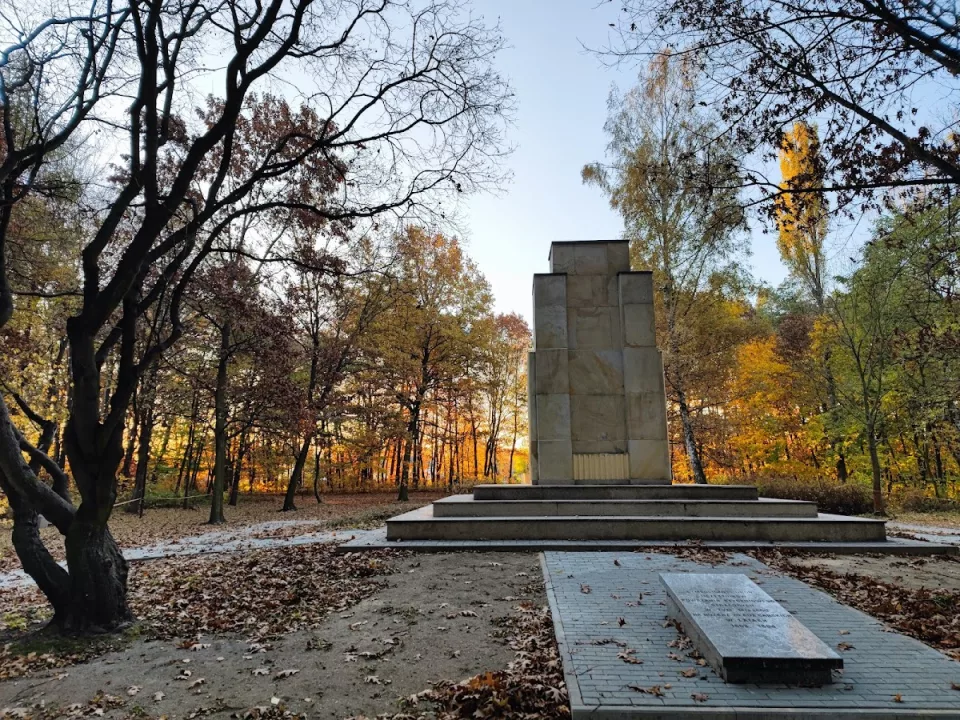
The January Uprising, which broke out in January 1863, also reached the lands of today's Łódź region. According to historians, more than a hundred battles and skirmishes were fought here, from small patrol clashes to engagements involving several hundred people on each side. Two of these episodes, fought a month apart, show well how differently the course of insurgent fighting could unfold within the same region.
The Battle near Dobra, 24 February 1863
Near Dobra, about 10 kilometres from Łódź, an insurgent group of roughly 300 people was surrounded by Russian forces. Despite two brave counterattacks by scythemen (kosynierzy), the battle ended in defeat: 63 Poles were killed, including 17 from Łódź.
Who was Maria Piotrowiczowa?
Among those killed near Dobra was Maria Piotrowiczowa, a 24-year-old teacher from Chocianowice near Łódź, today a district of Łódź. Together with her husband Konstanty she ran an elementary school, and when the uprising broke out, both joined the unit of Józef Dworzaczek. Maria, despite being pregnant again, chose to fight in the regular ranks rather than only take on support roles. According to accounts, she defended to the end the banner given to the insurgents by the women of Łódź, fighting with a scythe and a revolver; she was killed, stabbed by bayonets of Russian soldiers.
The skirmish near Radoszewice, 27 March 1863
A month later, on the night of 26 to 27 March, an insurgent unit commanded by Col. Teodor Cieszkowski reached the village of Radoszewice (today in Pajęczno County, next to Wieluń), exhausted by a forced march. The soldiers were quartered there to rest. The local landowner and ethnographer Ludwik Niemojowski, tied to the independence movement, supported the insurgents at the time.
Around 10:00, two rifle companies and a Cossack squadron under Major Pisanka arrived at Radoszewice. The insurgents put up determined resistance; riflemen commanded by Capt. Teofil Skalski held off the Russian assault. Unlike the clash near Dobra, the skirmish near Radoszewice and Kiełczygłów ended in a Polish victory.
Why it is worth knowing these two clashes together
Set side by side, the battle near Dobra and the skirmish near Radoszewice show that the January Uprising in the Łódź region was neither an unbroken chain of defeats nor a series of heroic victories: it was a guerrilla war in which the outcome of a single clash depended on surprise, numbers and terrain, not only on the fighters' determination. Both stories, however, share the same context: local gentry, teachers and peasants from the region who decided to take up arms against the Russian administration.
What commemorates these events today?
Dobra and Radoszewice themselves have no extensive tourist infrastructure related to the uprising today; these are small localities where the memory of the events of 1863 is kept alive mainly through local anniversary observances. In the region, however, one can see the Monument to the Insurgents of 1863 in Wieluń, the town closest to the battlefield near Radoszewice.
How to plan a visit to the region
Dobra and Radoszewice lie in different parts of the region, the former right next to Łódź, the latter near Wieluń, so it is not really possible to combine them sensibly into a single day trip. It is best to treat them as separate stops when visiting each of these areas, supplemented with some background reading before setting out: the battle sites themselves are today ordinary fields and villages, with no marked memorial trails.
More about the region's 19th-century history can be found in other articles of the Poznaj Łódź (Discover Łódź) section, and a list of the region's historic sites and memorial places can be found in the attractions catalogue.
Be the first! Add a comment.
You need to log in to add a comment.
Log in