
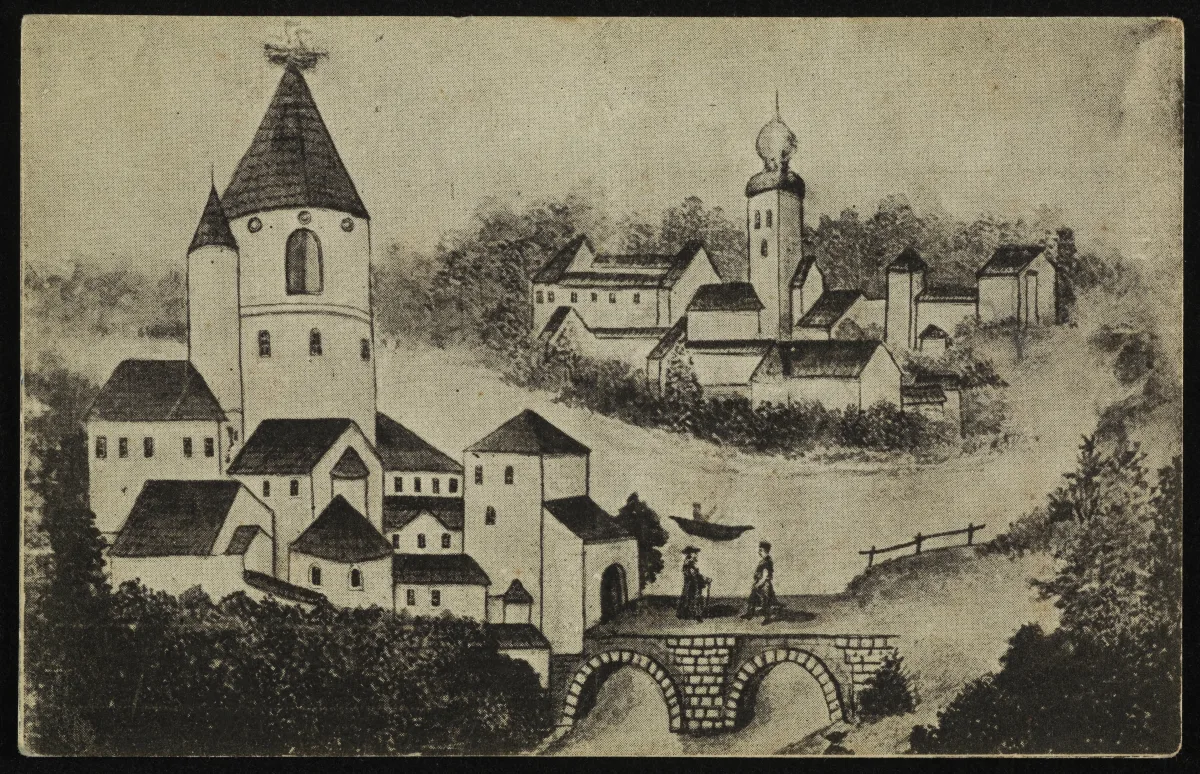
Before Łódź was even a village by a mill, Sieradz was already a town written about in Arab geographical treatises. Today it is a small county town, but for most of the Middle Ages it belonged to a handful of the most important places on the map of Poland - noble assemblies were held here, kings were chosen here, and a castle stood here whose history is just as turbulent as that of the whole country.
How do we know Sieradz is this old?
The oldest mention of Sieradz comes from 1136, in a document known as the Gniezno bull. Eighteen years later the town - under the name Sradja - appeared in the "Book of Roger", the great geographical work of the Arab scholar Al-Idrisi, written at the court of King Roger II of Sicily. Idrisi listed only six towns from what is now Poland, and Sieradz was among them, alongside Krakow, Gniezno and Wroclaw. It is this mention, still repeated today in the town's promotional materials, that lies behind the tongue-in-cheek slogan "Sieradz older than more than one record of Krakow" - it is not about the age of the settlement itself (Krakow is of course older), but about the fact that both towns appear on the same, very short medieval list.
Sieradz probably received town rights in 1247, though the exact date is not entirely certain - it is still one of the earlier town charters in this part of the country.
A stronghold that saw the Polish crown up close
The first stronghold on today's Castle Hill (Wzgórze Zamkowe) is thought to have been built as early as the reign of Bolesław the Brave, as a wooden fort. In the mid-13th century, under Duke Leszek the Black, a further, this time masonry, structure was built, and Sieradz became for a time a ducal seat. In 1331 the castle was seized and burned by the Teutonic Knights - a defeat the town needed decades to recover from.
Sieradz owes its rebuilding as a brick, Gothic stronghold to Casimir the Great, who erected a new castle here no later than 1357. It was then that the town experienced its greatest period of political significance: noble assemblies were held within the castle walls, and twice - in 1432, at the election of Władysław Warneńczyk, and in 1445, at the election of Casimir IV Jagiellon - the fate of the Polish throne was decided here. Few towns in the region can claim such a role in the history of the whole country.
How the castle disappeared from the town's landscape
The castle survived the following centuries, but its condition steadily worsened. In November 1655, during the Swedish Deluge, the forces of Charles X Gustav seized it without a fight and plundered it - after this invasion the stronghold never regained its former glory. Eventually, around 1800, the ruined castle was almost entirely dismantled for building material, as happened at the time to many decaying strongholds in the region.
Only one clear trace of the old building survives today: a decorated doorway, which in the 1920s was built into the wall of one of Sieradz's churches. The rest of the castle - foundations, cellars, the levels of the former structure - lies underground, with a park stretching above it today.
Castle Hill as a "museum in open space"
The site of the former castle has been developed in an original way - as the Park Kulturowy Wzgórze Zamkowy (Castle Hill Cultural Park), where the layout of the former stronghold, the moat and successive stages of development are marked directly on the ground, without reconstructing the walls from scratch. This is a rare solution nationally: instead of recreating the castle, its history is shown on plaques and in the layout of the greenery, letting visitors work out for themselves where the tower stood and where the gate was.
For anyone who wants to see concrete mementoes of the old town - militaria, documents, archaeological finds from Castle Hill - the natural way to round off the walk is the Muzeum Okręgowe w Sieradzu (Regional Museum in Sieradz), housed in a historic building in the town centre.
What else is worth seeing beyond the hill
The Sieradz market square (Rynek) has kept its medieval urban layout, even though most of today's buildings date from later centuries - it is a natural starting point for a walk through the historic centre, a few hundred metres from Castle Hill.
The whole route - from the market square, through the landmarks of the centre, to Castle Hill - is a walk of around an hour and a half to two hours, without rushing. Entry to the cultural park grounds is free, the museum usually charges a ticket price of a dozen or so zloty, and it is worth checking current opening hours before visiting. A full list of the town's landmarks and attractions can be found on the Sieradz page, and more topics like this from the region's history are in the Poznaj Łódź (Get to know Łódź) section.
Be the first! Add a comment.
You need to log in to add a comment.
Log in