
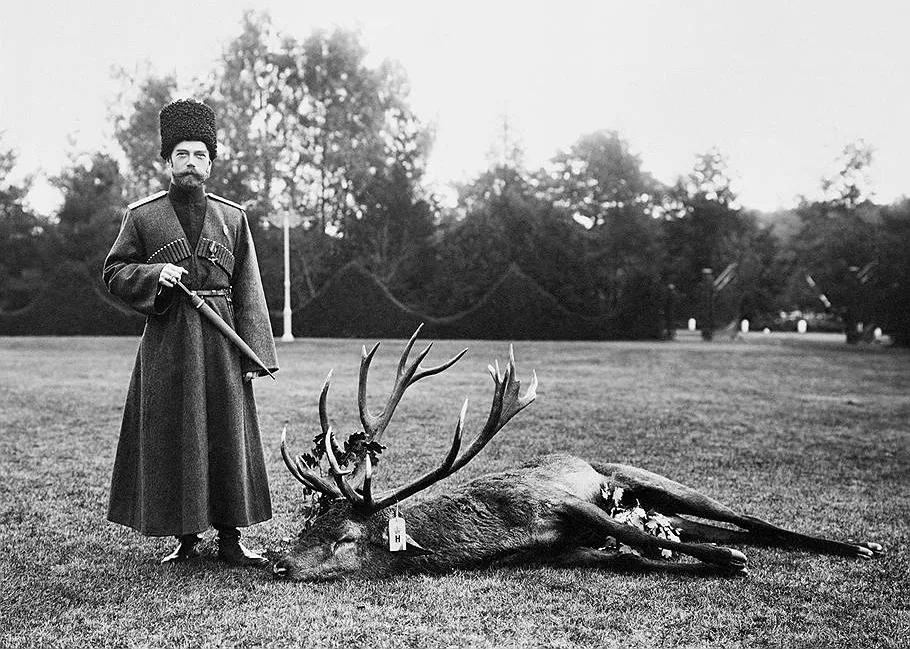
Spała is today above all a sports centre and a destination for trips on the Pilica river, but for over a hundred years it was a place of far greater importance - first a private hunting ground of the Russian tsars, then the official summer residence of the head of the reborn Polish state. Few towns in the Łódź region can boast such an unbroken presence at the very highest circles of power, and under two completely different political systems at that.
How Spała came into the tsar's hands
In 1880, Tsar Alexander III, hunting in the forests along the Pilica, was captivated by this stretch of woodland and decided to build a hunting residence here. The wooden palace, designed by the Kraków architect Leon Mikucki, was completed in 1885 - the tsar visited it for the first time that year, and afterwards returned regularly every two years for the autumn hunts during the deer rutting season.
Barracks for a squadron of Cossacks and a company of mounted rangers were built next to the palace, along with an officers' casino and guest houses - the residence had a status serious enough that access to the surrounding forests was banned, and the area was guarded by an armed squadron. The tsarist family - Nicholas II with his wife and children - visited Spała for the last time in 1912, shortly before the outbreak of the First World War, which closed this chapter of the town's history for good.
From tsarist retreat to presidential residence
After independence was regained in 1918, the former tsarist residence became the summer seat of the presidents of the Second Polish Republic. It was especially favoured by Ignacy Mościcki, for whom Spała was, between 1926 and 1939, almost a second Belweder - it was even called the most beautiful forester's lodge in Poland. It was on Mościcki's initiative that Spała began hosting the annual harvest festival and celebrations of the feast of Saint Hubert, the patron saint of hunters, continuing in a new, republican form the hunting tradition begun by the tsars.
The wooden palace itself burned down in 1945 and was never rebuilt, but the surrounding buildings of tsarist and presidential Spała have survived and can be seen today.
What survived of tsarist and presidential Spała
The Tsarist Tower still stands today, one of the most recognisable traces of the former residence, and nearby is the Tsarist Manor, a building that once accompanied the former palace complex.
From the presidential period, the memorial boulder of Ignacy Mościcki and a park named after him have survived, and at the House of Remembrance of the Struggle and Martyrdom of Polish Foresters and Woodworkers visitors can also learn about the wartime fate of this part of the Pilica Forest. The former tsarist coach house has also survived, a witness to the everyday functioning of the residence.
A forest that saw two political systems
It is rare for a single place in Poland to combine, so clearly, such different eras in its history - tsarist autocracy and the republican Second Polish Republic - and in the same role: a place of rest and hunting for the head of state. Today the site of the former hunting grounds is occupied, among others, by the Central Sports Centre, which continues the sporting, though now completely different, tradition of this place. For anyone interested in the region's history, Spała is one of the more interesting stops, because it shows how power in Poland changed over less than fifty years - from a tsar to a president elected by a national assembly.
How to visit Spała today
Spała lies about an hour's drive south of Łódź, in the heart of the Pilica Forest, close to Tomaszów Mazowiecki. Visiting the remains of the tsarist and presidential residence, together with a walk through the park, usually takes two to three hours. Most of the buildings can be viewed from the outside free of charge, while the exhibition at the House of Remembrance sometimes charges a symbolic fee - it is worth checking the current opening hours before setting off. More similar historical topics can be found in the Discover Łódź section.
Be the first! Add a comment.
You need to log in to add a comment.
Log in