
The title Righteous Among the Nations has been awarded since 1963 by the Israeli Yad Vashem Institute to people of non-Jewish origin who, during World War II, risked their own lives to save Jews from the Holocaust. Poles make up the largest group of honourees in the world, with more than seven thousand names. 92 of them come from the Łódź region.
What it took to receive the title
Yad Vashem's criteria are strict: what counts is documented, concrete help such as hiding people, forging documents, smuggling food or organising an escape, undertaken with no expectation of payment and with real risk to the rescuer's life and that of their family. In occupied Poland, helping Jews carried the death penalty, often extending to the entire family of the person hiding them. This sets the situation in Poland apart from most other occupied countries in Europe.
Specific stories from the Łódź region
Stanisław Laska saved a ten-year-old girl who had escaped from the Łódź ghetto - one of the few cases from this period for which a fuller account of the circumstances of the rescue has survived.
Elżbieta and Marian Pruski lived in Łódź, but moved to Tomaszów Mazowiecki during the occupation. In 1944, an old acquaintance, Elżbieta Kawenoki, who had escaped from the ghetto, came to them for help - the couple decided to help her, even though they themselves lived in wartime poverty and under constant risk of denunciation. They received the title Righteous Among the Nations in 1990, as did many other residents of the Łódź region.
The title was also awarded posthumously to Marianna and Edward Szubański from Kolonia Bilew, who saved the life of a Jewish baker, as well as to Antonina Łężak and Ewa and Mikołaj Turkin. In many cases from this period, the documentation is incomplete - a natural consequence of the fact that the help had to be kept secret even after the war, for fear of reprisals from neighbours or the authorities.
Why we know so little about most of them
Of the 92 people from the Łódź region, historians have full, documented biographies for only some of them. Many of the Righteous never told their story publicly - some died before anyone managed to record their memories, some did not want publicity. This is one of the reasons why collective commemoration, in the form of a monument with names, is today a more important form of remembrance than individual biographies - not every act of courage has been written up, but every one has been recorded.
Park Ocalałych - the place where their names are inscribed
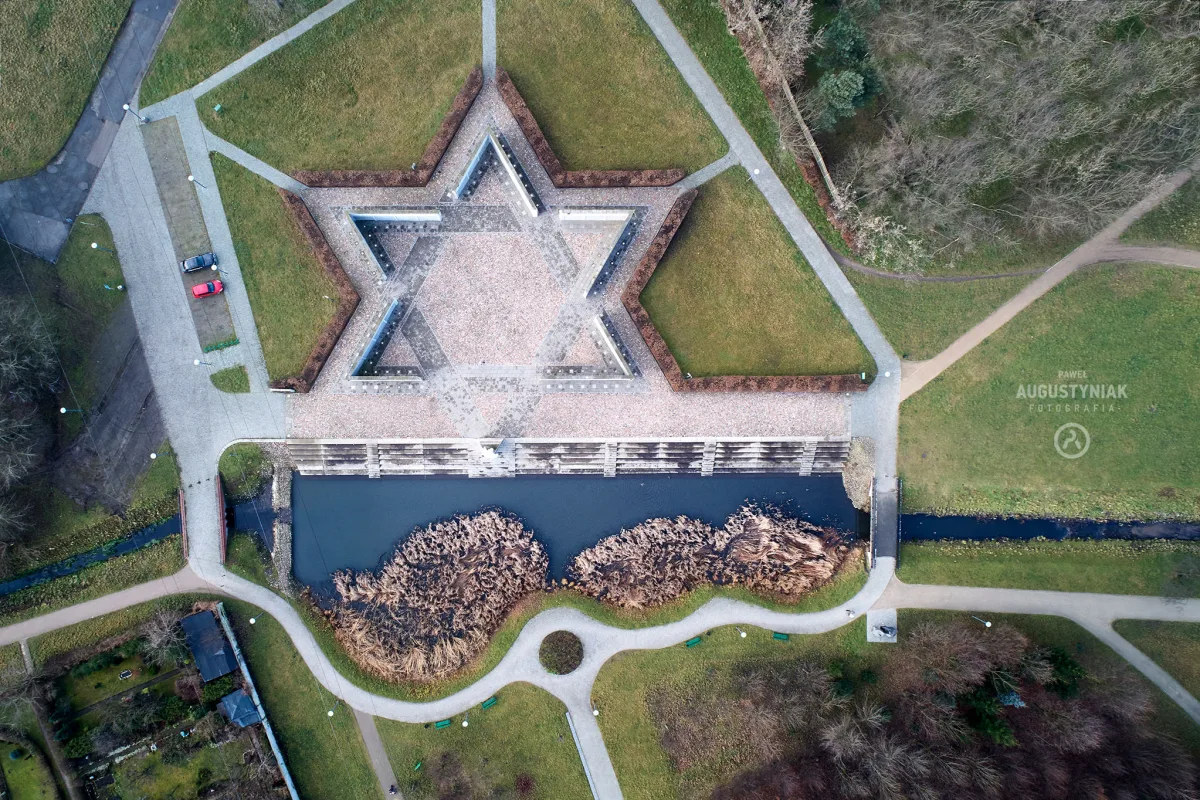
In 2004, on the 60th anniversary of the liquidation of the Łódź ghetto, Park Ocalałych (Survivors' Park) was created in Łódź. Five years later, in 2009, a monument was unveiled there in the shape of the Star of David, formed from plaques bearing the names of about seven thousand Poles honoured with the title Righteous Among the Nations, including residents of Łódź and the region. Above the star stands the White Eagle, together with quotations from the Gospel and the Talmud in three languages, including the sentence "whoever saves one life, saves the entire world".
How to visit the monument
The park lies in the valley of the Łódka river, between ulica Wojska Polskiego and ulica Oblęgorska, where the main entrances and car parks are also located. Visitors can follow a multimedia route through the park, lasting about 55 minutes, which includes the Righteous monument and the Memory Mound with the monument-bench of Jan Karski, the diplomat who tried to inform the world about the Holocaust.
Why this topic matters for a visitor
The story of the Righteous is the other side of occupied Łódź - alongside the Holocaust, the deportations from Stacja Radegast and the everyday life described, for instance, in the history of the Synagoga Reicherów (Reicher Synagogue), there were also specific people who decided to help, risking everything. This is an important addition to the picture of a city that is easy to reduce to tragedy alone.
More places of remembrance connected with the history of Jewish Łódź can be found among the city's parks and museums of Łódź, and the full historical context is gathered in the Poznaj Łódź (Discover Łódź) section.
Be the first! Add a comment.
You need to log in to add a comment.
Log in