
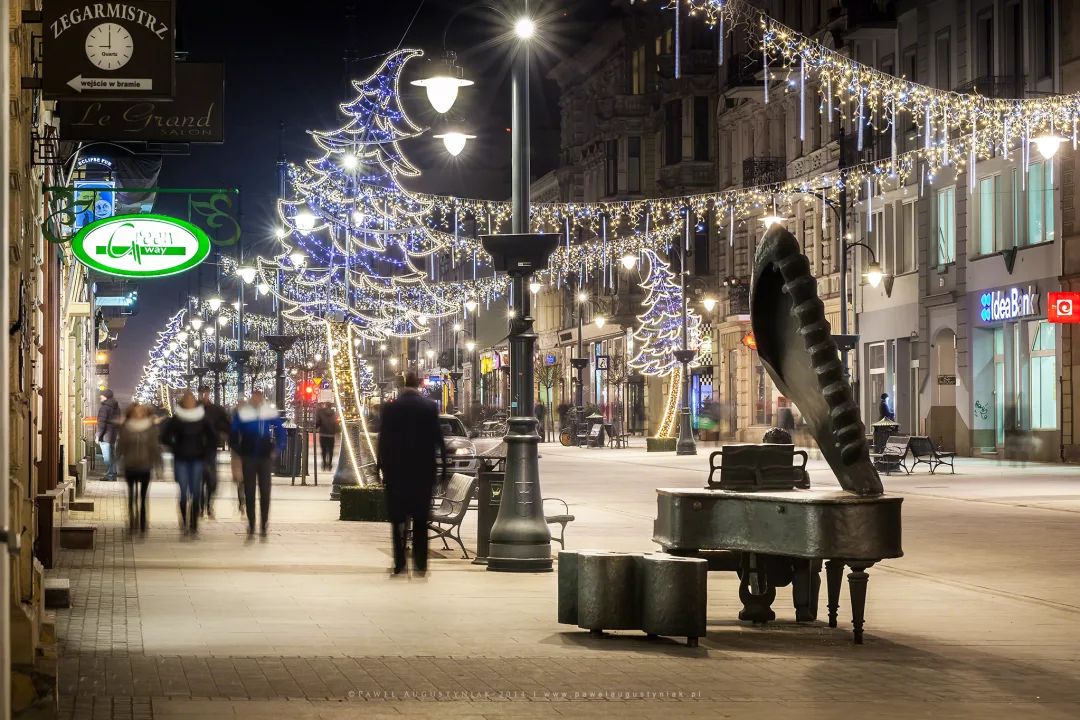
On Piotrkowska Street in Łódź, a few dozen metres from the Julian Tuwim bench, another famous son of the city sits at a bronze piano. This is Artur Rubinstein, one of the greatest pianists of the 20th century, who was born literally a few buildings away. His monument is today one of the favourite photo spots on the city's main street, but few people know that its creation sparked a dispute within the artist's own family.
Who was Artur Rubinstein
Artur Rubinstein was born on 28 January 1887 in Łódź, at Piotrkowska 76, the youngest of seven children in a wealthy Jewish factory-owning family. His musical talent showed itself very early - he gave his first public concert in Łódź at a charity event when he was just seven years old. His further musical education took place outside the city, in Berlin, where his debut on a major stage took place on 1 December 1900.
Rubinstein's career lasted more than 80 years, during which he gave over six thousand concerts around the world. He is regarded as one of the greatest interpreters of Chopin's music in history. In 1932 he married Aniela, daughter of the Polish conductor Emil Młynarski. The couple had four children, including their daughter Eva Rubinstein, born in 1933 in Buenos Aires, who herself became an acclaimed dancer and photographer.
Rubinstein kept in touch with his home city throughout his life, though he lived in Paris and later in the United States. He last visited Łódź in 1975. He died on 20 December 1982 in Geneva, at the age of 95.
A piano on Piotrkowska - how the monument came to be
The monument "Rubinstein's Piano" was unveiled in September 2000, near the house on Piotrkowska where the artist was born. Its author is Marcel Szytenchelm, an actor, director and cultural organiser. The composition shows Rubinstein sitting at a piano whose lid is raised in the shape of a bird's wing, with a treble clef symbol placed beside it, referencing the artist's musical legacy.
Interestingly, in the first years after its unveiling the bronze piano had a built-in music box - after a coin was dropped in, it played fragments of Rubinstein's recordings. This feature stopped working over time, once the label Sony BMG began enforcing copyright over the pianist's recordings.
The dispute over the monument's appearance
Not everyone liked the monument's form, however, and the loudest protest came from Eva Rubinstein, the artist's daughter. The dancer and photographer was reportedly outraged by the sculpture's appearance, which she called ugly, and demanded its removal, sending letters on the matter to Polish authorities. For several years she refused to visit Łódź, and a circle of cultural figures gathered around her in support of building a new monument, one they considered more dignified.
Łódź's authorities decided, however, that the existing sculpture would stay in place, arguing that it is liked by both residents and tourists and has become a recognisable feature of the city's landscape. This dispute shows how differently the commemoration of the same figure can be viewed: the city wanted a lively, interactive symbol, while the family expected a more dignified and traditional form.
Other places in Łódź connected with Rubinstein
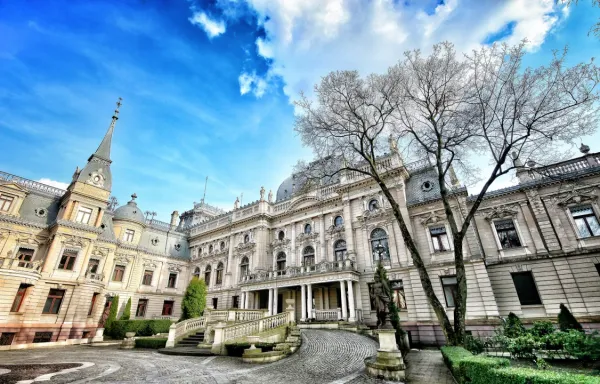
The monument at the piano is not the pianist's only trace in the city. The Łódź Philharmonic, one of the region's most important musical institutions, bears his name, and the Museum of the City of Łódź in the Poznański Palace holds a room with the artist's memorabilia. The city also has a passage named after him and a mural on Sienkiewicza Street referencing the musician. Similar tributes, in the form of stars with handprints, can be found in the nearby Avenue of Stars (Aleja Gwiazd).
In practice: how to see the monument
The sculpture stands outdoors on Piotrkowska, near number 78, and is freely accessible around the clock. It is best combined with a walk along the whole of Łódź's main street - within a few minutes on foot you can reach both the Tuwim bench and the Philharmonic building. More figures connected with the city can be discovered by browsing other articles in the Poznaj Łódź (Discover Łódź) series. Plan a relaxed 15-20 minutes for it if the goal is just a photo by the monument, or half a day if a visit to the Philharmonic or the Museum of the City of Łódź is also on the itinerary.
Be the first! Add a comment.
You need to log in to add a comment.
Log in