
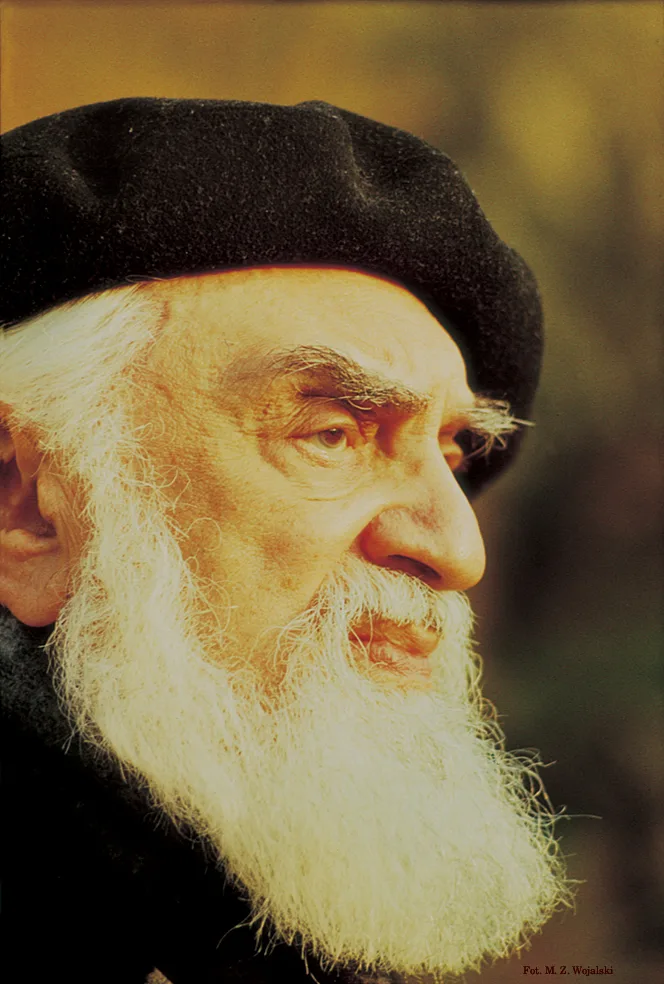
When in 1961 Yuri Gagarin became the first human to fly into space, the theoretical foundations for space flight had already been in place for a long time - largely thanks to the work of a man who spent his childhood and youth in Łódź. Ary Sternfeld, one of the pioneers of astronautics, was calculating the trajectories of artificial celestial bodies when no one yet seriously thought about actual space flight.
From Sieradz to Łódź
Ary Sternfeld was born on 14 May 1905 in Sieradz. He came to Łódź as a ten year old boy, together with his family, and lived in the house of his grandparents at today's Więckowskiego 21 street (then called Nowocegielniana). It was in Łódź that he completed the Boys' Gymnasium of the Society of Jewish Secondary Schools - and already at school he was passionate about astronautics, a subject at the time considered closer to science fiction than serious science.
Studies and first calculations
After graduating from secondary school in 1923, Sternfeld began studying philosophy at the Jagiellonian University, but gave it up after a year and left for France. There he completed engineering studies in Nancy, earning a diploma as a mechanical engineer. Working in Parisian engineering offices, he dealt with calculating the trajectories of artificial celestial bodies - decades before any satellite actually reached orbit.
Return to Łódź and "Introduction to Cosmonautics"
In 1932, Sternfeld returned to Łódź, where he prepared his most important work for publication - "Introduction to Cosmonautics". In Poland the book met with a cool reception, treated as a curiosity with no practical application. It was received quite differently in Paris and Moscow, where he was offered a job at an institute working on jet propulsion.
Career in the Soviet Union
In June 1935, Sternfeld left for Moscow, and a year later took Soviet citizenship. He almost immediately began working at the Reaction Propulsion Research Institute (RNII), though he had to leave it already in 1937 and continued his further work independently. During the Second World War he was evacuated to the Urals, to Syktyvkar, where he taught at a metallurgical technical school. After the war he returned to Moscow and, although formally no longer working at any institution connected with astronautics, continued his own calculations of the orbits of artificial satellites, which later proved to be of real significance for the Soviet space programme.
Sternfeld died on 5 July 1980 in Moscow, while preparing for another visit to Poland.
Memorial plaque in Łódź
On the wall of the building at Więckowskiego 21, a memorial plaque recalling Sternfeld's connection with this place has hung since 1984. In 2014, the plaque was damaged by vandals, which shows how few people today recognise this name - even though Sternfeld himself belongs to the group of people whose theoretical work later made real space flight possible, a subject also referenced by the permanent exhibition in Łódź museums.
Other Łódź scientists and creators of that era
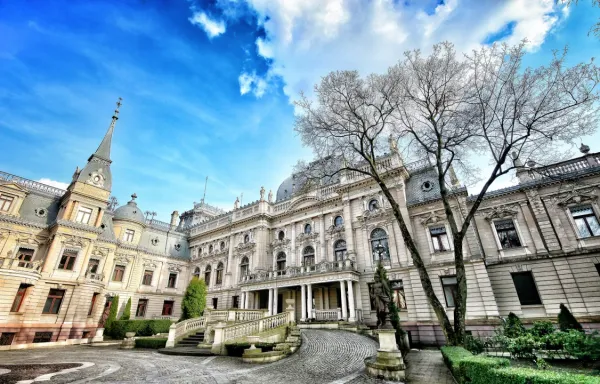
Sternfeld was not the only man from Łódź of that generation who was ahead of his time. A similar path - from his hometown out into the wider world - was followed among others by the composers Artur Rubinstein and Aleksander Tansman, to whom separate articles in this series have been devoted. Memorabilia of Łódź creators of that period can be seen at the Museum of the City of Łódź in the Poznański Palace.
Why he deserves to be remembered
Sternfeld's story is a good example of how many outstanding minds came from pre-war Łódź - a city associated above all with the textile industry, not with exact science - much like the stories of other figures described in the Discover Łódź series. Much like the case of contemporary Łódź scientists who helped discover graphene, Sternfeld's story shows that the city's intellectual heritage extends far beyond its factories and tenement houses - reaching all the way to the theoretical foundations of the conquest of space.
In practice: where to see the plaque
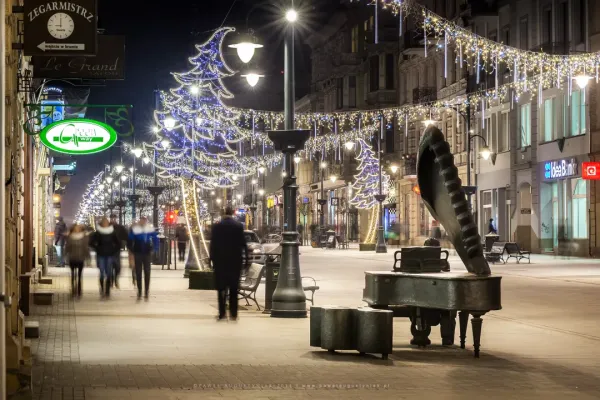
The memorial plaque is located on the facade of the tenement house at Więckowskiego 21 street, in Łódź's city centre, in close proximity to other addresses connected with the city's pre-war, multicultural history. It is a few minutes' walk from Łódź's Piotrkowska street, so it combines well with a wider walk through the city centre following the plaques dedicated to residents of Łódź now largely forgotten, as well as with a visit to the Museum of the City of Łódź, a few minutes' walk away.
Be the first! Add a comment.
You need to log in to add a comment.
Log in