
The oldest mentions of the costume from the Opoczno area date back to 1828, but its true golden age came after the enfranchisement of the peasants, when wealthier farmers began investing in increasingly rich, multicoloured fabrics. It lasted until the First World War, leaving behind a costume still considered one of the most colourful in the country.
Where "all the colours are walking" came from
The saying used to describe residents of the Opoczno region walking in their festive costumes was no exaggeration. Where many other regions favoured one or two dominant background colours, strój opoczyński combined far more at once, hence the impression that it was not a group of people in matching clothes walking by, but a moving palette of colour.
From red and black to cherry and blue
The oldest Opoczno striped fabrics (pasiaki) kept to a starker range: red-and-white, white-black-red, and black-and-white. Orange was added over time, and just before the Second World War cooler colours, blue, green and cherry, entered the patterns. In the youngest, pre-war pasiaki the palette widened the most, and the arrangement of stripes became far more varied than in the 19th-century versions.
A region at the meeting point of two worlds
Strój opoczyński is not exclusively a Łódź-region costume; its range, established during field research carried out between 1949 and 1955 by the ethnographer Janina Krajewska, covers the lands on the left bank of the Pilica river, centred on Rzeczyca and Sierzchowy, that is, the borderland between today's Łódź and Świętokrzyskie voivodeships. This is why the costume is sometimes also called the Rawa-Opoczno costume (strój rawsko-opoczyński), depending on which side of the regional border it is being discussed from.
Embroidery that finishes the colour
Besides the striped fabric of the skirts and trousers, a characteristic element of the costume is rich embroidery, decorating mainly the shirts, their collars and cuffs. Over the last hundred and fifty years it is this embroidery detail that changed just as much as the fabric colours themselves, as new weaving techniques and new threads appeared.
Rawa-Opoczno: the same costume, a different name
Because the costume's range extends beyond Opoczno county itself towards Rawa Mazowiecka, ethnographic literature also uses the name strój rawsko-opoczyński. The differences between the variants from the two parts of the region are minor and concern mainly the proportion of colours in the striped fabric and embroidery details, not the construction of the costume itself. For anyone who is not an ethnographer, both variants can be recognised by the same feature: a density and intensity of colour found in no other folk costume of the Łódź region.
Where to see strój opoczyński today
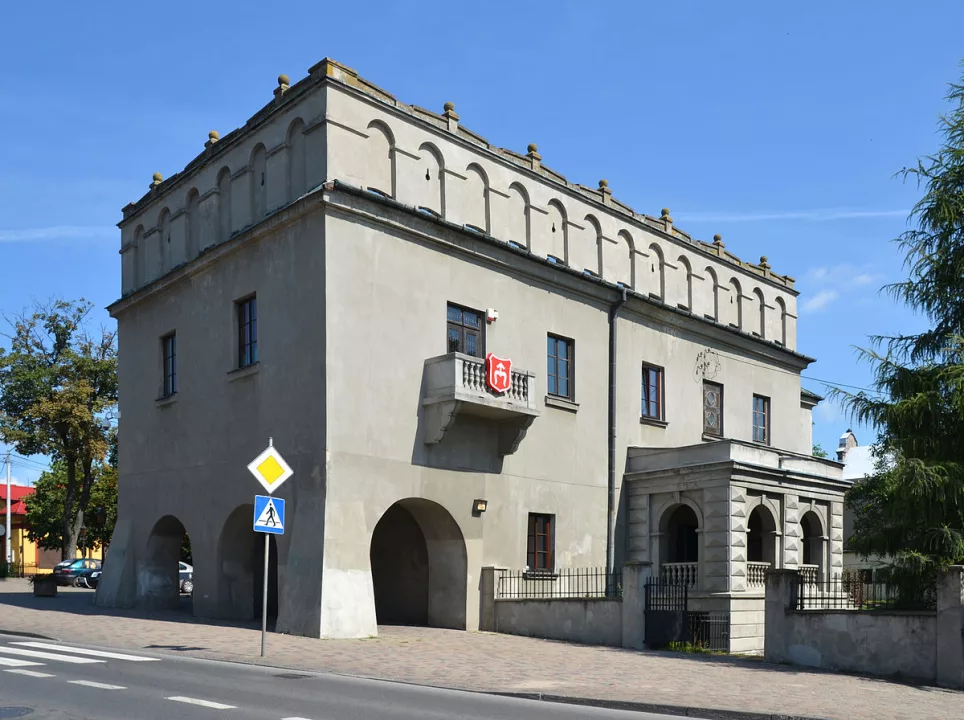
A good starting point for exploring the region is Opoczno itself, and within it the Casimir Castle (Zamek Kazimierzowski), home to the Regional Museum with a collection of costumes and everyday objects of the area's former residents.
It is also worth walking around the Market Square in Opoczno, where residents in festive striped costumes can still be seen during local holidays and fairs.
On the Rawa side, a similar role is played by the Museum of the Rawa Land (Muzeum Ziemi Rawskiej) in Rawa Mazowiecka, where the costume from that part of the region can be compared directly with the Opoczno one.
In practice
Strój opoczyński is easiest to see live during harvest festivals, church holidays and folklore fairs organised in Opoczno and the surrounding municipalities; a calendar of such events can be checked in the Events section. Outside the fair season, the most reliable place remains the museum display at the castle in Opoczno. More about the folk culture of the Łódź region can be found in the Poznaj Łódź (Discover Łódź) section.
Be the first! Add a comment.
You need to log in to add a comment.
Log in