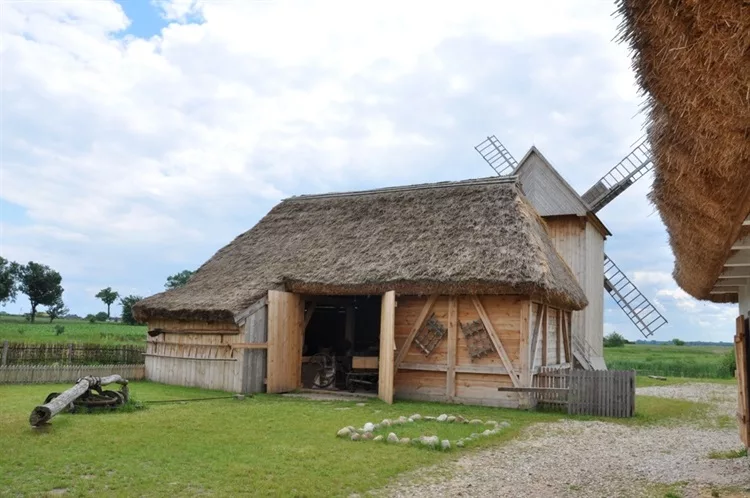
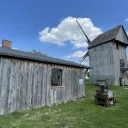
The open-air museum in Kwiatkówek by the Tumski canal, a branch of Łódź's Archaeological and Ethnographic Museum, recreates interwar village life through a cottage, an original 1820 post mill, a forge and an earth cellar.
Łęczycka Zagroda Chłopska Open-Air Museum is an ethnographic museum in the open air, in Kwiatkówek above the Tumski canal, a branch of the Museum of Archaeology and Ethnography in Łódź, which reconstructs rural life in Łęczyca from the interwar period through authentic buildings and everyday objects: a wooden cottage, a windmill, a smithy, a dugout and other buildings of a former farmstead.
The idea for creating the open-air museum was proposed at the end of 2009. After two years of preparation and construction work (2011-2013), the museum opened as a branch of MAIE in 2013. The project arose from the desire to preserve and promote local ethnographic heritage that was at risk of being forgotten. The open-air museum now serves as an important educational venue for schools and tourists interested in the history of village life.
The main building of the museum is a wooden cottage built of clay, surrounded by farm structures: a well, a chapel and beehives. Nearby is also an oil press. Each building contains exhibits related to daily village life, from agricultural tools to farm equipment.
One of only a few structures in the entire museum is not a reconstruction from scratch, but rather an original construction restored to its original location. The goat mill dates from 1820 and originally stood in Kwiatkówek. Around 1900 it was moved to the village of Zawada, where it operated solely by wind power until 1957. After the end of operation, the structure was transported back to Kwiatkówek and reconstructed as part of the developing open-air museum. The name "goat mill" refers to its construction: the entire mill building together with the milling mechanism rotates on a wooden post, known as a goat, positioning the sails to face the wind. Inside the building you can see an exhibition dedicated to traditional windmill milling from the turn of the 19th and 20th centuries.
Next to the mill stands a small dugout from 1848, a cellar dug into the earth. It served as an early, simple form of today's refrigerator: the interior, dug into the ground and lined with wood, maintained a low temperature throughout the year, so the household owners stored food in it, especially vegetables and dairy products, without access to artificial cooling.
The smithy preserves blacksmith's equipment and a hearth, typical of a blacksmith's workshop serving the needs of the surrounding village. The building shows what this type of craft looked like in a peasant farm in the Łęczyca region during the interwar period. The smithy, moved from Porszewice, is visited as part of a tour of the entire farmstead, not separately.
The open-air museum is situated above the Tumski canal, from which there is a view of the medieval collegiate church in Tum. This historical setting makes the place attractive to visitors interested in religious architecture and the history of the town. Grodzisko w Tumie, the remains of a medieval fortress, lies several hundred metres from the open-air museum and forms a natural part of a historical route. The area is also enriched by the Łęczycka Collegiate Church and walking routes along the Tumski canal.
The open-air museum serves as an educational workshop for pupils learning about the history of Polish village life. The display shows what everyday life looked like for peasants: from agriculture and animal husbandry, through crafts, to local customs and traditions. Museum staff lead groups, telling stories about old customs and farming practices. The institution regularly organises practical workshops, where visitors can try their hand at traditional skills.
| Monday | 00:00 – 24:00 |
| Tuesday | 00:00 – 24:00 |
| Wednesday | 00:00 – 24:00 |
| Thursday | 00:00 – 24:00 |
| Friday | 00:00 – 24:00 |
| Saturday | 00:00 – 24:00 |
| Sunday ← today | 00:00 – 24:00 |
Hours per Google Places - may change on public holidays.

Be the first! Add a comment.
You need to log in to add a comment.
Log in