A stronghold on a river island, reconstructed since 2022, that served as a seat of power for the early Piast rulers from the late 8th to the mid-14th century, with a rebuilt gate, well and watchtower.
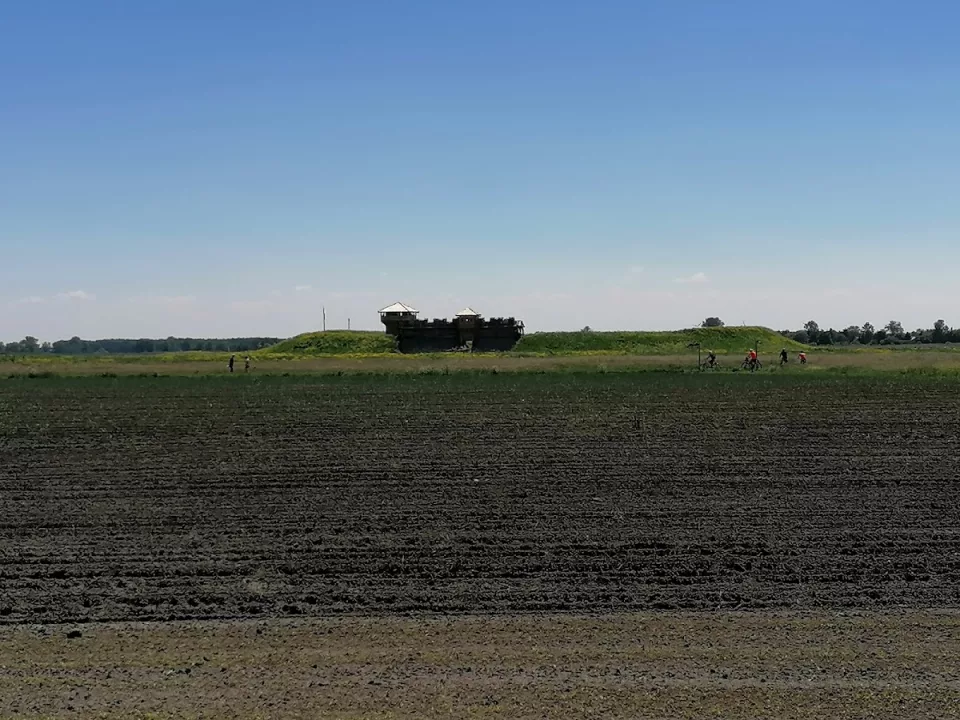
Gród Łęczycki in Tum is a reconstructed medieval stronghold which, for over five hundred years from the end of the eighth century to the middle of the fourteenth century, was one of the most important centres of power in Polish lands. It stands on a river island surrounded by boggy meadows in the Bzura valley, and since May 2022 its reconstructed section has been open to visitors. The site is managed by the Archaeological-Ethnographic Museum in Łódź.
The stronghold originated as a tribal fortress surrounded by bogs, and in the last decade of the tenth century it was occupied by the Piasts who were building the first Polish state. According to the account of chronicler Gall Anonim, the stronghold periodically served as the capital of the state, and for centuries remained the principal administrative and defensive centre of the Łęczycki region.
The fortress was surrounded by two moats, accessed by a long, narrow wooden bridge ending with a gateway. From the middle of the fourteenth century the stronghold declined rapidly, as its functions were taken over by a new castle built by Kazimierz the Great in the second half of that century, which still stands in Łęczyca as the Royal Castle.
During the work, archaeologists reconstructed a well, a gateway, a watchtower and viewpoint tower, and a boardwalk leading into the stronghold. On the site, archaeologists found artefacts from the eleventh to fourteenth centuries, including silver rings, weapons, jewellery and everyday tools, which document the lives of the stronghold's inhabitants over the centuries.
Right next to the stronghold stands the Koźlak windmill, and in a nearby village there operates the Łęczycka Peasant Farm Open-Air Museum, where you can see the old rural buildings of the region.
The stronghold stands in Tum, a few kilometres from present-day Łęczyca centre, because in the Middle Ages this location on a river island surrounded by bogs provided natural defence. When the stronghold's functions were taken over by Kazimierz the Great's castle, the urban centre moved to safer, more easily expandable terrain in present-day Łęczyca, and the old fortress in Tum fell into obscurity for several centuries before undergoing reconstruction.

Be the first! Add a comment.
You need to log in to add a comment.
Log in