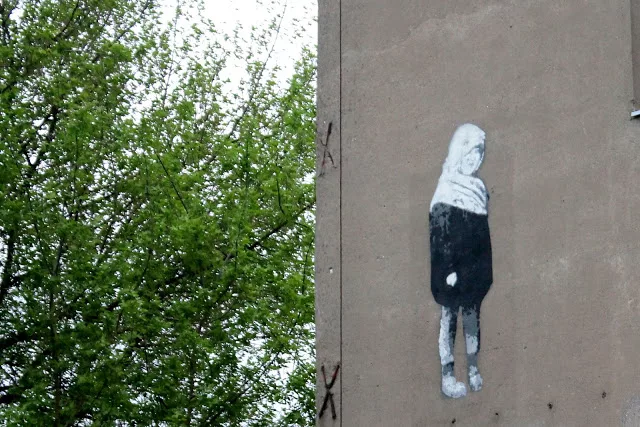
Mural by Piotr Saul and Damian Idzikowski commemorating the history of Łódź ghetto. A work of street art that documents the tragic past of the city and encourages reflection.
On the wall of a former railway signal box on aleja Pamięci Ofiar Litzmannstadt Getto [Avenue of Memory of the Victims of Litzmannstadt Ghetto], several dozen metres from the Radegast Station memorial, the faces of two children - a girl and a boy - look out from the wall. The portraits were painted by Piotr Saul and Damian Idzikowski, and were unveiled on 26 August 2017, on the seventy-fifth anniversary of the Great Sperre. The paintings are part of the Children of Bałuty cycle, murals of remembrance, which since 2012 has marked the former ghetto area with images of its youngest residents.
The children on this wall are anonymous. Their images were reconstructed from archival photographs documenting the Great Sperre, the September 1942 action, but their identities and fates could not be established. The authors noted that the road running past this building, leading to the transshipment station, was the final one for those being transported. The portraits are rendered in black and white tones, deliberately restrained, so as not to impose themselves on the space in which they stand.
The German term Allgemeine Gehsperre meant a total ban on leaving homes. The action lasted from 5 to 12 September 1942 and targeted people considered by the occupier to be unproductive: children under ten years of age, elderly people, the sick and the unemployed. From Litzmannstadt Ghetto, 15,681 people, including 5,862 children, were transported to the death camp in Chełmno nad Nerem. It is precisely this number that stands behind the empty names on the murals of the cycle, which commemorates the victims also in the Park Ocalałych.
The project is run by the association Na co dzień i od święta, and its concept was developed by Katarzyna Tośta. The portraits are painted by Piotr Saul from the Faculty of Painting and Sculpture at the Academy of Fine Arts in Wrocław, and Damian Idzikowski from the Workshop of Basics of Graphic Art at the Łódź Academy of Fine Arts. The first paintings were created in 2012, by 2017 there were around twenty-five, and a year later twenty-eight. Images of Polish, Jewish and Romani children were placed in locations connected to specific biographies, among others at addresses linked to the author of the diary David Sierakowiak and to young poets Abramek Cytryn and Abramek Koplowicz. Part of the works was co-financed by the Museum of the History of Poland in the Tomorrow's Patriotism programme.
Aleja Pamięci Ofiar Litzmannstadt Getto is the former Stalowa Street in Marysin, in the Bałuty district. Radegast station stands there, from which the Germans transported ghetto residents to death camps, and since 2004 a memorial has operated here, a branch of the Museum of Traditions of Independence. The mural on the signal box is usually viewed during a visit to the memorial, as part of the same route of remembrance. The area is open, without fencing and without staff.

Be the first! Add a comment.
You need to log in to add a comment.
Log in