Stary Rynek is the historic heart of Pabianice, where you will find heritage buildings, walks through narrow streets and the atmosphere of a traditional Polish town. It is an ideal place to discover architecture from centuries past and experience the rhythm of local life.
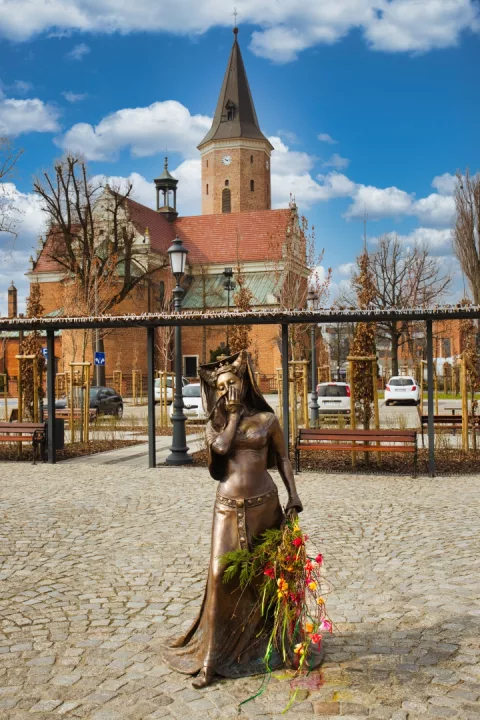
Stary Rynek is the main historic square of Pabianice, established probably in the early 14th century. For centuries it was the centre of the city; today, following thorough revitalisation, it is an open public space with benches, greenery and a sculpture of Pabiana, adjoining the oldest heritage sites of Pabianice.
Stary Rynek was established in the early 14th century, following the typical layout of Polish medieval cities, with approximately seven plots on each side of the square. In the 17th century it was the most densely built part of the city, with wooden houses of townspeople and a town hall serving administrative functions. The square's importance began to decline from the 18th century, when Nowy Rynek [New Market] was developing and the city's buildings were shifting westwards. Over subsequent centuries Stary Rynek remained in the memory of residents as the original, historic heart of Pabianice, even though the centre of city life had moved elsewhere.
The renovation of Stary Rynek involved a complete replacement of the square's surface, lighting and rainwater drainage, as well as installation of new benches, planters and fountains and planting of greenery. As part of the works, a concrete monument from the communist period was demolished, allowing the square to gain the character of a more open, welcoming public space for residents.
The symbol of the renovated square is a sculpture of Princess Pabiana, unveiled on 26 October 2024. The work was created by Ewa Maliszewska. The figure's face is covered with a veil, which references the legendary, historically unconfirmed character of Pabiana, to whom the city owes its name according to local legend.
At Stary Rynek stand two of the city's most important heritage sites. The first is the Church of St. Matthew [kościół św. Mateusza], dating from 1583 to 1588. The second is a former defensive manor of the Kraków chapter [dwór obronny kapituły krakowskiej], also called a castle, erected between 1565 and 1571 and considered the most valuable heritage site in Pabianice. Both buildings together with the square form a historic ensemble at the city's centre.

Be the first! Add a comment.
You need to log in to add a comment.
Log in