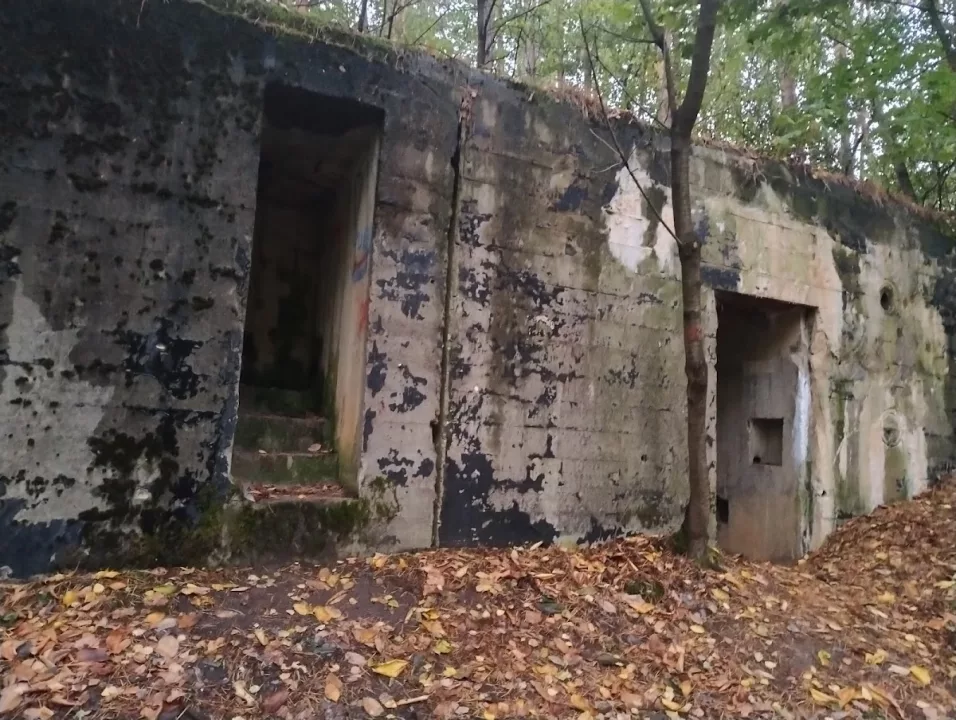
This structure combines a passive bunker for an infantry squad with an attached firing position, visible on the ground as two concrete masses fused together.
In Zakościele, a hamlet in Inowłódz commune, stands a bunker combining two types of German fortification from 1944: the passive Regelbau 668 and the attached Ringstand 58c firing position. The structure belongs to the Pilica defensive line (Piliza-Stellung), built by the Wehrmacht in the final months of the war on the Eastern Front.
The construction merges a passive shelter with an active firing post, visible on the ground as two distinct concrete masses joined together. The Regelbau 668 housed an infantry squad of 6–9 soldiers and was fitted with bunks, a stove, filter ventilators and doors of types 434PO1, 19P7 and 410P9, the last of which closed off the evacuation exit. The Ringstand 58c, colloquially called a Tobruk, was built on to this section: a position without living quarters, designed solely for firing.
The Ringstand 58c allowed the crew to fire in all directions without changing position. An MG34 or MG42 machine gun was mounted on a special metal rail, which in this example survives in good condition. The position has an additional chimney-type emergency exit, separate from the main entrance to the bunker.
In the Zakościele area and the neighbouring church hill in Inowłódz, a total of eleven structures of this line have been documented: six Ringstands 58c, two Regelbau 701s, two Regelbau 668s (including the one described here) and one fire-prevention tank. In Zakościele itself, along a forest road, this bunker is the second of five numbered structures, alongside another Regelbau with Ringstand, a fire-prevention pool and two independent Ringstands. Similar but separate positions stand on the other side of the Pilica, on the hill by St Idzi Church in Inowłódz, where there survive among others Ringstand 58c Bunker and Combat Ringstand 58c Bunker.
The fortifications were constructed from July 1944 to 15 January 1945 on orders from the Wehrmacht and Organisation Todt, with Heinrich Himmler personally overseeing defences on the central sector of the front. The aim was to halt the Soviet Red Army offensive after crossing the Vistula and reaching the San. Local Polish civilians aged 14 to 65 and prisoners of war were forcibly conscripted for construction work, alongside German engineer battalions and Eastern formations. A similar system of field fortifications, including a position for an anti-tank gun, is described in the entry Regelbau 701. Bunker for anti-tank gun.
| Monday | 00:00 – 24:00 |
| Tuesday | 00:00 – 24:00 |
| Wednesday | 00:00 – 24:00 |
| Thursday | 00:00 – 24:00 |
| Friday ← today | 00:00 – 24:00 |
| Saturday | 00:00 – 24:00 |
| Sunday | 00:00 – 24:00 |
Hours per Google Places - may change on public holidays.

Be the first! Add a comment.
You need to log in to add a comment.
Log in