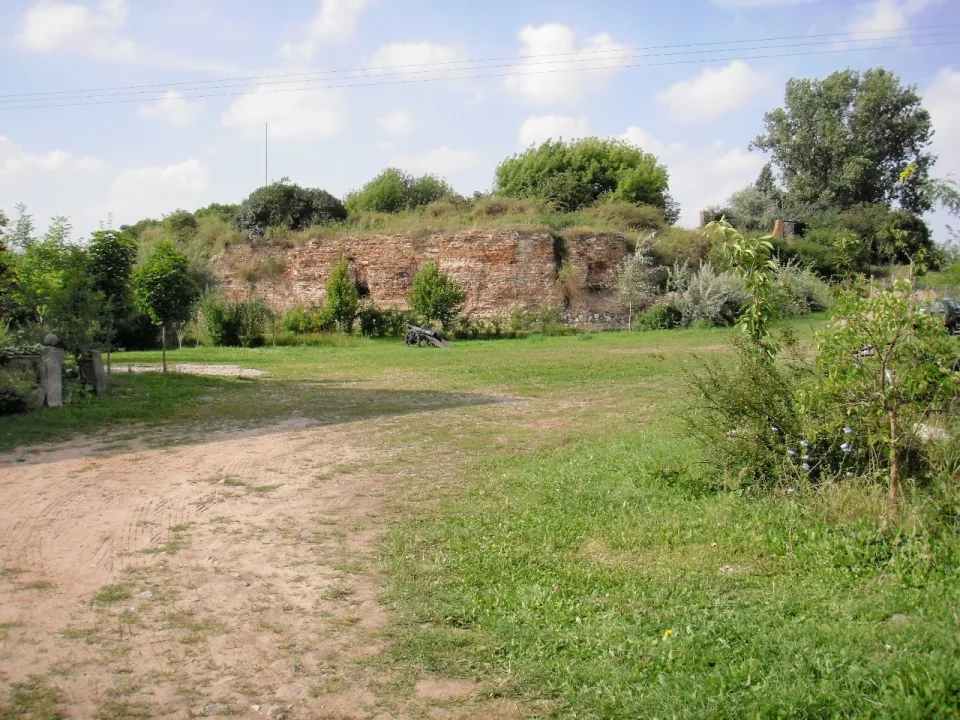
Fragments of walls, a moat and earthen ramparts are all that remain of the Gniezno archbishops' castle, blown up by the Swedes and later dismantled for building material.
The Ruins of Prymasowski Castle are the remains of a medieval fortress belonging to the archbishops of Gniezno, located in the Podgrodzie district in Łowicz. Fragments of walls and earthwork ramparts dating from the 14th–16th centuries constitute an important monument of local history.
The castle was first mentioned in 1359. Its construction was commissioned by Archbishop Jarosław Bogoria Skotnicki, who wished to create fortifications for the Gniezno Church. Originally the fortress had a quadrangular layout with defensive ramparts and a moat, which was typical medieval defensive strategy in Poland. Such an arrangement allowed for effective defence against attacks and served as a symbol of church power.
In the 16th century the castle was rebuilt, acquiring Renaissance features. The palace of the lower castle received a new form with an arcaded façade, which was built between 1573 and 1585. The change in style reflected the architectural fashions of the time and transformed the fortress into a more representational residence.
During the Swedish Deluge, which lasted from 1655 to 1660, the castle suffered serious damage. In June 1657 the Swedes blew up the building, destroying a significant portion of the fortifications. After the war ended, the castle was rebuilt between 1666 and 1670, though its importance diminished. It was ultimately dismantled between 1819 and 1822 for building materials for private houses, a common practice in the 19th century.
The castle remains constitute today a modest but important monument. Fragments of 16th-century walls have been preserved, along with remnants of the moat and natural earthwork ramparts that mark the former strength of the fortress. The ruins are accessible to tourists interested in the history of medieval Poland and defensive structures. The wall fragments allow one to imagine the original grandeur of the fortifications that served the archbishops of Gniezno.
The Ruins of Prymasowski Castle are part of the rich cultural heritage of Łowicz. The city was known for trade and Jewish activity, and the archbishop's castle was an important point on the map of regional seats of church power. Today the ruins attract lovers of medieval history and those wishing to understand the evolution of defensive architecture in Poland. The ramparts and moat remains are clearly visible, making it easier to imagine the fortifications from medieval times.

Be the first! Add a comment.
You need to log in to add a comment.
Log in