A historic park from 1901 in central Pabianice, split by the Dobrzynka river, with old trees and protected specimen trees after a 2015 revitalisation.
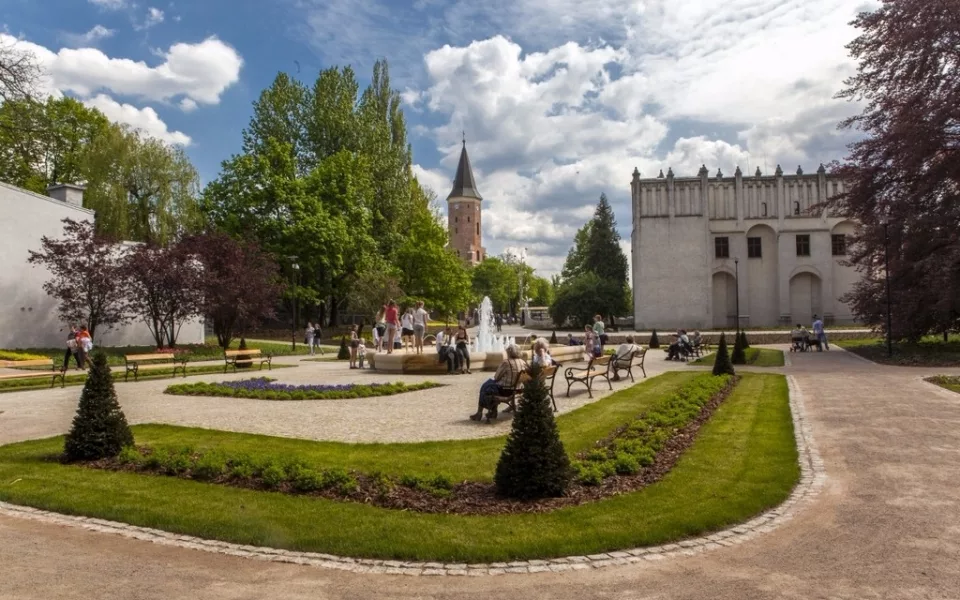
Park Słowackiego is a historic municipal park in the city centre of Pabianice, divided into two parts by the bed of the Dobrzynka river. It lies between Zamkowa, Piłsudskiego and Gdańska streets, in the area of Gdańska 6, not at the Stary Rynek, with which it is sometimes confused. The park covers 3.7 hectares and is entered in the municipal register of monuments.
The land for a public garden was given to the city by the Evangelical-Augsburg parish in 1900, and the park was formally established in 1901. The design, in the style of public gardens from the end of the nineteenth century, was drawn up by Ignacy Wilkowski. On 28 June 1902 the park was handed over to the City Magistrate, at which time it occupied around 3.57 hectares.
From 1919, Zygmunt Rudnicki was the municipal gardener, and he largely gave the park its present form. In the 1930s the park was named after Juliusz Słowacki and expanded to include land on the right bank of the Dobrzynka. A fountain was built at this time, which was not demolished until the 1970s. In May 1931 a new, modernist section of the design was opened.
During the occupation, in the years 1939-1945, the park was accessible only to Germans and was called Pastor Zimmer Park, in honour of pastor Reinhold Wilhelm Zimmer who was associated with Pabianice. After liberation, Zygmunt Rudnicki returned to work in the park. In the 1950s a concert shell with a wooden dome was built, which burned down in the early 1980s. In the early 1970s the gardener's house that stood in the park was also demolished, and in the 1970s the entire area underwent another reconstruction.
On 16 May 2015 the park reopened following revitalisation carried out in 2014-2015. It is home to oak, maple, linden, poplar, willow, spruce and cherry trees, among others, and three trees – an ash, a chestnut and a plane tree – were designated as natural monuments in 1993. The park also contains a memorial stone bearing the date 1902, and the whole is adjacent to a Renaissance defensive manor.
A visit to the park can easily be combined with the Museum of the City of Pabianice, which tells the history of the city from the same period when the park was established.
In the city centre of Pabianice, not far from the park, stands the Pałac Kruschego, the former residence of one of the city's industrialist families.
The Pałac rodziny Enderów has a similar history. Both are reminders that Pabianice owes its present city centre appearance primarily to the nineteenth-century textile industry, much the same as the park itself, which was funded during that period of the city's development.
| Monday | 07:00 – 22:00 |
| Tuesday | 07:00 – 22:00 |
| Wednesday | 07:00 – 22:00 |
| Thursday | 07:00 – 22:00 |
| Friday | 07:00 – 22:00 |
| Saturday ← today | 07:00 – 22:00 |
| Sunday | 07:00 – 22:00 |
Hours per Google Places - may change on public holidays.

Be the first! Add a comment.
You need to log in to add a comment.
Log in